

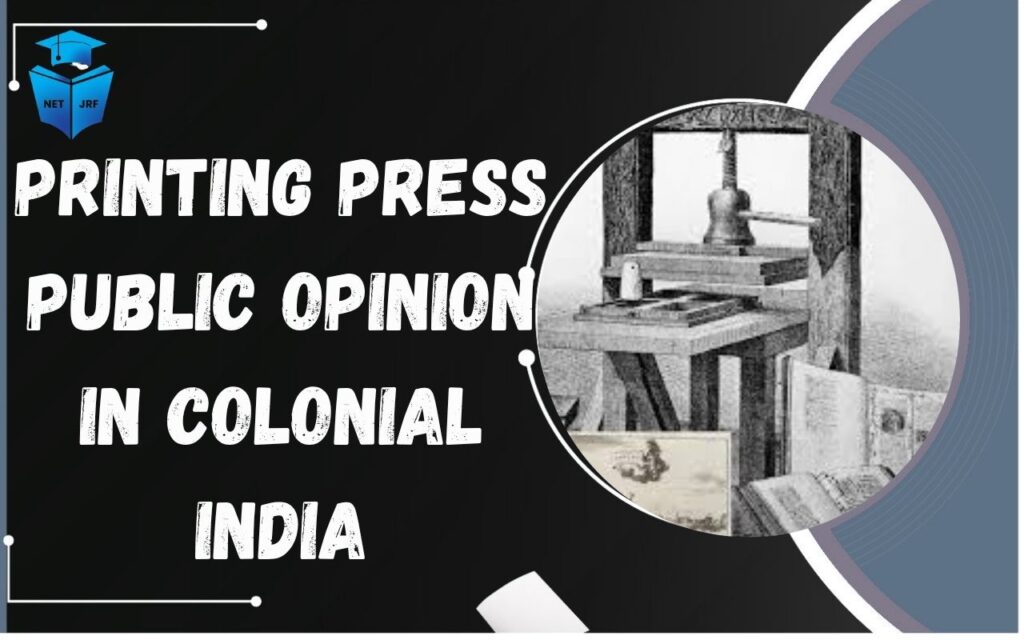
The Printing Press Public Opinion in Colonial India Journalism and Nationalism

The Printing Press Public Opinion in Colonial India In this topic you learn how newspapers journalism vernacular press colonial press laws social reform movements and nationalist ideas shaped public opinion political awareness and modern communication in colonial

vishal

Printing Press Public Opinion in Colonial India

Table of Contents

The Printing Press played a transformative role in shaping public opinion during colonial India. It enabled rapid spread of news, political ideas, social reform debates, nationalist consciousness across different regions of the country.

Study Planner

Before modern journalism emerged, communication moved slowly through letters, royal proclamations, and oral networks. The introduction of The Printing Press created a new public sphere where ideas circulated widely through newspapers, journals, pamphlets, political writings.

Join UGC NET Foundation Batch Online

Historical Background The Printing Press in India

Early forms of communication in India existed long before modern newspapers. Stone inscriptions, royal edicts, handwritten newsletters served as sources of public information.

  • For example, Emperor Ashoka used inscriptions on rocks to communicate moral teachings across his empire. Later, Mughal rulers used handwritten newsletters to inform officials about administrative developments.
  • However, modern journalism began when The Printing Press introduced printed newspapers during colonial rule. The first printed newspaper in India was Bengal Gazette started by James Augustus Hickey in 1780.
  • Printed newspapers gradually replaced manuscript newsletters because they could reach larger audiences quickly. This technological shift allowed ideas, information, and criticism of colonial rule to circulate widely.
  • Thus, The Printing Press marked the beginning of organized public debate in modern Indian society.

The Printing Press Growth of Newspapers

The expansion of newspapers during the nineteenth century played a crucial role in the growth of political consciousness in India. 

  • Nationalist leaders used newspapers to criticize colonial policies, mobilize public opinion, and spread reform ideas.
  • Large numbers of newspapers appeared across India during this period. They published articles discussing economic exploitation, political rights, and social reform movements.

Major Newspapers Developed Through The Printing Press

These newspapers show how The Printing Press expanded public communication across colonial India.

Newspaper Year Founder Significance
Bengal Gazette 1780 James Augustus Hickey First newspaper in India
Bombay Samachar 1822 Fardoonji Murazban Oldest running vernacular newspaper
Amrit Bazaar Patrika 1868 Sisir Kumar Ghosh Important nationalist newspaper
The Hindu 1878 G. Subramania Iyer Criticized British policies
Kesari 1881 Bal Gangadhar Tilak Spread nationalist ideas

The Printing Press and Public Opinion

The development of newspapers transformed the way society formed political opinions.

  • Through editorials, pamphlets, articles, newspapers created informed debates among educated Indians. Nationalist leaders used journalism to expose colonial economic exploitation.
  • Several newspapers also encouraged discussions about self-government, democracy, industrial development, and political rights.
  • Because of these developments, historians often describe The Printing Press as one of the most powerful tools in shaping Indian nationalism.

Ways Public Opinion Developed

  1. Spread of nationalist political ideas
  2. Criticism of colonial economic policies
  3. Awareness about global political events
  4. Promotion of social reform movements
  5. Growth of regional language literature

Thus The Printing Press helped connect educated Indians across different provinces.

App JRF Adda

The Printing Press Important Newspapers

Several newspapers played influential roles in spreading political ideas across India.

Newspaper Founder Political Role
Bande Mataram Bipin Chandra Pal Spread revolutionary nationalism
Yugantar Barindra Ghosh Promoted militant nationalism
Al-Hilal Maulana Abul Kalam Azad Encouraged Muslim participation in nationalism
Harijan Mahatma Gandhi Promoted campaign against untouchability
The Indian Sociologist Shyamji Krishna Varma Spread nationalist ideas internationally

These publications demonstrate how The Printing Press helped nationalist leaders communicate with the masses.

Top UGC NET Online Coaching

Colonial Laws Controlling The Printing Press

British authorities recognized the political power of newspapers. Therefore they introduced several restrictive laws to control criticism of colonial rule.

Important Press Laws

Law Year Purpose
Metcalfe Act 1835 Reduced restrictions on press
Vernacular Press Act 1878 Controlled Indian language newspapers
Indian Press Act 1910 Imposed censorship on nationalist press
  • The Vernacular Press Act of 1878 specifically targeted newspapers written in Indian languages to suppress criticism against British policies.
  • Later the Indian Press Act of 1910 further restricted publications believed to encourage revolutionary activities.
  • Despite these restrictions, journalists continued using The Printing Press to spread nationalist ideas.

Communication Before and After The Printing Press

This transformation shows how The Printing Press revolutionized information exchange in colonial India.

Communication Transformation 

Feature Before Printing Technology After Printing Technology
Information flow Slow Rapid
Medium Handwritten newsletters Printed newspapers
Audience Limited elites Wider reading public
Political awareness Low Expanding public debate
Literacy influence Minimal Encouraged literacy growth

The Printing Press in Social Reform Role 

Apart from political activism, newspapers played an important role in social reform movements.

Many reformers used newspapers to criticize social evils such as:

  • Sati
  • Child marriage
  • Untouchability
  • Caste discrimination
  • Articles published through The Printing Press helped spread progressive ideas about education, women’s rights, equality.
  • Reformers like Raja Ram Mohan Roy used newspapers to promote religious reform and rational thinking.
  • Because of such debates, newspapers became platforms for intellectual discussion across society.

The Printing Press and Growth of Nationalism

The growth of Indian nationalism during the late nineteenth century strongly depended on newspapers.

  • Newspapers connected political leaders from different provinces. They exchanged ideas about economic exploitation, political rights, and constitutional reforms.
  • Through newspapers people learned about global political events. For example, Japan’s victory over Russia in 1905 inspired many Indians to believe colonial powers could be defeated.
  • Nationalist leaders such as Bal Gangadhar Tilak used The Printing Press to mobilize political support.

His newspaper Kesari promoted ideas like:

  • Swaraj (self rule)
  • Swadeshi movement
  • Boycott of foreign goods
  • National education

These ideas later became central to the Indian freedom struggle.

Join UGC NET Coaching in Jaipur

Influence The Printing Press on Education and Literacy

Because of these factors, The Printing Press contributed to the emergence of an educated middle class. The spread of newspapers encouraged literacy across urban centers.

  • Educated middle classes began reading newspapers regularly to stay informed about political developments.
  • Educational institutions also used newspapers as sources of information for students.

Key educational effects included:

  • Development of reading culture
  • Spread of political knowledge
  • Growth of intellectual debates
  • Expansion of public education

Challenges Faced The Printing Press

Despite its importance, newspapers faced several difficulties during colonial rule.

Major challenges included:

  • Strict colonial censorship
  • Financial difficulties
  • Limited literacy among rural populations
  • Government surveillance
  • Confiscation of printing equipment

Journalists often risked imprisonment for criticizing British authorities. Yet these obstacles did not stop the expansion of The Printing Press across India.

Long-Term Legacy The Printing Press

The legacy of newspapers continued after independence.

  • Modern Indian democracy still depends heavily on journalism to promote public debate, accountability, and transparency.
  • A free press today acts as a watchdog against corruption, abuse of power, political misuse of authority.
  • Thus the historical role of The Printing Press continues to influence modern democratic institutions.

Best UGC NET Offline Coaching in Jaipur

Importance for UGC NET Modern Indian History

For UGC NET history preparation, the topic of press development remains extremely important.

Important exam themes include:

  1. Growth of nationalist newspapers
  2. Colonial censorship laws
  3. Role of press in political mobilization
  4. Social reform through journalism
  5. Spread of nationalist consciousness

Students should understand how The Printing Press shaped intellectual debates in colonial India.

JRF Adda Book

Conclusion

The development of journalism during colonial India created a powerful platform for intellectual debate, social reform, nationalist mobilization. Newspapers connected people across regions, encouraged political awareness, and challenged colonial policies. In modern history studies, The Printing Press remains a key factor in shaping public opinion during the freedom movement.

Read UGC NET Notes
1 Archaeological Sources for UGC NET Epigraphy – Study of Inscriptions Meaning of Historical Sources Archaeological
2 Meaning of Historical Sources Archaeological Sources for UGC NET Literary Sources in History Archaeological
3 Exploration in Archaeology Excavation Techniques in Archaeology Dating of Archaeological Sites Archaeological
4 Excavation Techniques in Archaeology Exploration in Archaeology Dating of Archaeological Sites Archaeological
5 Epigraphy – Study of Inscriptions Inscriptions in Reconstructing History Numismatics in History Archaeological
6 Inscriptions in Reconstructing History Epigraphy – Study of Inscriptions Archaeological Sources for UGC NET Archaeological
7 Numismatics in History Importance of Coins in History Epigraphy – Study of Inscriptions Archaeological
8 Importance of Coins in History Numismatics in History Archaeological Sources for UGC NET Archaeological
9 Dating of Archaeological Sites Excavation Techniques in Archaeology Dating Ancient Literary Sources Archaeological
10 Indigenous Literature Literary Sources in History Secular Literature as Historical Source Literary
11 Dating Ancient Literary Sources Literary Sources in History Dating of Archaeological Sites Literary
12 Literary Sources in History Indigenous Literature Foreign Accounts of India Literary
13 Foreign Accounts of India Greek Accounts on Ancient India Chinese Accounts on India Literary
14 Greek Accounts on Ancient India Foreign Accounts of India Chinese Accounts on India Literary
15 Secular Literature as Historical Source Literary Sources in History Indigenous Literature Literary
16 Role of Myths and Legends in Historical Reconstruction Literary Sources in History Secular Literature as Historical Source Literary
17 Chinese Accounts on India Foreign Accounts of India Greek Accounts on Ancient India Literary
18 Arabic Accounts on India Foreign Accounts of India Chinese Accounts on India Literary
19 Neolithic and Chalcolithic Phases Neolithic Revolution in India Chalcolithic Culture in India Neolithic
20 Hunting, Gathering & Food Production Neolithic Revolution in India Neolithic Settlements in India Neolithic
21 Neolithic Revolution in India Neolithic Settlements in India Tools and Technology in Neolithic Period Neolithic
22 Neolithic Settlements in India Distribution of Neolithic Cultures in India Neolithic Revolution in India Neolithic
23 Distribution of Neolithic Cultures in India Neolithic Settlements in India Tools and Technology in Neolithic Period Neolithic
24 Tools and Technology in Neolithic Period Neolithic Revolution in India Chalcolithic Culture in India Neolithic
25 Chalcolithic Culture in India Settlement Pattern & Economy in Chalcolithic Phase Trade & Exchange Networks in Chalcolithic Societies Neolithic
26 Settlement Pattern & Economy – Chalcolithic Phase Chalcolithic Culture in India Trade & Exchange Networks in Chalcolithic Societies Neolithic
27 Trade & Exchange Networks – Chalcolithic Societies Chalcolithic Culture in India IVC Internal & External Trade Neolithic
28 Indus Valley Civilization – UGC NET Major Sites of Indus Civilization Urban Planning in Harappan Civilization IVC
29 IVC Internal & External Trade Internal Trade – Harappan Civilization Craft Specialization in Harappan Civilization IVC
30 Political Organization – Harappan Civilization Social Structure – Indus Civilization Urban Planning in Harappan Civilization IVC
31 Major Sites of Indus Civilization Indus Valley Civilization – UGC NET Urban Planning in Harappan Civilization IVC
32 Urban Planning & Settlement – Harappan Civilization Architecture & Town Planning – Harappan Cities IVC as First Urbanization in India IVC
33 Architecture & Town Planning – Harappan Cities Urban Planning in Harappan Civilization Major Sites of Indus Civilization IVC
34 Craft Specialization & Industrial Activities – Harappan Agriculture & Food Economy – Harappans IVC Internal & External Trade IVC
35 Agriculture & Food Economy – Harappans Craft Specialization in Harappan Civilization Internal Trade – Harappan Civilization IVC
36 Internal Trade – Harappan Civilization IVC Internal & External Trade Craft Specialization in Harappan Civilization IVC
37 Religion & Beliefs – Indus Civilization Social Structure – Indus Civilization Indus Valley Civilization – UGC NET IVC
38 Social Structure – Indus Civilization Political Organization – Harappan Civilization Religion & Beliefs – Indus Civilization IVC
39 Decline of Indus Civilization Indus Valley Civilization – UGC NET IVC as First Urbanization in India IVC
40 IVC as First Urbanization in India Urban Planning in Harappan Civilization Second Urbanization in India IVC
41 Vedic & Later Vedic Periods – Aryan Varna System Early Vedic Society and Economy Later Vedic Society and Economy Vedic
42 Origin of Vedic Civilization Aryan Debate – Migration, Invasion & Indigenous Theories Early Vedic Society and Economy Vedic
43 Aryan Debate – Migration, Invasion & Indigenous Theories Origin of Vedic Civilization Early Vedic Society and Economy Vedic
44 Early Vedic Society and Economy Political Institutions – Early Vedic Period Social Structure – Early Vedic Period Vedic
45 Political Institutions – Early Vedic Period Early Vedic Society and Economy Monarchical States in Ancient India Vedic
46 Social Structure – Early Vedic Period Emergence of Varnas & Social Stratification Early Vedic Society and Economy Vedic
47 Later Vedic Society and Economy Emergence of Varnas & Social Stratification Impact of Iron Technology in India Vedic
48 Emergence of Varnas & Social Stratification Social Structure – Early Vedic Period Later Vedic Society and Economy Vedic
49 Emergence of Heterodox Sects in India Jainism, Buddhism & Ajivikas – Origins & Teachings Later Vedic Society and Economy Vedic
50 Impact of Iron Technology in India Later Vedic Society and Economy Agricultural Expansion & Economic Changes – Ancient India Vedic
51 Religious & Philosophical Vedic Ideas Emergence of Varnas & Social Stratification Emergence of Heterodox Sects in India Vedic
52 Megalithic Culture of South India Neolithic and Chalcolithic Phases Agricultural Expansion & Economic Changes General
53 State System in Ancient India Rise of Mahajanapadas Transition: Tribal Polities to Territorial States General
54 Transition: Tribal Polities to Territorial States Rise of Mahajanapadas Later Vedic Society and Economy General
55 Rise of Mahajanapadas Monarchical States in Ancient India Republican States (Gana-Sanghas) – Ancient India Magadha
56 Monarchical States in Ancient India Rise of Mahajanapadas Emergence of Magadha Magadha
57 Republican States (Gana-Sanghas) – Ancient India Rise of Mahajanapadas Monarchical States in Ancient India Magadha
58 Agricultural Expansion & Economic Changes – Ancient India Second Urbanization in India Impact of Iron Technology in India General
59 Second Urbanization in India IVC as First Urbanization in India Rise of Mahajanapadas General
60 Jainism, Buddhism & Ajivikas – Origins & Teachings Emergence of Heterodox Sects in India Ashoka’s Policy of Dhamma General
61 Emergence of Magadha Geographical Advantages of Magadha Early Rulers of Magadha Magadha
62 Geographical Advantages of Magadha Natural Resources & Economic Strength of Magadha Reasons for Success of Magadha Magadha
63 Natural Resources & Economic Strength of Magadha Geographical Advantages of Magadha Economic Policies of the Nandas Magadha
64 Early Rulers of Magadha Haryanka Dynasty – Rise of Magadha Emergence of Magadha Magadha
65 Haryanka Dynasty – Rise of Magadha Expansion Policy of Bimbisara Early Rulers of Magadha Magadha
66 Expansion Policy of Bimbisara Ajatashatru – Military Reforms Haryanka Dynasty – Rise of Magadha Magadha
67 Ajatashatru – Military Reforms Wars of Ajatashatru Expansion Policy of Bimbisara Magadha
68 Wars of Ajatashatru Ajatashatru – Military Reforms Udayin & Establishment of Pataliputra Magadha
69 Udayin & Establishment of Pataliputra Wars of Ajatashatru Shishunaga Dynasty Magadha
70 Shishunaga Dynasty Administrative Structure of the Shishunagas Nanda Dynasty Magadha
71 Administrative Structure of the Shishunagas Shishunaga Dynasty Central Administration Under Mauryas Magadha
72 Nanda Dynasty Mahapadma Nanda – Imperial Expansion Shishunaga Dynasty Magadha
73 Mahapadma Nanda – Imperial Expansion Military Strength of the Nandas Nanda Dynasty Magadha
74 Economic Policies of the Nandas Nanda Dynasty Taxation System – Mauryan State Magadha
75 Military Strength of the Nandas Mahapadma Nanda – Imperial Expansion Defeat of Nandas & Rise of Mauryan Empire Magadha
76 Reasons for Success of Magadha Geographical Advantages of Magadha Natural Resources & Economic Strength of Magadha Magadha
77 Mahajanapadas to Empire – Evolution & Rise of Magadha Rise of Mahajanapadas Emergence of Magadha Magadha
78 Mauryan Empire – Expansion Rise of Chandragupta Maurya Expansion of Mauryan Empire Maurya
79 Rise of Chandragupta Maurya Role of Chanakya in Rise of Mauryan Empire Defeat of Nandas & Rise of Mauryan Empire Maurya
80 Role of Chanakya in Rise of Mauryan Empire Rise of Chandragupta Maurya Defeat of Nandas & Rise of Mauryan Empire Maurya
81 Defeat of Nandas & Rise of Mauryan Empire Military Strength of the Nandas Rise of Chandragupta Maurya Maurya
82 Chandragupta Maurya – Seleucus Treaty & Diplomacy Expansion of Mauryan Empire Greek Accounts on Ancient India Maurya
83 Expansion of Mauryan Empire Chandragupta Maurya – Seleucus Treaty & Diplomacy Kalinga War Maurya
84 Administration of Chandragupta Maurya Central Administration Under Mauryas Mauryan Bureaucracy Maurya
85 Sources for Mauryan History Archaeological Sources for UGC NET Greek Accounts on Ancient India Maurya
86 Central Administration Under Mauryas Provincial Administration – Mauryan Empire Mauryan Bureaucracy Maurya
87 Provincial Administration – Mauryan Empire Local Administration – Mauryan Empire Central Administration Under Mauryas Maurya
88 Local Administration – Mauryan Empire Provincial Administration – Mauryan Empire Mauryan Bureaucracy Maurya
89 Mauryan Bureaucracy Central Administration Under Mauryas Espionage System – Mauryan Empire Maurya
90 Espionage System – Mauryan Empire Mauryan Bureaucracy Central Administration Under Mauryas Maurya
91 Ancient India – Trade and Commerce Trade and Commerce Under Mauryas Agrarian Economy – Mauryan Period Maurya
92 Agrarian Economy – Mauryan Period Taxation System – Mauryan State Trade and Commerce Under Mauryas Maurya
93 Trade and Commerce Under Mauryas Ancient India – Trade and Commerce Agrarian Economy – Mauryan Period Maurya
94 Taxation System – Mauryan State Agrarian Economy – Mauryan Period Economic Policies of the Nandas Maurya
95 Kalinga War Ashoka’s Policy of Dhamma Expansion of Mauryan Empire Maurya
96 Ashoka’s Policy of Dhamma Nature & Philosophy of Dhamma Kalinga War Maurya
97 Nature & Philosophy of Dhamma Ashoka’s Policy of Dhamma Jainism, Buddhism & Ajivikas Maurya

FAQs

Loader image

Colonial authorities feared newspapers would encourage nationalist resistance. Therefore censorship laws restricted publications critical of colonial rule.

Journalists exposed colonial economic exploitation, promoted political rights, encouraged unity among Indians. These discussions strengthened nationalist movements.

Bengal Gazette started in 1780 by James Augustus Hickey is considered the first newspaper printed in India.

The Printing Press expanded communication, encouraged literacy, spread reform ideas, created political awareness among educated classes.

The Vernacular Press Act of 1878 restricted Indian language newspapers that criticized British rule.

Bal Gangadhar Tilak, Mahatma Gandhi, Bipin Chandra Pal, Aurobindo Ghosh used journalism to mobilize nationalist movements.


Leave a Reply

Recent Posts
Aditi

Aditi Sharma, founder of JRFAdda, is a Computer Science educator with an MCA degree and JRF qualification (99.91 percentile, Dec 2019). Her experience includes roles as an SBI SO (DBA), work at Cognizant, and over 5 years of teaching online and offline. She has also served as a Government Computer Teacher in Rajasthan.

Check Our Recommended Course