
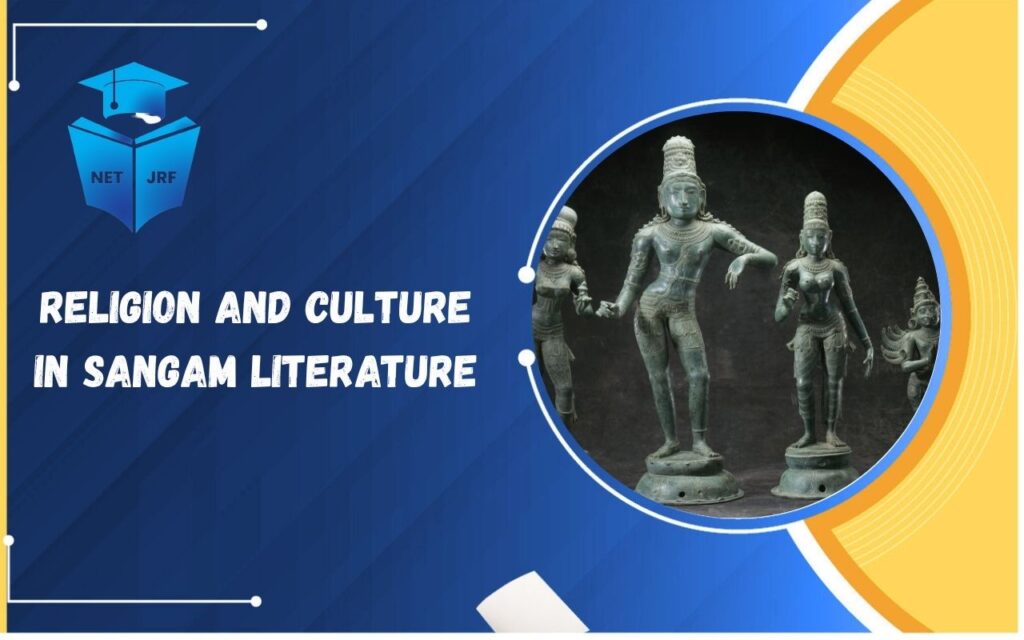

Religion and culture in Sangam literature give us a deep insight into the spiritual beliefs, traditions, and daily life of people in ancient Tamil society. This literature, written between 300 BCE and 300 CE, reflects a society that was closely connected with nature, emotions, and human values.

Religion and culture in Sangam literature Introduction
The Religion and culture in Sangam literature are not rigid or heavily ritualistic. Instead, they are simple, practical, and closely linked with everyday life.
- People worshipped nature, local gods, and heroes.
- Their beliefs were based on emotions, experiences, and surroundings.
- Sangam texts such as Tolkappiyam and Ettuthogai provide valuable details about rituals, festivals, and moral values.
Enroll UGC NET Online Coaching
Religious Beliefs and Practices
One of the most important features of Religion and culture in Sangam literature was nature worship.
- People worshipped mountains, rivers, trees, and forests
- Each region had its own deity connected with nature
- Nature was seen as a living force
For example, Murugan was associated with hills, and Varuna with the sea. This shows how Religion and culture in Sangam literature were deeply rooted in the environment.
Worship of Deities
The Religion and culture in Sangam literature included worship of several gods.
- Murugan – God of war and youth
- Shiva – Supreme god in some regions
- Indra – Associated with rain and fertility
- Korravai – Goddess of victory
These gods were worshipped through simple rituals, which reflects the simplicity of Religion and culture in Sangam literature.
Hero Worship
Hero worship was a unique feature.
- Warriors who died in battle were honored
- Hero stones called Nadukal were erected
- People worshipped these heroes
This tradition shows the importance of bravery in Religion and culture in Sangam literature.
Cultural Life in Sangam Age
The Religion and culture in Sangam literature also highlight rich cultural practices.
Music and Dance
- Music played a major role in daily life
- Instruments like drums and flutes were used
- Dance performances were common
These art forms reflect emotional expression in Religion and culture in Sangam literature.
Enroll UGC NET Offline Coaching in Jaipur
Festivals and Celebrations
Festivals were simple yet meaningful.
- Celebrations related to harvest
- Worship ceremonies for gods
- Community gatherings
Festivals brought people together and strengthened Religion and culture in Sangam literature.
Literature and Poetry
Sangam literature itself is a cultural treasure.
- Poems describe love, war, and daily life
- Writers expressed emotions in a realistic way
- Literature preserved traditions
Thus, Religion and culture in Sangam literature are best understood through poetry.
Moral Values and Ethics
The Religion and culture in Sangam literature emphasized strong moral values.
Key Values
- Honor and bravery
- Loyalty to family and king
- Truthfulness and generosity
People followed these values in everyday life. This made Religion and culture in Sangam literature morally strong.
Social Customs and Traditions
Social customs were an important part of Religion and culture in Sangam literature.
Marriage Customs
- Love marriages were common
- Families accepted relationships
- Emotional bonding was important
Death Rituals
- Burial and cremation practices existed
- Hero stones were erected for warriors
These customs show the human side of Religion and culture in Sangam literature.

Role of Women in Culture
Women played an active role.
Contributions
- Participation in festivals
- Involvement in arts and poetry
- Strong presence in family life
Women poets like Avvaiyar prove that Religion and culture in Sangam literature supported intellectual freedom.
Enroll UGC NET Coaching in Jaipur
Religion and culture in Sangam literature Overview
Sangam literature, composed between roughly the 3rd century BCE and 3rd century CE, provides a vivid picture of the religious beliefs, cultural practices, and everyday life of ancient Tamil society. These texts are a rich source for understanding how people lived, worshipped, and expressed themselves artistically.
| Aspect | Description |
| Religion and culture in Sangam literature | Based on nature worship and simple beliefs |
| Deities | Murugan, Shiva, Indra, Korravai |
| Practices | Hero worship, rituals, festivals |
| Culture | Music, dance, poetry |
| Values | Honor, loyalty, truth |
| Customs | Marriage, death rituals |
Interaction with Other Religions
The Religion and culture in Sangam literature also show early interaction with other belief systems.
- Influence of Jainism and Buddhism
- Presence of ascetics and monks
- Spread of ethical teachings
This interaction made Religion and culture in Sangam literature more diverse.
Daily Life and Cultural Expression
Daily life was full of cultural meaning.
Everyday Practices
- Worship at home and community level
- Participation in songs and storytelling
- Respect for elders and traditions
These practices made Religion and culture in Sangam literature lively and meaningful.

Conclusion
The Religion and culture in Sangam literature reflect a society that valued simplicity, nature, and human emotions. People lived in harmony with their surroundings and followed beliefs that were practical and meaningful.