

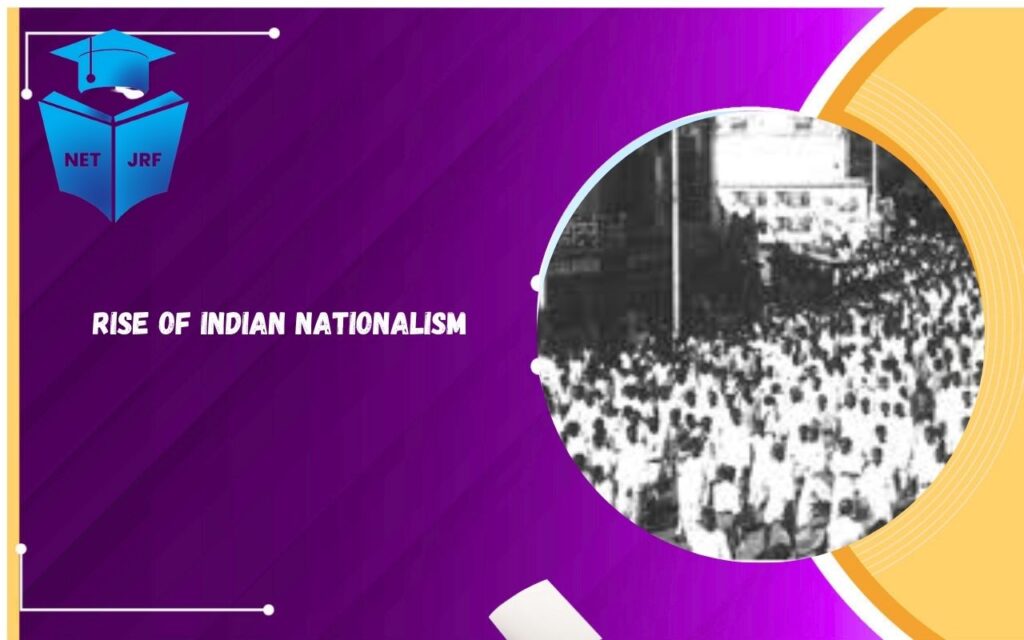
Rise of Indian Nationalism represents a major transformation in modern Indian history. It refers to the growth of political consciousness, collective identity, and anti-colonial sentiment among Indians during British rule. This process gradually united diverse groups of society in a common struggle for self-rule.

During the nineteenth century, several social, economic, political changes encouraged people to think beyond regional identities. Educated Indians started questioning colonial domination. These developments eventually produced the Rise of Indian Nationalism, which became the ideological foundation of the Indian freedom movement.
Enroll UGC NET Offline Classes in Jaipur
Meaning Nationalism in Indian Context
Nationalism refers to a feeling of loyalty, unity, and identity among people belonging to a nation. It creates a sense of shared destiny based on common history, culture, language, experiences.
- In India, nationalism developed mainly as a reaction against colonial rule. British policies created economic hardship, racial discrimination, and political exclusion. These conditions encouraged Indians to recognize their shared problems. Over time, this awareness produced the Rise of Indian Nationalism which mobilized people across regions, religions, social classes.
- The Rise of Indian Nationalism therefore emerged not suddenly but through gradual social awakening.
Rise of Indian Nationalism Social Economic Basis
The Rise of Indian Nationalism developed because of several interconnected factors. Social reform movements, economic exploitation, Western education, political organizations, modern communication systems all contributed to nationalist consciousness.
Social Transformation in Indian Society
Social changes during the nineteenth century played a crucial role in the Rise of Indian Nationalism.
Important developments included:
- Spread of modern education
- Growth of new middle class
- Emergence of reform movements
- Cultural awakening
- Criticism of social evils
- Reformers such as Raja Ram Mohan Roy, Swami Vivekananda, Jyotiba Phule promoted social change. These movements encouraged people to question traditions like caste discrimination, child marriage, untouchability.
- This social reform environment helped create intellectual awareness which supported the Rise of Indian Nationalism.
Impact of Western Education
Western education introduced Indians to ideas such as:
- Liberty
- Equality
- Democracy
- National sovereignty
Educated Indians read about the American Revolution, French Revolution. These events inspired them to demand political rights in India.
The educated middle class began forming political associations. Their intellectual debates strengthened the Rise of Indian Nationalism.
Join UGC NET Coaching in Jaipur
Economic Exploitation under Colonial Rule
Economic exploitation formed the most important basis of the Rise of Indian Nationalism.
British policies caused severe economic problems:
- Decline of traditional handicraft industries
- Heavy taxation on peasants
- Export of raw materials
- Import of British manufactured goods
- Continuous drain of wealth from India
Indian thinkers such as Dadabhai Naoroji argued that colonial rule caused poverty in India. His famous Drain Theory explained how wealth moved from India to Britain.
These economic realities strengthened nationalist feeling. People increasingly believed that only self-rule could solve India’s problems.
Poverty, Famines, Rural Crisis
During the nineteenth century, India faced repeated famines. Millions of people died because of food shortages.
Economic historians observed:
- Several famines occurred in late nineteenth century
- Food grain exports continued during famine years
- Colonial policies ignored welfare of Indian population
These crises intensified dissatisfaction with colonial rule. As a result, economic distress accelerated the Rise of Indian Nationalism.
Growth of Political Associations
Political organizations created platforms where Indians could express grievances.
Important early associations included:
- Indian National Association (1876)
- Indian National Congress (1885)
The Indian National Association founded by Surendranath Banerjee promoted political awareness across India.
Later the Indian National Congress became the central organization leading the nationalist movement. Such institutions strengthened the Rise of Indian Nationalism by providing political leadership.
Role of Press Literature
Newspapers played an important role in spreading nationalist ideas.
Examples of influential publications include:
- Kesari
- The Hindu
- Indian Spectator
Journalists criticized colonial policies, exposed economic exploitation, spread awareness among educated Indians. Nationalist literature also inspired patriotic feelings. Writers like Bankim Chandra Chatterjee, Rabindranath Tagore contributed to cultural awakening which encouraged the Rise of Indian Nationalism.

Cultural Revival Movements
The nineteenth century witnessed cultural revival movements such as the Bengal Renaissance.
The Bengal Renaissance created intellectual debates about:
- Indian culture
- social reform
- modern education
- national identity
These movements reshaped Indian society for almost two centuries, producing new political consciousness.This cultural revival directly supported the Rise of Indian Nationalism.
Enroll UGC NET Mock Test Series
8. Development of Transport Communication
Modern infrastructure introduced by the British unintentionally helped nationalism.
Important developments included:
- Railways
- Telegraph
- Postal services
- Print media
These systems connected different regions of India. People began sharing political ideas across provinces. National awareness spread faster.Thus communication networks indirectly supported the Rise of Indian Nationalism.
Major Events Strengthening National Consciousness
Several political events intensified nationalist feelings.
Rise of Indian Nationalism Major Events
| Rise of Indian Nationalism Major Events | Year | Significance |
| Formation of Indian National Congress | 1885 | Created national political platform |
| Partition of Bengal | 1905 | Triggered Swadeshi movement |
| Home Rule Movement | 1916 | Demand for self government |
| Jallianwala Bagh Massacre | 1919 | Intensified anti colonial anger |
| Non Cooperation Movement | 1920 | Mass participation in politics |
| Civil Disobedience Movement | 1930 | Nationwide protest against colonial laws |
| Quit India Movement | 1942 | Final phase of independence struggle |
Each event strengthened unity among Indians. These developments further accelerated the Rise of Indian Nationalism.
Participation of Different Social Groups
The Rise of Indian Nationalism became powerful because different sections of society joined the struggle.
Peasants
Peasants demanded:
- Reduction in taxes
- Protection from landlords
- Fair agricultural policies
Their participation expanded the social base of the Rise of Indian Nationalism.
-
Workers
-
-
- Industrial workers joined strikes against colonial economic exploitation. Labour movements also linked economic rights with nationalist politics.
-
-
Middle Class
-
-
- The educated middle class provided leadership for the Rise of Indian Nationalism through journalism, political organizations, intellectual debates.
-
-
Women
-
- Women actively participated in protests, picketing movements, civil disobedience campaigns. Their involvement broadened the social character of the Rise of Indian Nationalism.
Foundations of Indian Nationalism
Several intellectual ideas shaped the nationalist movement.
Important ideological influences included:
- Liberalism
- Democracy
- Economic nationalism
- Cultural revival
- Anti colonial resistance
Economic nationalism emphasized self-reliance, promotion of indigenous industry. The Swadeshi movement promoted use of Indian goods, boycott of foreign products. These ideas strengthened ideological support for the Rise of Indian Nationalism.
Enroll UGC NET Foundation Course
Impact of Nationalist Awakening
The Rise of Indian Nationalism transformed Indian society in several ways.
Major impacts included:
- creation of national unity
- development of democratic values
- expansion of political participation
- emergence of mass movements
- strengthening of anti colonial resistance
Nationalism united people across caste, religion, language divisions. It also prepared the ground for India’s independence in 1947.

Conclusion
The Rise of Indian Nationalism emerged through complex social change, economic exploitation, intellectual awakening and political organization. Social reform movements, Western education, economic hardships, cultural revival together created a strong national consciousness. These developments transformed scattered resistance into a unified freedom struggle.
Rise of Indian Nationalism FAQs

What were the economic causes of Indian nationalism?
Economic exploitation under colonial rule created poverty, decline of industries, heavy taxation on peasants. These conditions generated strong anti colonial feelings.
How did Western education influence nationalism?
Western education introduced ideas of liberty, equality, democracy. Educated Indians began questioning colonial domination which encouraged nationalist politics.
Why were social reform movements important for nationalism?
Social reform movements removed social evils, promoted rational thinking, cultural pride. These reforms created intellectual awareness that supported nationalist ideology.
Which political organization started the nationalist movement?
The Indian National Congress founded in 1885 became the main political platform for nationalist activities.