
Towards Independence and Partition marks one of the most decisive phases in modern South Asian history. During the final years of British colonial rule, political negotiations, nationalist movements, communal tensions, and constitutional reforms reshaped the political future of the Indian subcontinent. These developments ultimately led to the independence of India and the creation of Pakistan in 1947.
Enroll UGC NET Online Coaching
The period described as Towards Independence and Partition represents the culmination of decades of nationalist struggle combined with complex political negotiations among British authorities, Indian nationalists, and communal organizations.

Background of Indian Freedom Struggle
The roots of independence developed during the nineteenth and early twentieth centuries. Nationalist leaders challenged British colonial rule and demanded political rights for Indians.
Important developments included:
- Formation of the Indian National Congress in 1885
- Rise of mass nationalist movements
- Spread of modern political awareness
- Growth of anti colonial resistance
These movements gradually intensified the demand for complete independence. As nationalist politics evolved, the stage of Towards Independence and Partition began to emerge during the final decade of colonial rule.
Rise of Communal Politics
Communal politics played a significant role in shaping the political landscape before independence. Political organizations increasingly represented religious communities rather than a unified national identity.
Key developments included:
- Formation of the All India Muslim League in 1906
- Separate electorates introduced by the British
- Political debates over minority representation
These developments deepened communal divisions within Indian politics. Historians argue that communal tensions became one of the major factors influencing the phase of Towards Independence and Partition.
Towards Independence and Partition: Political Developments
During the 1930s and 1940s, several constitutional reforms attempted to address political demands in India.
Government of India Act 1935
The Government of India Act introduced provincial autonomy and expanded legislative representation. Indian political parties formed ministries in several provinces.
Key features included:
- Provincial self governance
- Expanded electorate
- Legislative assemblies in provinces
Although the act provided limited autonomy, nationalist leaders demanded full independence. These demands intensified the political climate that eventually led Towards Independence and Partition.
Role of Major Political Organizations
Different political organizations influenced the political direction of the subcontinent during the final stage of British rule.
-
Indian National Congress
-
-
- The Congress represented the primary nationalist movement seeking complete independence from colonial rule. Leaders organized mass movements, negotiations, and political campaigns.
-
-
Muslim League
-
- The Muslim League gradually emerged as a major political force representing Muslim political interests. Under the leadership of Muhammad Ali Jinnah, the organization demanded the creation of a separate state.
- The interaction between these political organizations significantly shaped the developments of Towards Independence and Partition.
Lahore Resolution and the Demand for Pakistan
In 1940, the Muslim League adopted the Lahore Resolution. This resolution proposed the creation of separate states for Muslims in regions where they formed a majority.
The resolution marked a turning point in the history of Towards Independence and Partition.
Important aspects of the resolution included:
- Demand for autonomous Muslim majority regions
- Emphasis on political safeguards
- Recognition of religious identity in politics
The Lahore Resolution strengthened the political movement that later resulted in the creation of Pakistan.
Second World War Impact
The Second World War significantly influenced the political situation in India. British authorities involved India in the war without consulting Indian leaders, which created political tension.
Important developments included:
- Quit India Movement launched in 1942
- Growing pressure on the British government
- Rising nationalist sentiments
These developments accelerated negotiations and political discussions related to Towards Independence and Partition.

Cabinet Mission Plan
In 1946, the British government sent the Cabinet Mission to India to propose a constitutional framework for independence.
Major proposals included:
- Creation of a federal union
- Grouping of provinces into sections
- Autonomy for provinces
Although the plan attempted to maintain a united India, disagreements between political parties prevented its success. The failure of this plan moved the political situation further Towards Independence and Partition.
Enroll UGC NET Coaching in Jaipur
Towards Independence and Partition Major Events Timeline
the key events that shaped the historical process of Towards Independence and Partition.
| Year | Event | Historical Significance |
| 1935 | Government of India Act | Provincial autonomy introduced |
| 1940 | Lahore Resolution | Demand for separate Muslim state |
| 1942 | Quit India Movement | Mass resistance against colonial rule |
| 1946 | Cabinet Mission Plan | Attempt to maintain united India |
| 1947 | Independence and Partition | Creation of India and Pakistan |
Mountbatten Plan
In 1947, the British government decided to end colonial rule in India and transfer power to Indian leaders. To manage this transition, Lord Louis Mountbatten was appointed as the final Viceroy. He proposed a political plan to solve the growing conflict between the Indian National Congress and the All India Muslim League over the future of the country.
The proposal, known as the Mountbatten Plan, suggested dividing British India into two separate independent states. The plan aimed to resolve communal tensions and political disagreements that had intensified in the final years of British rule.
Important Features of the Mountbatten Plan
- Partition of British India: The subcontinent would be divided into two sovereign countries.
- Creation of India and Pakistan: Separate nations would be formed to represent different political aspirations.
- Transfer of Power in August 1947: The British government agreed to transfer authority to the new governments by mid-August 1947.
The Mountbatten Plan therefore provided the final political framework for ending British rule and completing the long process of India’s struggle for independence.
Partition of India
The implementation of the Mountbatten Plan led to the Partition of India. In August 1947, British India was divided into two independent countries: India and Pakistan.
At the time of independence, Pakistan consisted of two geographically separate regions: West Pakistan (present-day Pakistan) and East Pakistan, which later became Bangladesh.
Important Consequences of Partition
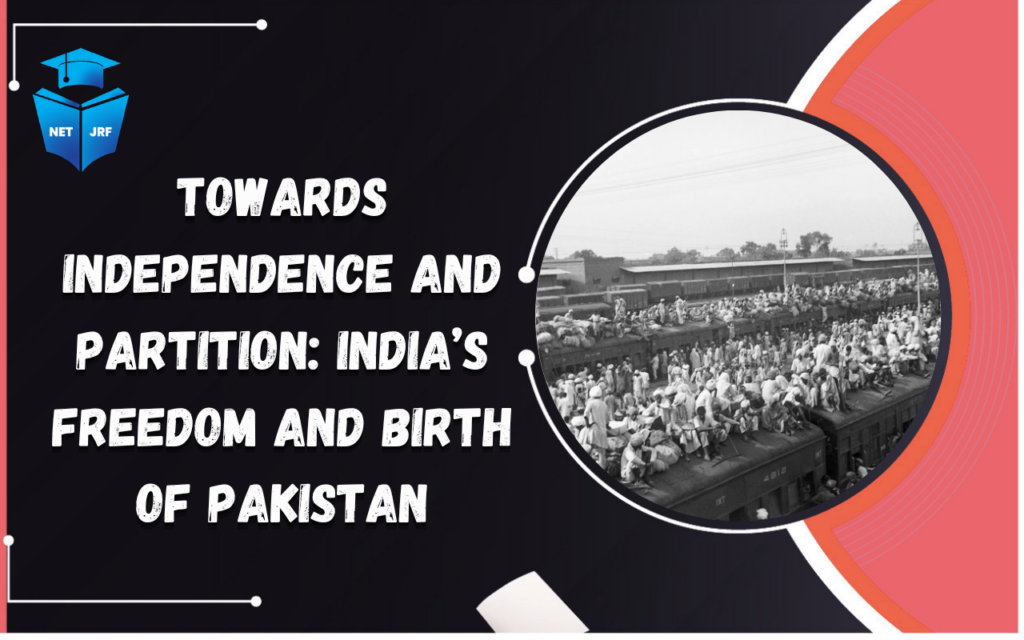
- Large-Scale Migration
Millions of people moved across the new borders to join the country where their religious community was in the majority. This migration was one of the largest population movements in modern history. - Communal Violence
The partition triggered severe communal riots in many regions, particularly in Punjab and Bengal. Thousands of people lost their lives, and many families were displaced. - Social and Economic Disruption
Communities were divided, properties were abandoned, and economic systems were disrupted. Refugees had to rebuild their lives in unfamiliar regions, creating long-term social and economic challenges.
Social and Political Impact
The events of 1947 had lasting consequences for South Asian society and politics.
Major impacts included:
1. Mass Migration
Millions of people moved across newly created borders to join communities of the same religion.
2. Communal Violence
Violence erupted in several regions as communities struggled during the transition.
3. Creation of New Nations
Two independent states emerged from British India, each with its own political system and constitution.
These consequences demonstrate the complex legacy of Towards Independence and Partition.
Enroll UGC NET Offline Coaching in Jaipur
Legacy in Modern South Asia
The events of 1947 continue to influence politics, society, and international relations in South Asia.
Important long term consequences include:
- Political relations between India and Pakistan
- Continued debates about communal identity
- Historical memory of migration and displacement
The historical process of Towards Independence and Partition therefore remains an important subject for historians and political scholars.

Conclusion
The period described as Towards Independence and Partition represents the final stage of India’s long struggle against colonial rule. Political negotiations, communal tensions, nationalist movements, and constitutional reforms shaped the path toward independence. The creation of India and Pakistan in 1947 transformed the political landscape of South Asia.
Towards Independence and Partition FAQs

2. What role did the Indian National Congress play in independence?
The Indian National Congress led mass nationalist movements, negotiated with British authorities, demanded complete independence from colonial rule.
3. Why did the All India Muslim League demand Pakistan?
The All India Muslim League argued that Muslims formed a distinct political community requiring a separate homeland to protect political rights.
4. What was the importance of the Lahore Resolution?
The Lahore Resolution of 1940 demanded autonomous Muslim majority states which later became the foundation for the creation of Pakistan.
5. How did the Quit India Movement influence independence?
The Quit India Movement of 1942 intensified pressure on the British government by demonstrating mass resistance against colonial rule.
6. What was the Cabinet Mission Plan?
The Cabinet Mission Plan of 1946 proposed a federal structure to keep India united while granting autonomy to provinces.