

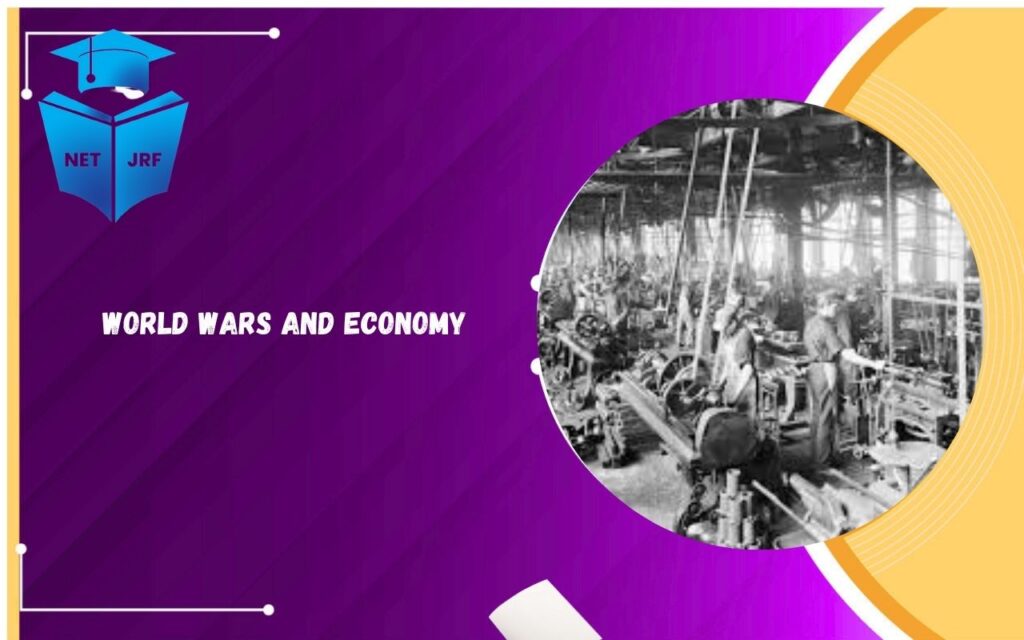
World Wars and Economy played a crucial role in shaping the twentieth-century global economic order. The two global conflicts dramatically transformed production systems, trade networks, labour markets, and government economic policies across many countries.
During both world wars governments expanded industrial production, controlled resources, and mobilized labour for military needs. These changes created rapid economic growth in some sectors while causing shortages, inflation, and economic instability in others.

World Wars and Economy
The term “World Wars and Economy” refers to the major economic changes during the First World War (1914–18) and Second World War (1939–45). Both wars had far-reaching effects on national and global economies.
Enroll UGC NET Online Coaching
Key Features
Expansion of War Industries
- Factories were converted to produce weapons, ammunition, vehicles, and other military supplies.
- Civilian production often declined as resources were diverted to the war effort.
Government Control over Economic Resources
- Governments regulated production, prices, and labor, and sometimes rationed essential goods.
- Centralized planning became necessary to meet war demands efficiently.
Increased Military Spending
- Huge sums were spent on arming and sustaining armies, fueling industrial growth in some sectors but straining national budgets.
Disruption of Global Trade
- Shipping routes, imports, and exports were interrupted by blockades, submarine warfare, and global instability.
- Countries had to rely more on domestic production, sometimes leading to shortages and inflation.
Historical Background of Global War Economy
The modern relationship between warfare and economic development became clear during the twentieth century.
First World War (1914–1918)
- Major powers like Britain, Germany, France, and Russia were involved.
- The war required massive production of weapons, food, and transportation equipment.
- Industrial production expanded rapidly to meet wartime demands.
- Governments increasingly regulated industries and labor to ensure supplies for the military.
Second World War (1939–1945)
- Even more destructive and resource-intensive than the First World War.
- Countries mobilized their entire economies for war efforts.
- There was a rise of large-scale military industries, significant technological innovation, and centralized economic planning.
- Civilian industries were often repurposed for military production, and global trade was heavily disrupted.
Both world wars reshaped national economies. The First World War expanded industrial production and government control, while the Second World War intensified economic mobilization, technological innovation, and centralized planning, setting the stage for modern wartime economies.
World Wars and Economy Major Economic Characteristics
The two global conflicts, World War I and World War II, greatly affected India’s economy and brought several important economic changes.
| Aspect | First World War | Second World War |
| Duration | 1914–1918 | 1939–1945 |
| Economic control | Partial state intervention | Extensive government control |
| Industrial production | Rapid expansion | Massive industrial mobilization |
| Global trade | Disrupted | Severely restricted |
Economic Causes of Global Conflict
The topic World Wars and Economy also relates to economic factors that contributed to the outbreak of wars.
Industrial Competition
- Industrialized nations like Britain, Germany, and France competed to sell their manufactured goods abroad.
- This rivalry for markets and resources created economic tensions between major powers.
Colonial Rivalry
- European powers sought colonies to secure raw materials (like cotton, rubber, and minerals) and new markets for their goods.
- Competition over colonies increased international conflicts.
Economic Nationalism
- Countries adopted protectionist policies, such as tariffs and trade restrictions, to protect domestic industries.
- These policies heightened economic competition, contributing to global political and military conflicts.
Economic Mobilization During War
During global conflict governments reorganized national economies to support war efforts.
Expansion of War Industries
- Factories were repurposed to produce weapons, vehicles, aircraft, and other military supplies.
- Many civilian industries were converted to meet wartime demands, reducing production of non-essential goods.
Labour Mobilization
- Millions of workers joined factories to support the war effort.
- Due to labor shortages, women entered industrial work in large numbers, taking up roles traditionally held by men.
Key Wartime Economic Policies
| Policy | Purpose |
| Price control | Prevent inflation |
| Rationing | Manage limited resources |
| War taxation | Fund military expenditure |
| Industrial regulation | Direct production toward war needs |
Impact on Global Trade
The relationship between World Wars and Economy also influenced international trade systems.
Trade Disruptions
- Naval blockades, military campaigns, and wartime restrictions disrupted global trade routes.
- Imports and exports became difficult or impossible in many regions.
Decline of Export Markets
- Wars damaged production capacities, reducing the ability of countries to export goods.
- Traditional export-oriented economies faced economic slowdowns and shortages.
Enroll UGC NET Coaching in Jaipur
Emergence of New Trade Patterns
- Some regions developed local industries to replace disrupted imports.
- This led to new economic relationships and a partial shift toward self-reliance in certain sectors.

Economic Conditions Before and During Wars
The economic conditions of India changed significantly with the outbreak of the two world wars—World War I and World War II—which transformed production, trade, and prices in the colonial economy.
| Feature | Pre-War Economy | Wartime Economy |
| Production focus | Consumer goods | Military equipment |
| Government role | Limited intervention | Strong economic control |
| Labour force | Regular employment | Mass mobilization |
| Resource allocation | Market driven | State directed |
Economic Consequences of World War I
The First World War produced major economic changes across the world.
World War I (1914–1918)
- Industrial Mobilization: Factories expanded production for weapons, vehicles, and military supplies.
- Labor Changes: Millions of workers, including women, joined war industries.
- Trade Disruptions: Naval blockades and wartime restrictions affected global trade.
- Debt and Inflation: Governments borrowed heavily, creating national debts and rising prices.
- Weakening of European Economies: Some European powers faced economic strain, though the global economic system largely remained intact.
World War II (1939–1945)
- Greater Industrial Mobilization: Entire national economies were geared toward war production.
- Technological Innovation: Advances in weapons, vehicles, aircraft, and other military technologies.
- Centralized Planning: Governments controlled production, labor, and resources more strictly.
- Severe Trade Disruptions: Global trade was heavily disrupted; some regions developed new industries.
- Inflation and Debt: Massive borrowing and expenditure created higher debts and inflation than WWI.
- Global Economic Shift: European economies weakened further, while the United States and Soviet Union emerged as dominant powers.
Social Impact of Wartime Economy
The connection between World Wars and the economy also influenced social structures.
- Women in the Workforce
-
-
- Millions of women joined factories and industrial jobs to replace men who were fighting in the wars.
- This changed traditional gender roles, giving women new economic opportunities and social visibility.
-
- Urban Industrial Expansion
-
-
- Cities with war-related industries grew rapidly as workers migrated for jobs.
- This led to population growth, urbanization, and new labor communities in industrial centers.
-
- Economic Inequality
-
- Some industries, like arms, steel, and chemical industries, earned enormous profits.
- Other sectors, such as consumer goods and agriculture, struggled due to war restrictions and resource diversion.
Key Economic Transformations
The economic changes produced by global conflict reshaped the modern world economy.
Expansion of Government Economic Control
- Governments took greater control over industries, labor, and resources to support the war effort.
- Centralized planning became a standard approach in many countries.
Growth of Industrial Production
- Wartime demand accelerated industrial output, especially in arms, vehicles, aircraft, and infrastructure.
- Factories were repurposed to meet military needs, driving industrial growth.
Development of New Technologies
- Wars stimulated innovation in aviation, weapons, communications, and manufacturing techniques.
- These technological advances later influenced civilian industries and post-war economies.
Increased International Economic Cooperation
- Post-war reconstruction and trade agreements led to new forms of international economic coordination.
- Organizations and agreements emerged to stabilize currencies, trade, and finance, laying the foundation for the modern global economy.
Enroll UGC NET Offline Coaching in Jaipur
Long-Term Economic
The relationship between World Wars and Economy produced lasting impacts on the global economic system.
Rise of New Economic Powers
- The United States emerged as a dominant global economic power after both World Wars.
- European economies were weakened, shifting the balance of global economic power.
Creation of International Institutions
- Post-war cooperation led to the formation of organizations like the International Monetary Fund (IMF) and World Bank.
- These institutions aimed to stabilize currencies, trade, and financial systems globally.
Growth of Welfare States
- Governments implemented policies to improve social welfare, employment, and economic stability.
- The wars influenced the rise of welfare-oriented economic planning in many countries
Economic Effects of the World Wars on India
The two global conflicts World War I and World War II had major economic impacts on colonial India.
- Expansion of War Industries in India
- During both World Wars, India became a supplier of raw materials like cotton, jute, and minerals for Britain’s war effort.
- Some local industries expanded to produce goods for military use, such as textiles, arms, and transport materials.
- Increased Taxation and Inflation
- The British government increased taxes and levies to finance war expenditure.
- Prices of essential goods rose sharply, causing inflation that hit common people hard.
- Disruption of Trade and Exports
- India’s traditional exports and imports were disrupted due to global wartime blockades.
- Exports of goods like textiles declined, while India became a market for British manufactured products.
- Growth of Rural Poverty
- The economic pressure of war, rising prices, and disruption of traditional industries worsened poverty, especially in villages.
- Many artisans and laborers faced loss of livelihood, forcing migration or dependence on low-paying agricultural work.
- Debt and Resource Extraction
- India contributed financial resources and soldiers for the war effort.
- The colony’s resources were heavily exploited, increasing economic dependence on Britain.
- Long-Term Industrial and Social Impact
- Some modern industries developed, especially in cities like Bombay (textiles) and Madras (engineering).
- Urban employment opportunities increased, but traditional craft industries continued to decline, reinforcing deindustrialization trends.

Conclusion
The study of World Wars and Economy reveals how global conflict reshaped economic systems across the world. Massive wartime production, state intervention, labour mobilization, and technological innovation transformed industrial structures and trade networks.
These changes weakened some traditional economic powers while strengthening others. The economic consequences of the world wars influenced international cooperation, industrial growth, and modern economic policy.
World Wars and Economy FAQs

How did the First World War affect global economic systems?
World War I increased military production, expanded government economic control, disrupted trade routes, created inflation, national debt across many countries.
How did the Second World War transform industrial production?
World War II caused massive industrial mobilization. Factories produced weapons, aircraft, vehicles, military supplies, accelerating technological development.
Why did governments control economic resources during wartime?
Governments introduced rationing, price control, industrial regulation to ensure efficient distribution of limited resources for military needs.
How did the World Wars affect the Indian economy?
During both wars colonial India supplied raw materials, soldiers, financial resources for Britain. War expenditure increased taxation, inflation, economic pressure on Indian population.