
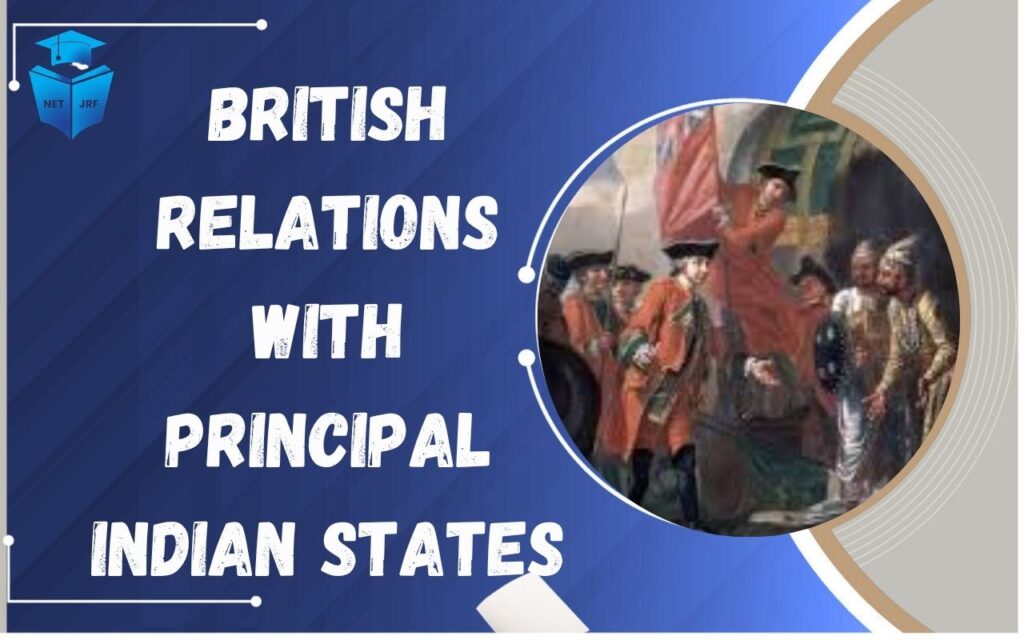

British Relations with Principal Indian States: Bengal, Oudh, Hyderabad, Mysore, Carnatic and Punjab

British Relations with Principal Indian States in this topic you learn how the British expanded control in India through alliances wars annexations diplomacy and political strategies across Bengal Oudh Hyderabad Mysore Carnatic and Punjab

vishal

British Relations with Principal Indian States

Table of Contents

British Relations with Principal Indian States formed a crucial part of the expansion of British power in India during the eighteenth and nineteenth centuries. Through wars, alliances, treaties, and diplomatic strategies, the British East India Company gradually established control over major Indian kingdoms. The major states involved in these interactions were Bengal, Oudh, Hyderabad, Mysore, Carnatic, and Punjab. Each state had a unique relationship with the British, influenced by military conflict, diplomacy, and colonial policies.

Study Planner

British Expansion in India Background 

Before discussing British Relations with Principal Indian States, it is important to understand the broader historical context.

Join UGC NET Online Coaching

The British East India Company initially came to India for trade during the seventeenth century. However, political instability in the Mughal Empire during the eighteenth century allowed the Company to expand its influence.

Key reasons for British expansion included:

  • Decline of Mughal authority
  • Rivalry among Indian rulers
  • Military superiority of the British
  • Strategic alliances with local rulers

Through these factors, the Company gradually transformed from a trading organization into a powerful political authority.

British Relations with Principal Indian States

British Relations with Principal Indian States developed through a combination of diplomacy, warfare, and administrative intervention. The British aimed to control resources, maintain strategic security, and expand territorial influence.

Major States Involved

Indian State Nature of British Interaction Outcome
Bengal Military conflict with Nawabs British political control
Oudh Alliance then annexation British annexation
Hyderabad Subsidiary alliance British influence
Mysore Anglo-Mysore wars British victory
Carnatic Anglo-French rivalry British dominance
Punjab Anglo-Sikh wars British annexation

Each of these states played a significant role in shaping colonial politics in India.

British Relations with Bengal

Bengal became the first major region where British Relations with Principal Indian States resulted in direct political control.

  • Battle of Plassey (1757)

      • The conflict between the British East India Company and Siraj-ud-Daulah, the Nawab of Bengal, led to the Battle of Plassey in 1757.
      • Important points:
      • Robert Clive led the British forces.
      • Mir Jafar betrayed Siraj-ud-Daulah.
      • The British gained control over Bengal’s administration.
  • Battle of Buxar (1764)

      • Another crucial event that shaped British Relations with Principal Indian States was the Battle of Buxar.
      • Participants included:
      • Mir Qasim (Nawab of Bengal)
      • Shuja-ud-Daulah (Nawab of Oudh)
      • Mughal Emperor Shah Alam II
      • The British victory strengthened their authority in eastern India.
  • Treaty of Allahabad (1765)

    • After the battle, the Mughal Emperor granted the Diwani rights to the British. This allowed them to collect revenue in Bengal, Bihar, and Orissa.
    • This event marked the beginning of British territorial rule in India.

Best UGC NET Mock Test Series

British Relations with Oudh (Awadh)

Oudh was another significant kingdom involved in British Relations with Principal Indian States.

Initially, the British treated Oudh as an ally and buffer state.

Key Developments

  1. The British supported the Nawabs of Oudh to maintain stability.
  2. Oudh provided financial assistance to the Company.
  3. British troops were stationed in the region.

However, over time the Company increased its control.

Annexation of Oudh (1856)

Lord Dalhousie annexed Oudh in 1856 on the grounds of misgovernment.

Consequences included:

  • Political resentment among nobles
  • Discontent among soldiers
  • Contribution to the Revolt of 1857

Thus Oudh became one of the most controversial examples of British expansion.

British Relations with Hyderabad

Hyderabad played an important role in British Relations with Principal Indian States through diplomatic alliances rather than direct warfare.

  • Subsidiary Alliance System

      • Lord Wellesley introduced the Subsidiary Alliance policy.
      • Key conditions included:
      • Indian rulers accepted British troops in their territory.
      • The ruler paid for the maintenance of the army.
      • The ruler could not form alliances with other powers.
      • Hyderabad became the first state to accept the Subsidiary Alliance in 1798.
  • Impact

    • This alliance reduced the independence of the Nizam of Hyderabad while allowing the British to increase political influence.

App JRF Adda

British Relations with Mysore

Mysore emerged as one of the strongest opponents in British Relations with Principal Indian States.

The kingdom was ruled by Hyder Ali and later Tipu Sultan.

Join UGC NET Offline Coaching in Jaipur

Anglo-Mysore Wars

Four major wars shaped the relationship between Mysore and the British.

War Years Result
First Anglo-Mysore War 1767–1769 Treaty of Madras
Second Anglo-Mysore War 1780–1784 Treaty of Mangalore
Third Anglo-Mysore War 1790–1792 British victory
Fourth Anglo-Mysore War 1799 Death of Tipu Sultan

The defeat of Tipu Sultan in 1799 marked the end of Mysore’s resistance. This strengthened British power in southern India.

British Relations with Carnatic

The Carnatic region in South India was another important arena for British Relations with Principal Indian States.

The politics of Carnatic became closely linked with the Anglo-French rivalry in India.

Carnatic Wars

Three Carnatic wars occurred between the British and the French.

Important outcomes included:

  • Decline of French influence in India
  • Rise of British dominance in southern India
  • Control over regional rulers

Eventually, the British reduced the Nawab of Carnatic to a subordinate position.

British Relations with Punjab

Punjab was the last major kingdom to challenge British expansion in northern India.

  • Rule of Maharaja Ranjit Singh

    • Ranjit Singh established a strong Sikh kingdom in Punjab.
    • His leadership helped maintain independence from British control for many years.
    • However, after his death in 1839, political instability weakened the state.

Anglo-Sikh Wars

Two major wars shaped British Relations with Principal Indian States in Punjab.

War Year Outcome
First Anglo-Sikh War 1845–1846 Partial British control
Second Anglo-Sikh War 1848–1849 Annexation of Punjab

After the second war, the British annexed Punjab in 1849. This marked the final stage of British territorial expansion in India.

British Policy Toward Major Indian States

British Relations with Principal Indian States – Policy Comparison

State British Strategy Result
Bengal Military conquest Political control
Oudh Alliance then annexation Direct rule
Hyderabad Subsidiary alliance Indirect control
Mysore Military wars British dominance
Carnatic Diplomatic manipulation Subordinate state
Punjab Anglo-Sikh wars Annexation

Major Strategies Used by the British

During the period of British relations with Indian states, the British East India Company used several strategies to expand its political influence across the subcontinent. These methods combined military strength, diplomacy, and administrative policies to gradually establish British dominance in India.

  1. Military Conquest
    One of the most direct methods of expansion was military conquest. The British defeated several Indian rulers through important battles and wars. For example, the Battle of Plassey gave the Company control over Bengal, while the Anglo-Mysore Wars weakened the powerful kingdom of Mysore. These victories allowed the British to gain territory, wealth, and political authority.
  2. Subsidiary Alliance
    The Subsidiary Alliance system was introduced by Lord Wellesley. Under this policy, Indian rulers were required to accept British troops within their territories and pay for their maintenance. In return, the British promised protection from external enemies. However, this system greatly reduced the independence of Indian states because rulers could not maintain their own armies or form alliances without British approval.
  3. Annexation Policies
    The British also expanded their territory through annexation policies. Some states were taken over on the grounds of misgovernment, while others were annexed through policies like the Doctrine of Lapse. According to this rule, if a ruler died without a natural male heir, the British could take control of the state.
  4. Diplomatic Alliances
    Another important strategy was forming diplomatic alliances with local rulers. The Company often supported one ruler against another in regional conflicts. By doing this, the British gained influence over internal politics and gradually extended their authority.

Together, these strategies helped the British transform a trading company into a powerful colonial empire that controlled most of the Indian subcontinent.

Top UGC NET Offline Coaching in Jaipur

Key Takeaways British Relations with Principal Indian States 

The study of British Relations with Principal Indian States reveals how the British 

Aspect Description
Bengal Bengal became the first major region to come under the control of the British East India Company after victories in the Battle of Plassey and Battle of Buxar.
Oudh (Awadh) The British annexed Awadh in 1856 on the grounds of alleged misgovernment, increasing British territorial control in northern India.
Hyderabad The ruler of Hyderabad accepted the Subsidiary Alliance system introduced by Lord Wellesley, placing the state under British protection and influence.
Mysore The kingdom of Mysore strongly resisted British expansion under the leadership of Tipu Sultan until his defeat in 1799.
Carnatic Political conflicts in Carnatic reflected the rivalry between European powers, especially during the Carnatic Wars.
Punjab The powerful Sikh kingdom of Punjab was annexed by the British after the Anglo-Sikh Wars, bringing the region under British rule.
Historical Significance These relations between the British and major Indian states helped expand British political control and shaped the course of modern Indian history.

Conclusion

In summary, British Relations with Principal Indian States played a decisive role in the expansion of British power across India. Through strategic alliances, military conflicts, diplomatic agreements, and annexations, the British East India Company gradually established dominance over Bengal, Oudh, Hyderabad, Mysore, Carnatic, and Punjab. 

JRF Adda Book

Read UGC NET Notes
1 Archaeological Sources for UGC NET Epigraphy – Study of Inscriptions Meaning of Historical Sources Archaeological
2 Meaning of Historical Sources Archaeological Sources for UGC NET Literary Sources in History Archaeological
3 Exploration in Archaeology Excavation Techniques in Archaeology Dating of Archaeological Sites Archaeological
4 Excavation Techniques in Archaeology Exploration in Archaeology Dating of Archaeological Sites Archaeological
5 Epigraphy – Study of Inscriptions Inscriptions in Reconstructing History Numismatics in History Archaeological
6 Inscriptions in Reconstructing History Epigraphy – Study of Inscriptions Archaeological Sources for UGC NET Archaeological
7 Numismatics in History Importance of Coins in History Epigraphy – Study of Inscriptions Archaeological
8 Importance of Coins in History Numismatics in History Archaeological Sources for UGC NET Archaeological
9 Dating of Archaeological Sites Excavation Techniques in Archaeology Dating Ancient Literary Sources Archaeological
10 Indigenous Literature Literary Sources in History Secular Literature as Historical Source Literary
11 Dating Ancient Literary Sources Literary Sources in History Dating of Archaeological Sites Literary
12 Literary Sources in History Indigenous Literature Foreign Accounts of India Literary
13 Foreign Accounts of India Greek Accounts on Ancient India Chinese Accounts on India Literary
14 Greek Accounts on Ancient India Foreign Accounts of India Chinese Accounts on India Literary
15 Secular Literature as Historical Source Literary Sources in History Indigenous Literature Literary
16 Role of Myths and Legends in Historical Reconstruction Literary Sources in History Secular Literature as Historical Source Literary
17 Chinese Accounts on India Foreign Accounts of India Greek Accounts on Ancient India Literary
18 Arabic Accounts on India Foreign Accounts of India Chinese Accounts on India Literary
19 Neolithic and Chalcolithic Phases Neolithic Revolution in India Chalcolithic Culture in India Neolithic
20 Hunting, Gathering & Food Production Neolithic Revolution in India Neolithic Settlements in India Neolithic
21 Neolithic Revolution in India Neolithic Settlements in India Tools and Technology in Neolithic Period Neolithic
22 Neolithic Settlements in India Distribution of Neolithic Cultures in India Neolithic Revolution in India Neolithic
23 Distribution of Neolithic Cultures in India Neolithic Settlements in India Tools and Technology in Neolithic Period Neolithic
24 Tools and Technology in Neolithic Period Neolithic Revolution in India Chalcolithic Culture in India Neolithic
25 Chalcolithic Culture in India Settlement Pattern & Economy in Chalcolithic Phase Trade & Exchange Networks in Chalcolithic Societies Neolithic
26 Settlement Pattern & Economy – Chalcolithic Phase Chalcolithic Culture in India Trade & Exchange Networks in Chalcolithic Societies Neolithic
27 Trade & Exchange Networks – Chalcolithic Societies Chalcolithic Culture in India IVC Internal & External Trade Neolithic
28 Indus Valley Civilization – UGC NET Major Sites of Indus Civilization Urban Planning in Harappan Civilization IVC
29 IVC Internal & External Trade Internal Trade – Harappan Civilization Craft Specialization in Harappan Civilization IVC
30 Political Organization – Harappan Civilization Social Structure – Indus Civilization Urban Planning in Harappan Civilization IVC
31 Major Sites of Indus Civilization Indus Valley Civilization – UGC NET Urban Planning in Harappan Civilization IVC
32 Urban Planning & Settlement – Harappan Civilization Architecture & Town Planning – Harappan Cities IVC as First Urbanization in India IVC
33 Architecture & Town Planning – Harappan Cities Urban Planning in Harappan Civilization Major Sites of Indus Civilization IVC
34 Craft Specialization & Industrial Activities – Harappan Agriculture & Food Economy – Harappans IVC Internal & External Trade IVC
35 Agriculture & Food Economy – Harappans Craft Specialization in Harappan Civilization Internal Trade – Harappan Civilization IVC
36 Internal Trade – Harappan Civilization IVC Internal & External Trade Craft Specialization in Harappan Civilization IVC
37 Religion & Beliefs – Indus Civilization Social Structure – Indus Civilization Indus Valley Civilization – UGC NET IVC
38 Social Structure – Indus Civilization Political Organization – Harappan Civilization Religion & Beliefs – Indus Civilization IVC
39 Decline of Indus Civilization Indus Valley Civilization – UGC NET IVC as First Urbanization in India IVC
40 IVC as First Urbanization in India Urban Planning in Harappan Civilization Second Urbanization in India IVC
41 Vedic & Later Vedic Periods – Aryan Varna System Early Vedic Society and Economy Later Vedic Society and Economy Vedic
42 Origin of Vedic Civilization Aryan Debate – Migration, Invasion & Indigenous Theories Early Vedic Society and Economy Vedic
43 Aryan Debate – Migration, Invasion & Indigenous Theories Origin of Vedic Civilization Early Vedic Society and Economy Vedic
44 Early Vedic Society and Economy Political Institutions – Early Vedic Period Social Structure – Early Vedic Period Vedic
45 Political Institutions – Early Vedic Period Early Vedic Society and Economy Monarchical States in Ancient India Vedic
46 Social Structure – Early Vedic Period Emergence of Varnas & Social Stratification Early Vedic Society and Economy Vedic
47 Later Vedic Society and Economy Emergence of Varnas & Social Stratification Impact of Iron Technology in India Vedic
48 Emergence of Varnas & Social Stratification Social Structure – Early Vedic Period Later Vedic Society and Economy Vedic
49 Emergence of Heterodox Sects in India Jainism, Buddhism & Ajivikas – Origins & Teachings Later Vedic Society and Economy Vedic
50 Impact of Iron Technology in India Later Vedic Society and Economy Agricultural Expansion & Economic Changes – Ancient India Vedic
51 Religious & Philosophical Vedic Ideas Emergence of Varnas & Social Stratification Emergence of Heterodox Sects in India Vedic
52 Megalithic Culture of South India Neolithic and Chalcolithic Phases Agricultural Expansion & Economic Changes General
53 State System in Ancient India Rise of Mahajanapadas Transition: Tribal Polities to Territorial States General
54 Transition: Tribal Polities to Territorial States Rise of Mahajanapadas Later Vedic Society and Economy General
55 Rise of Mahajanapadas Monarchical States in Ancient India Republican States (Gana-Sanghas) – Ancient India Magadha
56 Monarchical States in Ancient India Rise of Mahajanapadas Emergence of Magadha Magadha
57 Republican States (Gana-Sanghas) – Ancient India Rise of Mahajanapadas Monarchical States in Ancient India Magadha
58 Agricultural Expansion & Economic Changes – Ancient India Second Urbanization in India Impact of Iron Technology in India General
59 Second Urbanization in India IVC as First Urbanization in India Rise of Mahajanapadas General
60 Jainism, Buddhism & Ajivikas – Origins & Teachings Emergence of Heterodox Sects in India Ashoka’s Policy of Dhamma General
61 Emergence of Magadha Geographical Advantages of Magadha Early Rulers of Magadha Magadha
62 Geographical Advantages of Magadha Natural Resources & Economic Strength of Magadha Reasons for Success of Magadha Magadha
63 Natural Resources & Economic Strength of Magadha Geographical Advantages of Magadha Economic Policies of the Nandas Magadha
64 Early Rulers of Magadha Haryanka Dynasty – Rise of Magadha Emergence of Magadha Magadha
65 Haryanka Dynasty – Rise of Magadha Expansion Policy of Bimbisara Early Rulers of Magadha Magadha
66 Expansion Policy of Bimbisara Ajatashatru – Military Reforms Haryanka Dynasty – Rise of Magadha Magadha
67 Ajatashatru – Military Reforms Wars of Ajatashatru Expansion Policy of Bimbisara Magadha
68 Wars of Ajatashatru Ajatashatru – Military Reforms Udayin & Establishment of Pataliputra Magadha
69 Udayin & Establishment of Pataliputra Wars of Ajatashatru Shishunaga Dynasty Magadha
70 Shishunaga Dynasty Administrative Structure of the Shishunagas Nanda Dynasty Magadha
71 Administrative Structure of the Shishunagas Shishunaga Dynasty Central Administration Under Mauryas Magadha
72 Nanda Dynasty Mahapadma Nanda – Imperial Expansion Shishunaga Dynasty Magadha
73 Mahapadma Nanda – Imperial Expansion Military Strength of the Nandas Nanda Dynasty Magadha
74 Economic Policies of the Nandas Nanda Dynasty Taxation System – Mauryan State Magadha
75 Military Strength of the Nandas Mahapadma Nanda – Imperial Expansion Defeat of Nandas & Rise of Mauryan Empire Magadha
76 Reasons for Success of Magadha Geographical Advantages of Magadha Natural Resources & Economic Strength of Magadha Magadha
77 Mahajanapadas to Empire – Evolution & Rise of Magadha Rise of Mahajanapadas Emergence of Magadha Magadha
78 Mauryan Empire – Expansion Rise of Chandragupta Maurya Expansion of Mauryan Empire Maurya
79 Rise of Chandragupta Maurya Role of Chanakya in Rise of Mauryan Empire Defeat of Nandas & Rise of Mauryan Empire Maurya
80 Role of Chanakya in Rise of Mauryan Empire Rise of Chandragupta Maurya Defeat of Nandas & Rise of Mauryan Empire Maurya
81 Defeat of Nandas & Rise of Mauryan Empire Military Strength of the Nandas Rise of Chandragupta Maurya Maurya
82 Chandragupta Maurya – Seleucus Treaty & Diplomacy Expansion of Mauryan Empire Greek Accounts on Ancient India Maurya
83 Expansion of Mauryan Empire Chandragupta Maurya – Seleucus Treaty & Diplomacy Kalinga War Maurya
84 Administration of Chandragupta Maurya Central Administration Under Mauryas Mauryan Bureaucracy Maurya
85 Sources for Mauryan History Archaeological Sources for UGC NET Greek Accounts on Ancient India Maurya
86 Central Administration Under Mauryas Provincial Administration – Mauryan Empire Mauryan Bureaucracy Maurya
87 Provincial Administration – Mauryan Empire Local Administration – Mauryan Empire Central Administration Under Mauryas Maurya
88 Local Administration – Mauryan Empire Provincial Administration – Mauryan Empire Mauryan Bureaucracy Maurya
89 Mauryan Bureaucracy Central Administration Under Mauryas Espionage System – Mauryan Empire Maurya
90 Espionage System – Mauryan Empire Mauryan Bureaucracy Central Administration Under Mauryas Maurya
91 Ancient India – Trade and Commerce Trade and Commerce Under Mauryas Agrarian Economy – Mauryan Period Maurya
92 Agrarian Economy – Mauryan Period Taxation System – Mauryan State Trade and Commerce Under Mauryas Maurya
93 Trade and Commerce Under Mauryas Ancient India – Trade and Commerce Agrarian Economy – Mauryan Period Maurya
94 Taxation System – Mauryan State Agrarian Economy – Mauryan Period Economic Policies of the Nandas Maurya
95 Kalinga War Ashoka’s Policy of Dhamma Expansion of Mauryan Empire Maurya
96 Ashoka’s Policy of Dhamma Nature & Philosophy of Dhamma Kalinga War Maurya
97 Nature & Philosophy of Dhamma Ashoka’s Policy of Dhamma Jainism, Buddhism & Ajivikas Maurya

British Relations with Principal Indian States FAQs

Loader image

The Battle of Plassey in 1757 marked the beginning of British political dominance in India. It gave the British control over Bengal's administration and resources.

The British annexed Oudh in 1856 citing misgovernment. This decision angered many groups and contributed to the Revolt of 1857.

The Subsidiary Alliance forced rulers to depend on British troops. It limited their foreign relations and gradually reduced their independence.

Mysore under Hyder Ali and Tipu Sultan strongly resisted British power. The Anglo-Mysore wars became major conflicts in South India.

After the death of Ranjit Singh, internal conflicts weakened the Sikh kingdom. The British defeated the Sikhs in two wars and annexed Punjab in 1849.

The Carnatic wars weakened French influence in India. This allowed the British to dominate southern Indian politics.

British Relations with Principal Indian States describe the political interactions between the British East India Company and major Indian kingdoms through wars, alliances, treaties, and annexations.

Leave a Reply

Recent Posts
Aditi

Aditi Sharma, founder of JRFAdda, is a Computer Science educator with an MCA degree and JRF qualification (99.91 percentile, Dec 2019). Her experience includes roles as an SBI SO (DBA), work at Cognizant, and over 5 years of teaching online and offline. She has also served as a Government Computer Teacher in Rajasthan.

Check Our Recommended Course