
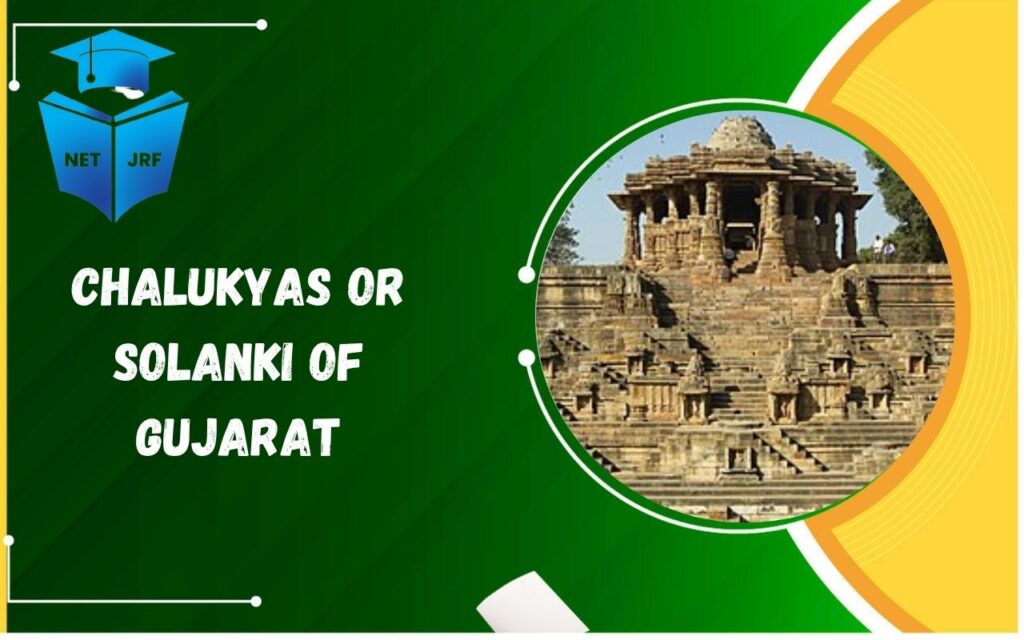

Chalukyas Or Solanki Of Gujarat played a very important role in shaping the political, cultural, and economic history of western India. This dynasty ruled Gujarat for several centuries and created a strong regional kingdom after the decline of earlier powers.
The story of Chalukyas Or Solanki Of Gujarat is not just about kings and battles. It also shows how administration worked, how temples were built, and how trade and culture developed during that time.

Introduction Chalukyas Or Solanki Of Gujarat
The Chalukyas Or Solanki Of Gujarat ruled mainly between the 10th and 13th centuries CE.
- Their capital was Anahilapataka, present-day Patan in Gujarat.
- They were known for strong administration, military strength, and rich cultural achievements. The Chalukyas Or Solanki Of Gujarat created a powerful state that controlled large parts of western India.
Top UGC NET Coaching in Jaipur
Rise of Dynasty
The rise of the Chalukyas Or Solanki Of Gujarat started with Mularaja, who is considered the founder of the dynasty.
Early Formation
- Mularaja established control over Gujarat
- He removed local rulers and created a strong base
- Gradually expanded territory
The early growth of the Chalukyas Or Solanki Of Gujarat shows how regional powers emerged after the decline of major empires.
Expansion Phase
- Expansion into Rajasthan and Malwa
- Control over trade routes
- Strong alliances and military campaigns
This expansion made the Chalukyas Or Solanki Of Gujarat a dominant power in western India.
Important Rulers of Dynasty
The success of the Chalukyas, also known as the Solankis of Gujarat, depended greatly on their capable and visionary rulers. Each king played a unique role in building, strengthening, and expanding the kingdom. Their leadership ensured political stability as well as cultural and religious growth.
Key Kings
Mularaja – Founder
Mularaja was the founder of the Solanki (Chalukya) dynasty in Gujarat. He laid the foundation of the kingdom by establishing his authority in the region.
- Starting from a relatively small base, he gradually expanded his control and built a stable political structure.
- His leadership marked the beginning of Solanki power in Gujarat, and he set the stage for future rulers to strengthen the kingdom.
Siddharaja Jayasimha
Siddharaja Jayasimha is considered one of the greatest rulers of the Solanki dynasty.
- He was known for his strong administrative skills and effective governance.
- Under his rule, the kingdom expanded, and administration became more organized.
- He focused on maintaining law and order and improving governance, which brought stability and prosperity to the state. His reign is often seen as a golden period of political strength.
Kumarapala
Kumarapala is remembered for his support of religion and culture.
- He was a great patron of Jainism and promoted religious activities across his kingdom.
- His rule saw the construction of temples and encouragement of religious scholars.
- This not only strengthened cultural life but also created a peaceful and harmonious society.
Administrative System of Chalukyas (Solanki) of Gujarat
The Solankis developed a well-organized administrative system that helped them manage a large and diverse kingdom efficiently. Their system was structured, with clear roles and responsibilities at different levels.
Central Administration
The king was the highest authority in the administration.
- All major decisions were taken by him, and he controlled the overall functioning of the state.
- His leadership ensured unity and stability, and his authority was respected throughout the kingdom.
Ministers Assisted Governance
The king was supported by a group of ministers who advised him on important matters. These ministers helped in administration, policy-making, and implementation of decisions.
- Their support made governance more effective and balanced.
Strong Decision-Making System
The administration had a clear and organized decision-making process.
- Responsibilities were well-defined, which reduced confusion and ensured smooth functioning.
- This strong system allowed quick and effective responses to political and administrative challenges.
Best UGC NET Offline Classes in Jaipur
Provincial Administration
To manage the kingdom properly, it was divided into provinces. This made administration easier, especially in distant regions.
Each province was handled separately, ensuring better control and efficiency.
Officials Managed Local Areas
Officials were appointed to manage provinces and local regions.
- They acted as representatives of the king and were responsible for implementing policies.
- Their presence ensured that the king’s authority reached every part of the kingdom.

Revenue and Law Enforcement at Local Level
Local officials handled important tasks such as tax collection and maintaining law and order. This decentralized system made administration more practical and responsive.
- It ensured that local issues were resolved quickly without always depending on the central authority.
- contribution highlights the importance of religion in shaping the identity of the kingdom.
Chalukyas Or Solanki Of Gujarat Administration Structure
The Chalukyas, also known as the Solankis of Gujarat, developed a well-planned and structured administrative system. Their governance combined strong central authority with practical local management. This balance helped them efficiently control a large kingdom and maintain long-term stability.
Key Features of Administration
The Solanki administration was based on a monarchical system, where the king was the supreme authority. All major decisions whether related to governance, military, or policy were taken by the ruler.
- The king’s leadership played a crucial role in maintaining unity and order.
- His power ensured that administration remained strong and organized across the kingdom.
Decentralized Administration
Even though the king held supreme authority, the Solankis followed a decentralized system of administration.
- This means that power was shared with officials at different levels.
- Provinces and local areas were managed by appointed officers who handled day-to-day governance.
- This reduced the burden on the central authority and ensured that local issues were addressed quickly and effectively.
Strong Bureaucracy
The Solankis had a strong and organized bureaucracy. A group of trained officials assisted the king in managing the state.
- Each official had clearly defined duties, which reduced confusion and improved efficiency. This structured system helped in smooth functioning of administration and better implementation of policies.
Important Officials
Amatyas were ministers who advised the king on important matters of governance.
- They played a key role in decision-making and administration.
- Their guidance helped the king manage the kingdom more effectively and ensured that policies were properly implemented.
Senapati (Military Head)
The Senapati was the head of the army and was responsible for defense and military organization.
-
- He ensured that the kingdom was protected from external threats and maintained internal security.
- His role was crucial in maintaining the strength and stability of the state.
-
Revenue Officers
-
- Revenue officers were responsible for collecting taxes and managing the financial system of the kingdom.
- They ensured that income from various sources was properly collected and used for administration, defense, and development.
Revenue System of Chalukyas (Solanki) of Gujarat
The economic strength of the Solanki kingdom depended mainly on agriculture and trade. Their revenue system was well-organized and provided a steady income to support administration and development.
-
Sources of Income
-
-
- Land tax was the primary source of income. Farmers were required to pay a portion of their agricultural produce as tax.
- Since agriculture was widely practiced, this provided a stable and regular source of revenue for the state.
-
-
Trade Duties
-
-
- Trade duties were collected from merchants and traders on goods being transported or sold.
- Because Gujarat was an important trade region, these duties brought significant income to the kingdom. This also shows the importance of commerce in their economy.
-
-
Fines
-
- Fines were imposed as penalties for breaking laws or rules. This served both as a source of revenue and a way to maintain discipline in society.
Land Revenue System
The Solanki rulers followed a system where farmers paid taxes based on their production. This meant that tax depended on how much crop was grown.
This system was practical and somewhat flexible, as it adjusted according to agricultural output. It helped farmers manage their burden while ensuring that the state received revenue.
Military Organization of Chalukyas (Solanki) of Gujarat
The Chalukyas (Solankis) of Gujarat maintained a strong and well-organized military system. Their army played a crucial role not only in protecting the kingdom but also in expanding their power. A powerful military ensured stability and helped the rulers maintain control over their territories.
Features of the Military
Infantry formed the backbone of the Solanki army. These were foot soldiers who fought on the ground using weapons like swords, spears, and shields.
They were large in number and played an important role in battles. Their presence ensured strength and support in both defensive and offensive operations.
Cavalry
- The cavalry consisted of soldiers on horseback. These troops were fast and mobile, making them very effective in warfare.
- They were used for quick attacks, chasing enemies, and covering large distances in a short time. Cavalry added speed and flexibility to the army.
Forts
- Forts were an essential part of the Solanki military system. They were built at strategic locations to protect important regions and cities.
- Forts acted as defensive centers during attacks and also helped in controlling surrounding areas. Their strong construction made them difficult for enemies to capture.
Role of the Military
The primary role of the military was to protect the kingdom from external threats. The Solankis faced challenges from neighboring powers, so a strong army was necessary to defend their borders.
Expansion of Territory
- The military was also used for expanding the kingdom. Through planned campaigns, the Solankis were able to bring new regions under their control.
Economic Development of Chalukyas (Solanki) of Gujarat
The Solanki period saw significant economic growth. Their economy was mainly based on trade and agriculture, both of which were well-developed and supported by the rulers.
Trade and Commerce
-
- Gujarat was one of the most important trade regions in India. Its location made it a center for both inland and overseas trade.
-
Ports Connected India to Foreign Lands
-
- The presence of ports along the coast helped connect India with foreign regions such as West Asia and Africa.
- These connections increased the flow of goods and wealth, making the kingdom economically strong.
-
Role of Merchants
- Merchants played a key role in economic development. They carried goods, promoted trade, and contributed to the prosperity of the kingdom.
- The rulers supported merchants by ensuring safety and proper trade conditions.
Agriculture
-
- Agriculture was the main occupation of the people. Most of the population depended on farming for their livelihood.
-
Irrigation Systems
- The Solankis developed irrigation systems to support agriculture. These systems ensured a steady water supply, which improved crop production.
- Better irrigation meant better harvests, which strengthened the economy.
Cultural Contributions of Chalukyas (Solanki) of Gujarat
The Solankis made important contributions to culture, which reflected their interest in religion, literature, and art.
Religion
-
Support to Jainism and Hinduism
-
- The Solanki rulers supported both Jainism and Hinduism. They followed a policy of religious tolerance and encouraged different beliefs.
-
Temples and Religious Centers
- They built many temples and religious centers, which became important places of worship and social life.
- These structures also reflected their devotion and artistic taste.
Literature
Development of Sanskrit and Regional Languages
- During their rule, Sanskrit and regional languages developed significantly. These languages were used in literature, administration, and education.
Support to Scholars
- The rulers supported scholars and writers, which encouraged intellectual growth. This created a rich literary environment in the kingdom.
Temple Architecture of the Chalukyas (Solanki) of Gujarat
The Solankis are especially famous for their temple architecture, which shows high levels of artistic skill and creativity.
Features of Architecture
-
- Their temples are known for detailed and intricate carvings. These carvings depict religious themes, daily life, and artistic patterns.
-
Use of Stone
-
- Stone was widely used in construction, which made the temples strong and long-lasting.
-
Artistic Designs
- The designs of the temples were highly artistic and well-planned. Every part of the structure showed attention to detail and creativity.
Famous Temples
The Sun Temple at Modhera is one of the most famous examples of Solanki architecture. It is known for its beautiful design, detailed carvings, and architectural brilliance.


Jain Temples
The Solankis also built many Jain temples, which are known for their elegance and fine craftsmanship.

Chalukyas Or Solanki Of Gujarat Overview
The Chalukyas (Solanki) of Gujarat built a powerful kingdom supported by a strong military, a growing economy, and rich cultural traditions. Their achievements in trade, agriculture, religion, literature, and especially temple architecture highlight their lasting contribution to Indian history.
| Feature | Details |
| Dynasty | Chalukyas Or Solanki Of Gujarat |
| Capital | Anahilapataka (Patan) |
| Founder | Mularaja |
| Economy | Agriculture and trade |
| Culture | Temple architecture |

Role in Regional Politics
The Chalukyas Or Solanki Of Gujarat played a key role in regional politics.
Political Influence
- Controlled western India
- Fought with neighboring kingdoms
- Maintained alliances
Their political strategies made the Chalukyas Or Solanki Of Gujarat powerful.
Decline of Dynasty
The Chalukyas Or Solanki Of Gujarat declined due to multiple reasons.
Causes of Decline
- Weak successors
- Internal conflicts
- External invasions
These factors led to the fall of the Chalukyas Or Solanki Of Gujarat.
The history of the Chalukyas Or Solanki Of Gujarat shows how a regional dynasty can rise, grow, and create a lasting impact. Their administration, culture, and architecture still influence Indian history. The Chalukyas Or Solanki Of Gujarat remain an important example of strong regional governance.