
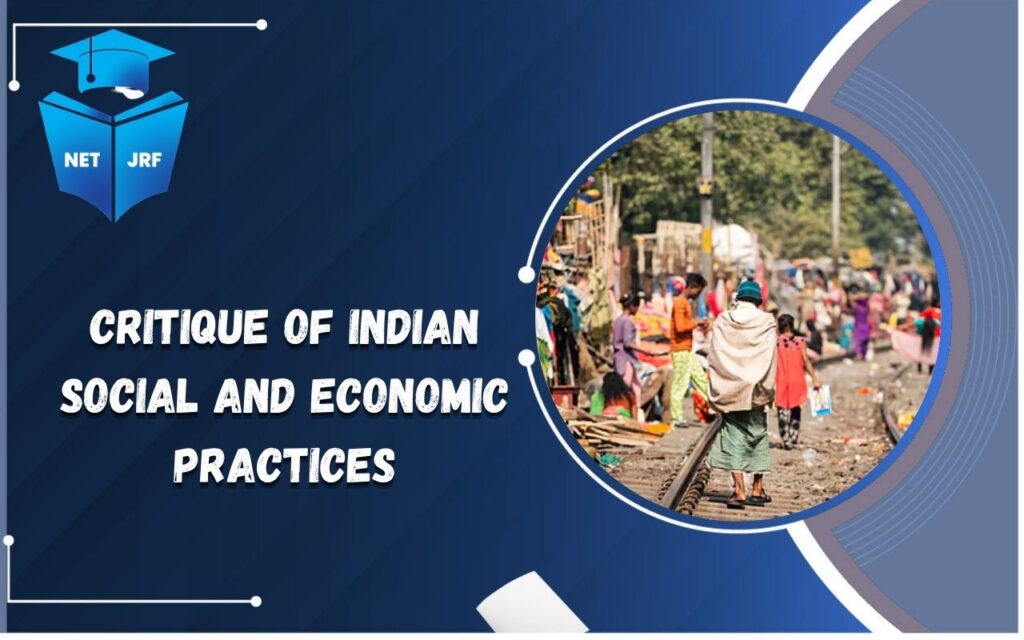
Critique of Indian society emerged strongly during the nineteenth century when reformers began questioning social customs, economic inequality, and religious traditions in colonial India. Intellectual debates about caste hierarchy, gender inequality, and outdated customs encouraged the development of new reform movements.
Colonial contact with Western ideas, modern education, and Christian missionary activity introduced fresh perspectives on social organization. These influences motivated Indian thinkers to examine traditional institutions critically.

Social Criticism in Colonial India
The Critique of Indian social practices refers to the process through which reformers examined traditional customs and questioned practices that created inequality or injustice.
This intellectual movement focused on improving society by promoting rational thinking, equality, and modern values.
Areas of Social Criticism
- Caste hierarchy and discrimination
- Gender inequality and women’s rights
- Economic exploitation within society
- Ritualistic religious practices
- Lack of education among the masses
These concerns formed the foundation of reform debates in colonial India.
Critique of Indian Social Structure
The Critique of Indian social structure developed through reform movements that aimed to correct social injustices and improve moral values.
-
Influence of Western Education
-
-
- Western education introduced concepts such as liberty, equality, and rational inquiry. Educated Indians began comparing traditional practices with modern ideals.
-
-
Growth of Reform Organizations
-
-
- Reformers established organizations that promoted new social ideas.
- Examples include reform societies that worked to eliminate harmful customs and encourage education.
-
-
Impact of Print Culture
-
- The spread of newspapers and journals allowed reformers to publish ideas and debate social issues openly.
Criticism Caste System
The Critique of the Indian caste system became one of the most significant aspects of social reform.
Many reformers argued that caste divisions prevented social unity and created discrimination.
Major Points of Criticism
The caste system in India faced significant criticism for creating social inequality and limiting opportunities for large sections of society. Key points include:
- Caste hierarchy created inequality by giving higher status and privileges to upper castes while marginalizing lower castes.
- Restrictions on social mobility prevented people from improving their social or economic status.
- Exclusion of lower castes from education limited their access to knowledge, jobs, and public life.
- Social segregation within communities reinforced discrimination in daily life, including in temples, marriages, and public spaces.
Reform Women’s Status
Another important dimension of the Critique of Indian social practices focused on the condition of women.
During colonial India, several social issues limited women’s rights and opportunities:
- Child marriage forced girls into early marriages, affecting their health and personal freedom.
- Restrictions on widow remarriage denied widows the chance to rebuild their lives.
- Limited educational opportunities kept women dependent and excluded from public life.
- Social dependence on male authority reinforced patriarchal control over women’s choices.
Enroll UGC NET Foundation Batch Online
In response, social reformers advocated for women’s education, legal reforms, and greater social freedom, aiming to improve women’s status and reduce gender-based inequalities.

Criticism Religious Practices
The Critique of Indian religious beliefs also formed a major part of reform movements.
Reformers believed that excessive ritualism and superstition weakened the moral foundation of religion.
Colonial-era social reformers highlighted several issues in religious and social practices:
- Blind faith in rituals, which discouraged critical thinking and personal judgment.
- Superstitious beliefs, leading to exploitation and social stagnation.
- Dominance of priests in religious life, concentrating power and controlling community practices.
- Lack of ethical interpretation of religion, where moral values were often overshadowed by ritualistic practices.
To address these concerns, reformers promoted a rational and ethical understanding of religion, encouraging individuals to focus on morality, social justice, and human welfare rather than blind adherence to customs.
Role of Reform Leaders
Several influential thinkers contributed to the Critique of Indian society.
Several reformers played a key role in promoting social change during colonial India:
- Raja Rammohan Roy – Advocated against sati, promoted modern education, and supported rational thinking in religion.
- Ishwar Chandra Vidyasagar – Worked for widow remarriage, women’s education, and social upliftment.
- Swami Dayananda Saraswati – Founded the Arya Samaj, emphasizing Vedic teachings, rational religion, and social reform.
- Jyotirao Phule – Championed education for lower castes and women, and fought against caste discrimination.
These reformers used education, writing, speeches, and public debates to challenge social evils and encourage progressive change in Indian society.
Methods Used Social Reform
Reformers adopted various methods to promote the Critique of Indian social practices.
Social reformers in colonial India adopted several strategies to promote social change and challenge traditional practices:
- Establishment of reform societies to organize collective action and campaigns for social improvement.
- Publication of newspapers and books to spread ideas, raise awareness, and educate the public.
- Public debates on social issues to challenge orthodox beliefs and encourage rational thinking.
- Promotion of modern education for women and marginalized communities to empower them socially and economically.
Enroll UGC NET Offline Coaching in Jaipur
These strategies helped reform ideas reach different regions and highlighted the contrast between traditional institutions and progressive, reformist thinking.

Indian Society Impact
The Critique of Indian social practices produced significant transformation in colonial society.
The social reform movements in colonial India led to significant transformations in society:
- Growth of modern education, increasing literacy and awareness among women and marginalized communities.
- Development of social reform laws, such as those against sati and in favor of widow remarriage.
- Improvement in women’s rights, including better access to education and opportunities for social participation.
- Rise of rational religious thought, encouraging ethical and moral interpretation over blind ritualism.
Together, these changes contributed to the modernization of Indian society and laid the foundation for progressive social and cultural development.
Quick RevisionCritique of Indian Social Practices
Key points to remember:
- Reform movements challenged social inequality, addressing caste discrimination and oppressive customs.
- Western education influenced new ideas, inspiring reformers to question traditional practices.
- Reformers advocated women’s education, widow remarriage, and improved social status.
- Religious reform emphasized rational thinking, ethics, and moral values over blind ritualism.
- Social criticism contributed to modernization, paving the way for a more progressive Indian society.
Join UGC NET Offline Coaching in Jaipur
The reform debates of the nineteenth century marked a significant stage in India’s intellectual history. Reformers examined traditional institutions critically and encouraged new ideas about equality, education, and social justice.
FAQs

2. Why did social criticism develop during colonial India?
Social criticism emerged due to several factors: Western education, which exposed Indians to ideas of equality, liberty, and rational thinking, .Missionary influence, introducing concepts of human rights and social reform ,Intellectual debates among educated Indians, encouraging questioning of outdated customs and advocating modernization and social progress.
3. What social issues were criticized by reformers?
Reformers targeted multiple issues, including:
Caste discrimination, which restricted social mobility and created inequality.
Gender inequality, limiting women’s education and social participation.
Child marriage and restrictions on widow remarriage, which harmed women’s rights and welfare.
Lack of education, particularly for women and lower-caste groups, which perpetuated social backwardness
4. Who were important social reformers?
Some of the most influential social reformers included:
Raja Rammohan Roy – campaigned against sati and promoted modern education.
Ishwar Chandra Vidyasagar – advocated widow remarriage and women’s education.
Jyotirao Phule – fought against caste discrimination and promoted education for lower castes.
Swami Dayananda Saraswati – founded the Arya Samaj, emphasizing Vedic values, rational religion, and social reform.
5. How did reformers spread their ideas?
Reformers used multiple methods to reach society and inspire change:
Education – establishing schools for girls and marginalized groups.
Newspapers and books – publishing writings that criticized social evils.
Public debates and lectures – engaging the community in discussions on social reform.
Reform organizations and societies – coordinating collective action and campaigns to implement change.