

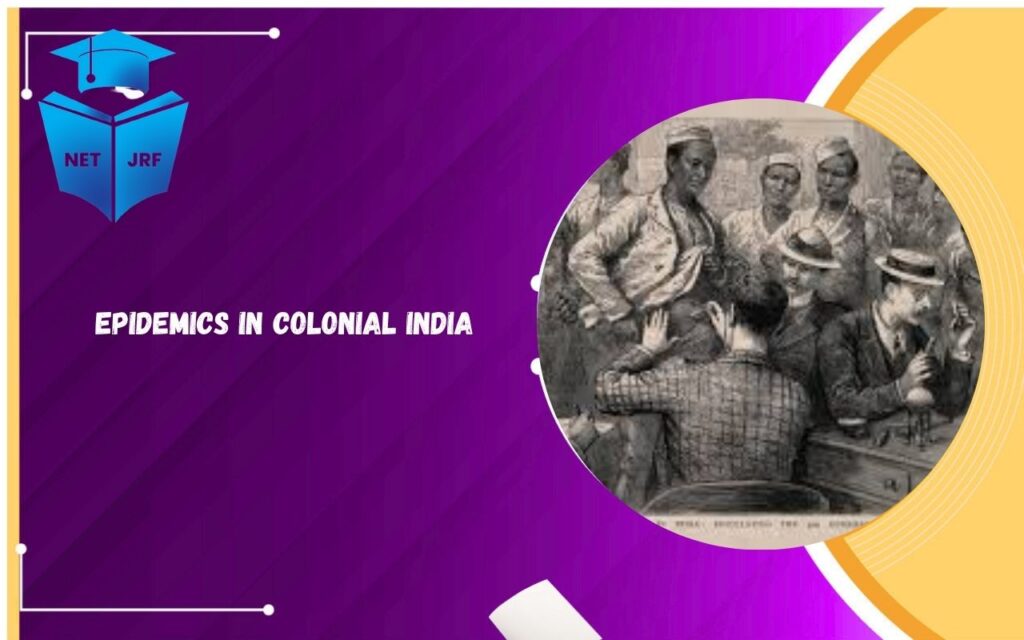
Epidemics in Colonial India: Check Causes, Cholera, Plague, Malaria and Public Health Policies

Epidemics in Colonial India in this topic you learn how cholera plague malaria influenza poor sanitation overcrowding famine conditions and colonial health policies shaped public health crises and demographic changes during British rule

pawan

Epidemics in Colonial India

Table of Contents

Epidemics played a major role in shaping social and demographic history during the colonial period in India. Disease outbreaks affected millions of people across villages and cities, often leading to high mortality and social disruption.

During the nineteenth and early twentieth centuries, India experienced several deadly disease outbreaks such as cholera, plague, malaria, and influenza. These diseases spread rapidly due to poor sanitation, overcrowded settlements, malnutrition, and weak medical infrastructure.

Study Planner

Meaning of Epidemics

Epidemics refer to sudden outbreaks of infectious diseases that spread rapidly among large populations within a particular region.

Such disease outbreaks often occur when sanitation systems are weak, medical knowledge is limited, or environmental conditions encourage the spread of infections.

Enroll UGC NET Mock Test Series

Key Characteristics

  • Rapid spread of disease in a community
  • High number of infected individuals
  • Increased mortality rate
  • Public health crisis
  • Social and economic disruption

These characteristics made epidemic diseases one of the most serious threats to public health in colonial India.

Epidemics in Colonial India

Epidemics became frequent during British rule due to changing social, economic, and environmental conditions.

Rapid urbanization created crowded cities where sanitation facilities were inadequate. Large numbers of migrants lived in small houses without clean water or proper drainage systems.

These unhealthy conditions allowed disease-causing bacteria and viruses to spread quickly among populations.

Colonial administrative policies often prioritized trade and military interests rather than improving health conditions for ordinary people.

Enroll UGC NET Foundation Course

Major Epidemic Diseases in Colonial India

Several infectious diseases spread widely during the colonial period.

  • Cholera

      • Cholera was one of the earliest and most widespread epidemic diseases in India. The disease spread through contaminated water and caused severe dehydration and death.
      • Cholera outbreaks frequently occurred in crowded towns and pilgrimage centres.
  • Plague

      • The bubonic plague outbreak began in Bombay in 1896 and quickly spread to other parts of India.
      • This disease killed millions of people during the late nineteenth and early twentieth centuries.
  • Malaria

      • Malaria remained one of the most persistent diseases in colonial India. Mosquitoes transmitted the infection in rural areas with stagnant water.
      • Millions of people suffered from fever, weakness, and death due to malaria.
  • Influenza Pandemic (1918)

    • The influenza outbreak of 1918 caused enormous loss of life across India.
    • Historians estimate that millions of people died within a short period due to the rapid spread of the virus.

Major Epidemics in Colonial India

Disease Time Period Impact
Cholera 19th century Widespread outbreaks
Bubonic Plague 1896 onwards Millions of deaths
Malaria Continuous Major rural health crisis
Influenza 1918 Massive mortality

Causes of Epidemics

Several factors contributed to the spread of Epidemics in colonial India.

1. Poor Sanitation

Most cities lacked proper drainage systems, waste disposal methods, and clean water supply.

Dirty streets and contaminated water sources created ideal conditions for disease transmission.

2. Overcrowded Urban Settlements

Industrialization and trade attracted migrants to cities.

Large numbers of people lived in small houses with little ventilation.

3. Poverty and Malnutrition

Poor nutrition weakened the immune system of many people.

Malnourished populations became more vulnerable to infectious diseases.

4. Weak Medical Infrastructure

Medical services remained limited in colonial India.

Hospitals, trained doctors, and medicines were insufficient for large populations.

5. Famine Conditions

Food shortages weakened populations and increased vulnerability to diseases.

In many cases, Epidemics followed major famine events.

App JRF Adda

Social Impact of Epidemics

The social effects of Epidemics were severe and long-lasting.

Large numbers of people died within short periods, causing demographic changes in many regions.

Families lost breadwinners and struggled to survive economically.

Migration increased as people moved away from infected areas.

Major Social Consequences

  • Population decline
  • Family disruption
  • Migration from affected areas
  • Fear and social panic

These conditions changed everyday life in both villages and cities.

Enroll UGC NET Offline Classes in Jaipur

Economic Impact of Epidemics

Disease outbreaks created serious economic challenges.

Agricultural production declined because farmers fell sick or died.

Urban industries also suffered because workers could not continue their jobs.

Economic Consequences

  • Reduction in labour supply
  • Decline in agricultural output
  • Disruption of trade activities
  • Increased poverty levels

Economic instability often followed major epidemic disasters.

Colonial Government Response

The colonial government eventually recognized the need to control Epidemics through public health measures.

Authorities introduced several administrative policies to monitor disease outbreaks.

Public Health Measures

  • Sanitation improvements
  • Establishment of hospitals
  • Vaccination programs
  • Medical research initiatives

These measures helped reduce the spread of certain diseases but remained limited in many rural areas.

Epidemic Diseases Act of 1897

One of the most important legal measures introduced by the British government was the Epidemic Diseases Act of 1897.

This law allowed authorities to take emergency steps during disease outbreaks.

Government officials could isolate infected individuals, inspect houses, and enforce quarantine measures.

However, many people resisted these actions because they feared government interference in personal life.

Join UGC NET Coaching in Jaipur

Stepwise Spread of Epidemic Diseases

The spread of Epidemics usually followed a predictable pattern.

  1. Emergence of disease in a specific region
  2. Transmission through water, air, or insects
  3. Rapid infection among crowded populations
  4. High mortality due to weak medical support
  5. Gradual decline after intervention or immunity

Understanding this process helps historians analyze the impact of disease outbreaks.

JRF Adda Book

Conclusion

Disease outbreaks significantly shaped the history of colonial India. Weak sanitation systems, poverty, overcrowded cities, and limited medical knowledge allowed infectious diseases to spread rapidly among populations.

Read UGC NET Notes
1 Archaeological Sources for UGC NET Epigraphy – Study of Inscriptions Meaning of Historical Sources Archaeological
2 Meaning of Historical Sources Archaeological Sources for UGC NET Literary Sources in History Archaeological
3 Exploration in Archaeology Excavation Techniques in Archaeology Dating of Archaeological Sites Archaeological
4 Excavation Techniques in Archaeology Exploration in Archaeology Dating of Archaeological Sites Archaeological
5 Epigraphy – Study of Inscriptions Inscriptions in Reconstructing History Numismatics in History Archaeological
6 Inscriptions in Reconstructing History Epigraphy – Study of Inscriptions Archaeological Sources for UGC NET Archaeological
7 Numismatics in History Importance of Coins in History Epigraphy – Study of Inscriptions Archaeological
8 Importance of Coins in History Numismatics in History Archaeological Sources for UGC NET Archaeological
9 Dating of Archaeological Sites Excavation Techniques in Archaeology Dating Ancient Literary Sources Archaeological
10 Indigenous Literature Literary Sources in History Secular Literature as Historical Source Literary
11 Dating Ancient Literary Sources Literary Sources in History Dating of Archaeological Sites Literary
12 Literary Sources in History Indigenous Literature Foreign Accounts of India Literary
13 Foreign Accounts of India Greek Accounts on Ancient India Chinese Accounts on India Literary
14 Greek Accounts on Ancient India Foreign Accounts of India Chinese Accounts on India Literary
15 Secular Literature as Historical Source Literary Sources in History Indigenous Literature Literary
16 Role of Myths and Legends in Historical Reconstruction Literary Sources in History Secular Literature as Historical Source Literary
17 Chinese Accounts on India Foreign Accounts of India Greek Accounts on Ancient India Literary
18 Arabic Accounts on India Foreign Accounts of India Chinese Accounts on India Literary
19 Neolithic and Chalcolithic Phases Neolithic Revolution in India Chalcolithic Culture in India Neolithic
20 Hunting, Gathering & Food Production Neolithic Revolution in India Neolithic Settlements in India Neolithic
21 Neolithic Revolution in India Neolithic Settlements in India Tools and Technology in Neolithic Period Neolithic
22 Neolithic Settlements in India Distribution of Neolithic Cultures in India Neolithic Revolution in India Neolithic
23 Distribution of Neolithic Cultures in India Neolithic Settlements in India Tools and Technology in Neolithic Period Neolithic
24 Tools and Technology in Neolithic Period Neolithic Revolution in India Chalcolithic Culture in India Neolithic
25 Chalcolithic Culture in India Settlement Pattern & Economy in Chalcolithic Phase Trade & Exchange Networks in Chalcolithic Societies Neolithic
26 Settlement Pattern & Economy – Chalcolithic Phase Chalcolithic Culture in India Trade & Exchange Networks in Chalcolithic Societies Neolithic
27 Trade & Exchange Networks – Chalcolithic Societies Chalcolithic Culture in India IVC Internal & External Trade Neolithic
28 Indus Valley Civilization – UGC NET Major Sites of Indus Civilization Urban Planning in Harappan Civilization IVC
29 IVC Internal & External Trade Internal Trade – Harappan Civilization Craft Specialization in Harappan Civilization IVC
30 Political Organization – Harappan Civilization Social Structure – Indus Civilization Urban Planning in Harappan Civilization IVC
31 Major Sites of Indus Civilization Indus Valley Civilization – UGC NET Urban Planning in Harappan Civilization IVC
32 Urban Planning & Settlement – Harappan Civilization Architecture & Town Planning – Harappan Cities IVC as First Urbanization in India IVC
33 Architecture & Town Planning – Harappan Cities Urban Planning in Harappan Civilization Major Sites of Indus Civilization IVC
34 Craft Specialization & Industrial Activities – Harappan Agriculture & Food Economy – Harappans IVC Internal & External Trade IVC
35 Agriculture & Food Economy – Harappans Craft Specialization in Harappan Civilization Internal Trade – Harappan Civilization IVC
36 Internal Trade – Harappan Civilization IVC Internal & External Trade Craft Specialization in Harappan Civilization IVC
37 Religion & Beliefs – Indus Civilization Social Structure – Indus Civilization Indus Valley Civilization – UGC NET IVC
38 Social Structure – Indus Civilization Political Organization – Harappan Civilization Religion & Beliefs – Indus Civilization IVC
39 Decline of Indus Civilization Indus Valley Civilization – UGC NET IVC as First Urbanization in India IVC
40 IVC as First Urbanization in India Urban Planning in Harappan Civilization Second Urbanization in India IVC
41 Vedic & Later Vedic Periods – Aryan Varna System Early Vedic Society and Economy Later Vedic Society and Economy Vedic
42 Origin of Vedic Civilization Aryan Debate – Migration, Invasion & Indigenous Theories Early Vedic Society and Economy Vedic
43 Aryan Debate – Migration, Invasion & Indigenous Theories Origin of Vedic Civilization Early Vedic Society and Economy Vedic
44 Early Vedic Society and Economy Political Institutions – Early Vedic Period Social Structure – Early Vedic Period Vedic
45 Political Institutions – Early Vedic Period Early Vedic Society and Economy Monarchical States in Ancient India Vedic
46 Social Structure – Early Vedic Period Emergence of Varnas & Social Stratification Early Vedic Society and Economy Vedic
47 Later Vedic Society and Economy Emergence of Varnas & Social Stratification Impact of Iron Technology in India Vedic
48 Emergence of Varnas & Social Stratification Social Structure – Early Vedic Period Later Vedic Society and Economy Vedic
49 Emergence of Heterodox Sects in India Jainism, Buddhism & Ajivikas – Origins & Teachings Later Vedic Society and Economy Vedic
50 Impact of Iron Technology in India Later Vedic Society and Economy Agricultural Expansion & Economic Changes – Ancient India Vedic
51 Religious & Philosophical Vedic Ideas Emergence of Varnas & Social Stratification Emergence of Heterodox Sects in India Vedic
52 Megalithic Culture of South India Neolithic and Chalcolithic Phases Agricultural Expansion & Economic Changes General
53 State System in Ancient India Rise of Mahajanapadas Transition: Tribal Polities to Territorial States General
54 Transition: Tribal Polities to Territorial States Rise of Mahajanapadas Later Vedic Society and Economy General
55 Rise of Mahajanapadas Monarchical States in Ancient India Republican States (Gana-Sanghas) – Ancient India Magadha
56 Monarchical States in Ancient India Rise of Mahajanapadas Emergence of Magadha Magadha
57 Republican States (Gana-Sanghas) – Ancient India Rise of Mahajanapadas Monarchical States in Ancient India Magadha
58 Agricultural Expansion & Economic Changes – Ancient India Second Urbanization in India Impact of Iron Technology in India General
59 Second Urbanization in India IVC as First Urbanization in India Rise of Mahajanapadas General
60 Jainism, Buddhism & Ajivikas – Origins & Teachings Emergence of Heterodox Sects in India Ashoka’s Policy of Dhamma General
61 Emergence of Magadha Geographical Advantages of Magadha Early Rulers of Magadha Magadha
62 Geographical Advantages of Magadha Natural Resources & Economic Strength of Magadha Reasons for Success of Magadha Magadha
63 Natural Resources & Economic Strength of Magadha Geographical Advantages of Magadha Economic Policies of the Nandas Magadha
64 Early Rulers of Magadha Haryanka Dynasty – Rise of Magadha Emergence of Magadha Magadha
65 Haryanka Dynasty – Rise of Magadha Expansion Policy of Bimbisara Early Rulers of Magadha Magadha
66 Expansion Policy of Bimbisara Ajatashatru – Military Reforms Haryanka Dynasty – Rise of Magadha Magadha
67 Ajatashatru – Military Reforms Wars of Ajatashatru Expansion Policy of Bimbisara Magadha
68 Wars of Ajatashatru Ajatashatru – Military Reforms Udayin & Establishment of Pataliputra Magadha
69 Udayin & Establishment of Pataliputra Wars of Ajatashatru Shishunaga Dynasty Magadha
70 Shishunaga Dynasty Administrative Structure of the Shishunagas Nanda Dynasty Magadha
71 Administrative Structure of the Shishunagas Shishunaga Dynasty Central Administration Under Mauryas Magadha
72 Nanda Dynasty Mahapadma Nanda – Imperial Expansion Shishunaga Dynasty Magadha
73 Mahapadma Nanda – Imperial Expansion Military Strength of the Nandas Nanda Dynasty Magadha
74 Economic Policies of the Nandas Nanda Dynasty Taxation System – Mauryan State Magadha
75 Military Strength of the Nandas Mahapadma Nanda – Imperial Expansion Defeat of Nandas & Rise of Mauryan Empire Magadha
76 Reasons for Success of Magadha Geographical Advantages of Magadha Natural Resources & Economic Strength of Magadha Magadha
77 Mahajanapadas to Empire – Evolution & Rise of Magadha Rise of Mahajanapadas Emergence of Magadha Magadha
78 Mauryan Empire – Expansion Rise of Chandragupta Maurya Expansion of Mauryan Empire Maurya
79 Rise of Chandragupta Maurya Role of Chanakya in Rise of Mauryan Empire Defeat of Nandas & Rise of Mauryan Empire Maurya
80 Role of Chanakya in Rise of Mauryan Empire Rise of Chandragupta Maurya Defeat of Nandas & Rise of Mauryan Empire Maurya
81 Defeat of Nandas & Rise of Mauryan Empire Military Strength of the Nandas Rise of Chandragupta Maurya Maurya
82 Chandragupta Maurya – Seleucus Treaty & Diplomacy Expansion of Mauryan Empire Greek Accounts on Ancient India Maurya
83 Expansion of Mauryan Empire Chandragupta Maurya – Seleucus Treaty & Diplomacy Kalinga War Maurya
84 Administration of Chandragupta Maurya Central Administration Under Mauryas Mauryan Bureaucracy Maurya
85 Sources for Mauryan History Archaeological Sources for UGC NET Greek Accounts on Ancient India Maurya
86 Central Administration Under Mauryas Provincial Administration – Mauryan Empire Mauryan Bureaucracy Maurya
87 Provincial Administration – Mauryan Empire Local Administration – Mauryan Empire Central Administration Under Mauryas Maurya
88 Local Administration – Mauryan Empire Provincial Administration – Mauryan Empire Mauryan Bureaucracy Maurya
89 Mauryan Bureaucracy Central Administration Under Mauryas Espionage System – Mauryan Empire Maurya
90 Espionage System – Mauryan Empire Mauryan Bureaucracy Central Administration Under Mauryas Maurya
91 Ancient India – Trade and Commerce Trade and Commerce Under Mauryas Agrarian Economy – Mauryan Period Maurya
92 Agrarian Economy – Mauryan Period Taxation System – Mauryan State Trade and Commerce Under Mauryas Maurya
93 Trade and Commerce Under Mauryas Ancient India – Trade and Commerce Agrarian Economy – Mauryan Period Maurya
94 Taxation System – Mauryan State Agrarian Economy – Mauryan Period Economic Policies of the Nandas Maurya
95 Kalinga War Ashoka’s Policy of Dhamma Expansion of Mauryan Empire Maurya
96 Ashoka’s Policy of Dhamma Nature & Philosophy of Dhamma Kalinga War Maurya
97 Nature & Philosophy of Dhamma Ashoka’s Policy of Dhamma Jainism, Buddhism & Ajivikas Maurya

Epidemics : Colonial India UGC NET  FAQs

Loader image

Epidemics occurred frequently due to poor sanitation, overcrowded cities, poverty, and limited medical infrastructure.

Cholera, bubonic plague, malaria, and the influenza pandemic of 1918 were among the most significant diseases.

It was a law that allowed the colonial government to take emergency measures such as quarantine and inspection to control disease outbreaks.

They caused large population loss, migration, family disruption, and widespread fear among communities.

Poor sanitation and contaminated water sources allowed infectious diseases to spread quickly in crowded settlements.

Epidemics describe widespread disease outbreaks that affected millions of people due to poor public health conditions during British rule.


Leave a Reply

Recent Posts
Aditi

Aditi Sharma, founder of JRFAdda, is a Computer Science educator with an MCA degree and JRF qualification (99.91 percentile, Dec 2019). Her experience includes roles as an SBI SO (DBA), work at Cognizant, and over 5 years of teaching online and offline. She has also served as a Government Computer Teacher in Rajasthan.