
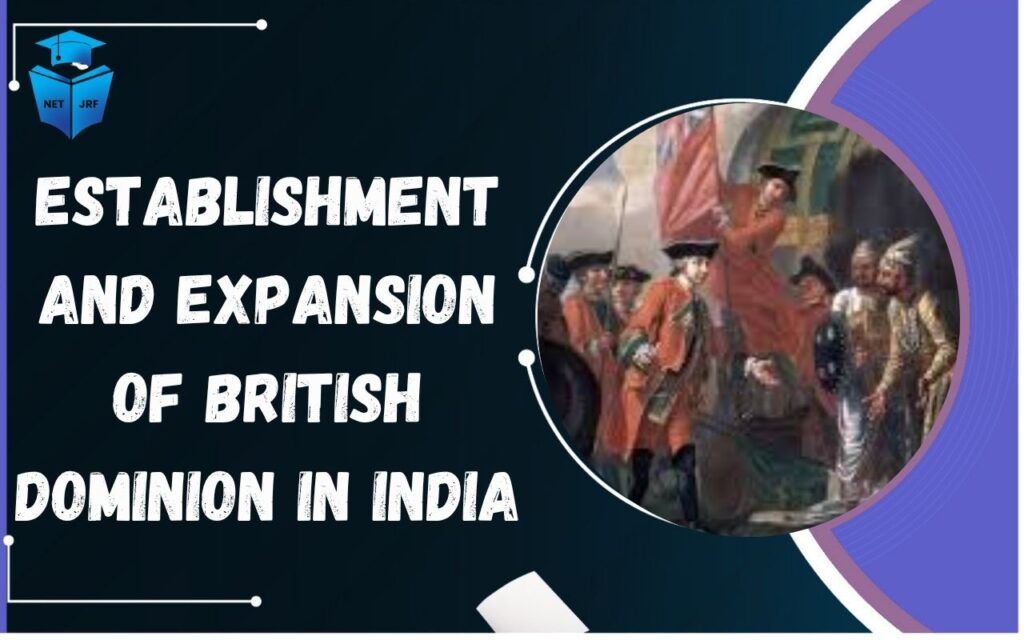

Establishment and Expansion of British Dominion in India History and Major Policies

Establishment and Expansion of British Dominion in India in this topic you learn how British rule expanded through battles alliances annexation policies administrative reforms economic changes and the Revolt of 1857 across the Indian subcontinent

vishal

Establishment and Expansion of British Dominion in India

Table of Contents

Establishment and Expansion of British Dominion in India. marks one of the most important developments in Modern Indian history. During the eighteenth century, political instability created opportunities for European trading companies to increase their influence. Gradually, the British East India Company transformed from a commercial enterprise into a political authority. The decline of the Mughal Empire after the death of Aurangzeb in 1707 weakened central authority. Regional kingdoms emerged across the subcontinent. European powers used this situation to strengthen their positions.

Study Planner

Background Establishment and Expansion of British Dominion in India.

The eighteenth century witnessed political fragmentation in India. Several regional states gained independence from Mughal control.

Best UGC NET Online Coaching

Important regional powers included:

  • Maratha Empire
  • Kingdom of Mysore
  • Hyderabad State
  • Kingdom of Awadh

European trading companies competed for commercial dominance during this period. Among them, the British eventually established the strongest position.

Arrival of European Trading Companies

Several European powers entered India for trade during the sixteenth century.

Important companies included:

  • Portuguese traders in Goa
  • Dutch East India Company
  • French East India Company
  • British East India Company

Initially these companies focused on commerce such as textiles, spices, silk. Later, they began to participate in regional politics.

Early Phase of British Political Power

The transformation from traders to rulers occurred through military victories.

Battle of Plassey (1757)

The Battle of Plassey marked the first major step in the Establishment and Expansion of British Dominion in India. During this conflict, Robert Clive defeated the Nawab of Bengal Siraj ud-Daulah.

Key consequences included:

  • British control over Bengal administration
  • Economic access to Bengal resources
  • Political influence in eastern India

Bengal’s wealth helped the company expand its military strength.

Best UGC NET Online Test Series

Battle of Buxar (1764)

Another significant event was the Battle of Buxar. British forces defeated the combined armies of:

  • Mir Qasim
  • Shuja-ud-Daula
  • Shah Alam II

This victory strengthened the Establishment and Expansion of the British Dominion in India. by granting the company control over revenue collection in Bengal.

App JRF Adda

Major Battles in British Expansion

Year Event Historical Significance
1757 Battle of Plassey Beginning of British political power
1764 Battle of Buxar Control over Bengal revenue
1799 Fourth Anglo Mysore War Defeat of Mysore ruler
1818 Third Anglo Maratha War End of Maratha power

These battles formed milestones in the Establishment and Expansion of the British Dominion in India.

Administrative Consolidation

After gaining territories, the company introduced administrative systems to strengthen control.

Revenue Administration

British authorities implemented land revenue systems such as:

  • Permanent Settlement
  • Ryotwari System
  • Mahalwari System

These policies aimed to maximize revenue collection.

Judicial Reforms

British administrators also created modern legal institutions. Courts replaced traditional justice systems. Codified laws regulated civil, criminal procedures.

Such reforms supported the Establishment and Expansion of the British Dominion in India. by centralizing authority.

Annexation Policies

The British expanded territory through strategic political policies.

Subsidiary Alliance

Governor-General Lord Wellesley introduced the Subsidiary Alliance system.

Main features included:

  1. Indian rulers accepted British troops
  2. Rulers paid subsidy for military support
  3. Foreign policy remained under British control

States such as Hyderabad State accepted this system.

Join UGC NET Offline Classes in Jaipur

Doctrine of Lapse

Another policy was the Doctrine of Lapse introduced by Lord Dalhousie.

According to this rule:

  • If a ruler died without a natural heir
  • The kingdom would become British territory

Important annexations included:

  • Jhansi
  • Satara
  • Nagpur

This policy accelerated the Establishment and Expansion of British Dominion in India.


Subsidiary Alliance vs Doctrine of Lapse

Feature Subsidiary Alliance Doctrine of Lapse
Introduced by Lord Wellesley Lord Dalhousie
Method Military protection treaty Direct annexation
Impact Political dependency Territorial expansion
Example Hyderabad Jhansi

These policies played a crucial role in the Establishment and Expansion of British Dominion in India.

Economic Impact of British Expansion

British expansion brought major economic changes in India. One important effect was the decline of traditional industries. India had once been famous for handmade textiles like muslin and silk. However, after the Industrial Revolution, machine-made goods from Britain entered Indian markets at cheaper prices. This caused many local artisans to lose their work.

  • Another change was the growth of plantation agriculture. The British encouraged the cultivation of cash crops such as tea, indigo, and coffee for export. Tea plantations developed in regions like Assam, while indigo cultivation expanded in eastern India. These crops were mainly produced to meet the needs of foreign markets.
  • British rule also promoted an export-based economy. India exported raw materials such as cotton and jute to Britain, while finished goods were imported back into Indian markets. Major ports like Calcutta and Bombay became important centers of colonial trade.
  • At the same time, heavy taxation increased pressure on farmers. Land revenue systems such as the Permanent Settlement collected large amounts of tax from agricultural land. These economic policies helped strengthen colonial finances and supported the Establishment and Expansion of the British Dominion in India.

Administrative Developments During British Rule

Policy Year Impact
Permanent Settlement 1793 Land revenue reform
Charter Act 1813 Trade regulation
Government of India Act 1858 Crown rule established

Administrative reforms formed institutional foundations of the Establishment and Expansion of the British Dominion in India.

Revolt of 1857

The Indian Rebellion of 1857 was the first large-scale uprising against British colonial rule in India. It began as a revolt of Indian soldiers (sepoys) in the army of the British East India Company and soon spread to many regions of northern and central India.

  • Several prominent leaders took part in the uprising. Rani Lakshmibai became a symbol of courage while defending Jhansi against British forces. 
  • Bahadur Shah Zafar was declared the symbolic leader of the revolt in Delhi. Tantia Tope organized military resistance in central India and continued the struggle even after many rebel forces were defeated.
  • Although the revolt ultimately failed, it had major consequences. 
  • The British government ended the rule of the East India Company and brought India under direct control of the British Crown in 1858. 
  • The uprising temporarily interrupted the Establishment and Expansion of British Dominion in India, and it forced the British administration to adopt new policies in governance and military organization


Aspect Description
Event Indian Rebellion of 1857 was the first large-scale uprising against British colonial rule in India.
Beginning of Revolt The revolt started among Indian soldiers (sepoys) serving in the army of the British East India Company and quickly spread across northern and central India.
Major Leaders Important leaders included Rani Lakshmibai, Bahadur Shah Zafar, and Tantia Tope.
Role of Rani Lakshmibai She led the resistance in Jhansi and became a symbol of bravery while fighting against British forces.
Role of Bahadur Shah Zafar The Mughal emperor was declared the symbolic leader of the rebellion in Delhi.
Role of Tantia Tope He organized military resistance in central India and continued fighting even after many rebel forces were defeated.
Outcome of the Revolt The rebellion failed to overthrow British rule due to lack of unity, limited resources, and strong British military power.
Major Consequence After the revolt, the British government ended the rule of the East India Company and brought India under direct control of the British Crown in 1858.
Historical Impact The uprising temporarily interrupted the Establishment and Expansion of British Dominion in India and forced the British to change their administrative and military policies.


Transition from Company Rule to Crown Rule

After the revolt, the British Parliament passed the Government of India Act 1858.

Major changes included:

  • End of East India Company rule
  • Direct control by British Crown
  • Creation of Secretary of State for India

These reforms marked a new stage in the Establishment and Expansion of British Dominion in India.

Best UGC NET Offline Classes in Jaipur

Role of Infrastructure Development

Colonial authorities introduced several infrastructure projects to strengthen administration and economic control. Important developments included railways, telegraph systems, modern ports, canal irrigation networks. These projects improved communication, transport, governance across the subcontinent.

The introduction of the Indian Railways began in 1853, connecting major cities, trade centers. Railways allowed faster movement of goods, troops, and officials, which helped the colonial government maintain political control.

The Electric Telegraph also played a key role. Telegraph lines enabled quick communication between distant administrative centers, especially during emergencies or rebellions.

Similarly, development of modern ports in cities like Bombay, Calcutta, Madras improved maritime trade with global markets. Canal irrigation systems increased agricultural production in some regions.

Overall, these infrastructure projects improved administrative efficiency while also strengthening the Establishment and Expansion of the British Dominion in India by making governance, trade, military movement more efficient.

JRF Adda Book

Conclusion

The Establishment and Expansion of the British Dominion in India. resulted from a combination of military victories, diplomatic strategies, administrative reforms. Starting with the Battle of Plassey, the British gradually extended control across the subcontinent. Policies such as Subsidiary Alliance, Doctrine of Lapse accelerated territorial expansion. Economic changes, infrastructure development strengthened colonial authority. 

Read UGC NET Notes
1 Archaeological Sources for UGC NET Epigraphy – Study of Inscriptions Meaning of Historical Sources Archaeological
2 Meaning of Historical Sources Archaeological Sources for UGC NET Literary Sources in History Archaeological
3 Exploration in Archaeology Excavation Techniques in Archaeology Dating of Archaeological Sites Archaeological
4 Excavation Techniques in Archaeology Exploration in Archaeology Dating of Archaeological Sites Archaeological
5 Epigraphy – Study of Inscriptions Inscriptions in Reconstructing History Numismatics in History Archaeological
6 Inscriptions in Reconstructing History Epigraphy – Study of Inscriptions Archaeological Sources for UGC NET Archaeological
7 Numismatics in History Importance of Coins in History Epigraphy – Study of Inscriptions Archaeological
8 Importance of Coins in History Numismatics in History Archaeological Sources for UGC NET Archaeological
9 Dating of Archaeological Sites Excavation Techniques in Archaeology Dating Ancient Literary Sources Archaeological
10 Indigenous Literature Literary Sources in History Secular Literature as Historical Source Literary
11 Dating Ancient Literary Sources Literary Sources in History Dating of Archaeological Sites Literary
12 Literary Sources in History Indigenous Literature Foreign Accounts of India Literary
13 Foreign Accounts of India Greek Accounts on Ancient India Chinese Accounts on India Literary
14 Greek Accounts on Ancient India Foreign Accounts of India Chinese Accounts on India Literary
15 Secular Literature as Historical Source Literary Sources in History Indigenous Literature Literary
16 Role of Myths and Legends in Historical Reconstruction Literary Sources in History Secular Literature as Historical Source Literary
17 Chinese Accounts on India Foreign Accounts of India Greek Accounts on Ancient India Literary
18 Arabic Accounts on India Foreign Accounts of India Chinese Accounts on India Literary
19 Neolithic and Chalcolithic Phases Neolithic Revolution in India Chalcolithic Culture in India Neolithic
20 Hunting, Gathering & Food Production Neolithic Revolution in India Neolithic Settlements in India Neolithic
21 Neolithic Revolution in India Neolithic Settlements in India Tools and Technology in Neolithic Period Neolithic
22 Neolithic Settlements in India Distribution of Neolithic Cultures in India Neolithic Revolution in India Neolithic
23 Distribution of Neolithic Cultures in India Neolithic Settlements in India Tools and Technology in Neolithic Period Neolithic
24 Tools and Technology in Neolithic Period Neolithic Revolution in India Chalcolithic Culture in India Neolithic
25 Chalcolithic Culture in India Settlement Pattern & Economy in Chalcolithic Phase Trade & Exchange Networks in Chalcolithic Societies Neolithic
26 Settlement Pattern & Economy – Chalcolithic Phase Chalcolithic Culture in India Trade & Exchange Networks in Chalcolithic Societies Neolithic
27 Trade & Exchange Networks – Chalcolithic Societies Chalcolithic Culture in India IVC Internal & External Trade Neolithic
28 Indus Valley Civilization – UGC NET Major Sites of Indus Civilization Urban Planning in Harappan Civilization IVC
29 IVC Internal & External Trade Internal Trade – Harappan Civilization Craft Specialization in Harappan Civilization IVC
30 Political Organization – Harappan Civilization Social Structure – Indus Civilization Urban Planning in Harappan Civilization IVC
31 Major Sites of Indus Civilization Indus Valley Civilization – UGC NET Urban Planning in Harappan Civilization IVC
32 Urban Planning & Settlement – Harappan Civilization Architecture & Town Planning – Harappan Cities IVC as First Urbanization in India IVC
33 Architecture & Town Planning – Harappan Cities Urban Planning in Harappan Civilization Major Sites of Indus Civilization IVC
34 Craft Specialization & Industrial Activities – Harappan Agriculture & Food Economy – Harappans IVC Internal & External Trade IVC
35 Agriculture & Food Economy – Harappans Craft Specialization in Harappan Civilization Internal Trade – Harappan Civilization IVC
36 Internal Trade – Harappan Civilization IVC Internal & External Trade Craft Specialization in Harappan Civilization IVC
37 Religion & Beliefs – Indus Civilization Social Structure – Indus Civilization Indus Valley Civilization – UGC NET IVC
38 Social Structure – Indus Civilization Political Organization – Harappan Civilization Religion & Beliefs – Indus Civilization IVC
39 Decline of Indus Civilization Indus Valley Civilization – UGC NET IVC as First Urbanization in India IVC
40 IVC as First Urbanization in India Urban Planning in Harappan Civilization Second Urbanization in India IVC
41 Vedic & Later Vedic Periods – Aryan Varna System Early Vedic Society and Economy Later Vedic Society and Economy Vedic
42 Origin of Vedic Civilization Aryan Debate – Migration, Invasion & Indigenous Theories Early Vedic Society and Economy Vedic
43 Aryan Debate – Migration, Invasion & Indigenous Theories Origin of Vedic Civilization Early Vedic Society and Economy Vedic
44 Early Vedic Society and Economy Political Institutions – Early Vedic Period Social Structure – Early Vedic Period Vedic
45 Political Institutions – Early Vedic Period Early Vedic Society and Economy Monarchical States in Ancient India Vedic
46 Social Structure – Early Vedic Period Emergence of Varnas & Social Stratification Early Vedic Society and Economy Vedic
47 Later Vedic Society and Economy Emergence of Varnas & Social Stratification Impact of Iron Technology in India Vedic
48 Emergence of Varnas & Social Stratification Social Structure – Early Vedic Period Later Vedic Society and Economy Vedic
49 Emergence of Heterodox Sects in India Jainism, Buddhism & Ajivikas – Origins & Teachings Later Vedic Society and Economy Vedic
50 Impact of Iron Technology in India Later Vedic Society and Economy Agricultural Expansion & Economic Changes – Ancient India Vedic
51 Religious & Philosophical Vedic Ideas Emergence of Varnas & Social Stratification Emergence of Heterodox Sects in India Vedic
52 Megalithic Culture of South India Neolithic and Chalcolithic Phases Agricultural Expansion & Economic Changes General
53 State System in Ancient India Rise of Mahajanapadas Transition: Tribal Polities to Territorial States General
54 Transition: Tribal Polities to Territorial States Rise of Mahajanapadas Later Vedic Society and Economy General
55 Rise of Mahajanapadas Monarchical States in Ancient India Republican States (Gana-Sanghas) – Ancient India Magadha
56 Monarchical States in Ancient India Rise of Mahajanapadas Emergence of Magadha Magadha
57 Republican States (Gana-Sanghas) – Ancient India Rise of Mahajanapadas Monarchical States in Ancient India Magadha
58 Agricultural Expansion & Economic Changes – Ancient India Second Urbanization in India Impact of Iron Technology in India General
59 Second Urbanization in India IVC as First Urbanization in India Rise of Mahajanapadas General
60 Jainism, Buddhism & Ajivikas – Origins & Teachings Emergence of Heterodox Sects in India Ashoka’s Policy of Dhamma General
61 Emergence of Magadha Geographical Advantages of Magadha Early Rulers of Magadha Magadha
62 Geographical Advantages of Magadha Natural Resources & Economic Strength of Magadha Reasons for Success of Magadha Magadha
63 Natural Resources & Economic Strength of Magadha Geographical Advantages of Magadha Economic Policies of the Nandas Magadha
64 Early Rulers of Magadha Haryanka Dynasty – Rise of Magadha Emergence of Magadha Magadha
65 Haryanka Dynasty – Rise of Magadha Expansion Policy of Bimbisara Early Rulers of Magadha Magadha
66 Expansion Policy of Bimbisara Ajatashatru – Military Reforms Haryanka Dynasty – Rise of Magadha Magadha
67 Ajatashatru – Military Reforms Wars of Ajatashatru Expansion Policy of Bimbisara Magadha
68 Wars of Ajatashatru Ajatashatru – Military Reforms Udayin & Establishment of Pataliputra Magadha
69 Udayin & Establishment of Pataliputra Wars of Ajatashatru Shishunaga Dynasty Magadha
70 Shishunaga Dynasty Administrative Structure of the Shishunagas Nanda Dynasty Magadha
71 Administrative Structure of the Shishunagas Shishunaga Dynasty Central Administration Under Mauryas Magadha
72 Nanda Dynasty Mahapadma Nanda – Imperial Expansion Shishunaga Dynasty Magadha
73 Mahapadma Nanda – Imperial Expansion Military Strength of the Nandas Nanda Dynasty Magadha
74 Economic Policies of the Nandas Nanda Dynasty Taxation System – Mauryan State Magadha
75 Military Strength of the Nandas Mahapadma Nanda – Imperial Expansion Defeat of Nandas & Rise of Mauryan Empire Magadha
76 Reasons for Success of Magadha Geographical Advantages of Magadha Natural Resources & Economic Strength of Magadha Magadha
77 Mahajanapadas to Empire – Evolution & Rise of Magadha Rise of Mahajanapadas Emergence of Magadha Magadha
78 Mauryan Empire – Expansion Rise of Chandragupta Maurya Expansion of Mauryan Empire Maurya
79 Rise of Chandragupta Maurya Role of Chanakya in Rise of Mauryan Empire Defeat of Nandas & Rise of Mauryan Empire Maurya
80 Role of Chanakya in Rise of Mauryan Empire Rise of Chandragupta Maurya Defeat of Nandas & Rise of Mauryan Empire Maurya
81 Defeat of Nandas & Rise of Mauryan Empire Military Strength of the Nandas Rise of Chandragupta Maurya Maurya
82 Chandragupta Maurya – Seleucus Treaty & Diplomacy Expansion of Mauryan Empire Greek Accounts on Ancient India Maurya
83 Expansion of Mauryan Empire Chandragupta Maurya – Seleucus Treaty & Diplomacy Kalinga War Maurya
84 Administration of Chandragupta Maurya Central Administration Under Mauryas Mauryan Bureaucracy Maurya
85 Sources for Mauryan History Archaeological Sources for UGC NET Greek Accounts on Ancient India Maurya
86 Central Administration Under Mauryas Provincial Administration – Mauryan Empire Mauryan Bureaucracy Maurya
87 Provincial Administration – Mauryan Empire Local Administration – Mauryan Empire Central Administration Under Mauryas Maurya
88 Local Administration – Mauryan Empire Provincial Administration – Mauryan Empire Mauryan Bureaucracy Maurya
89 Mauryan Bureaucracy Central Administration Under Mauryas Espionage System – Mauryan Empire Maurya
90 Espionage System – Mauryan Empire Mauryan Bureaucracy Central Administration Under Mauryas Maurya
91 Ancient India – Trade and Commerce Trade and Commerce Under Mauryas Agrarian Economy – Mauryan Period Maurya
92 Agrarian Economy – Mauryan Period Taxation System – Mauryan State Trade and Commerce Under Mauryas Maurya
93 Trade and Commerce Under Mauryas Ancient India – Trade and Commerce Agrarian Economy – Mauryan Period Maurya
94 Taxation System – Mauryan State Agrarian Economy – Mauryan Period Economic Policies of the Nandas Maurya
95 Kalinga War Ashoka’s Policy of Dhamma Expansion of Mauryan Empire Maurya
96 Ashoka’s Policy of Dhamma Nature & Philosophy of Dhamma Kalinga War Maurya
97 Nature & Philosophy of Dhamma Ashoka’s Policy of Dhamma Jainism, Buddhism & Ajivikas Maurya

Establishment and Expansion of British Dominion in India FAQs

Loader image

The Battle of Plassey in 1757 allowed the British East India Company to gain control over Bengal. This victory marked the beginning of British political power in India.

The Subsidiary Alliance required Indian rulers to accept British troops in their territories. In return they received protection but lost political independence.

Lord Dalhousie introduced the Doctrine of Lapse. According to this policy, territories without a natural heir became part of British territory.

The revolt occurred due to political annexations, economic exploitation, military grievances, cultural tensions between Indians and colonial authorities.

The British Parliament passed the Government of India Act 1858. This act transferred power from the East India Company to the British Crown.

Railways, telegraphs, roads improved communication and troop movement. These developments strengthened colonial administration.

Leave a Reply

Recent Posts
Aditi

Aditi Sharma, founder of JRFAdda, is a Computer Science educator with an MCA degree and JRF qualification (99.91 percentile, Dec 2019). Her experience includes roles as an SBI SO (DBA), work at Cognizant, and over 5 years of teaching online and offline. She has also served as a Government Computer Teacher in Rajasthan.

Check Our Recommended Course