
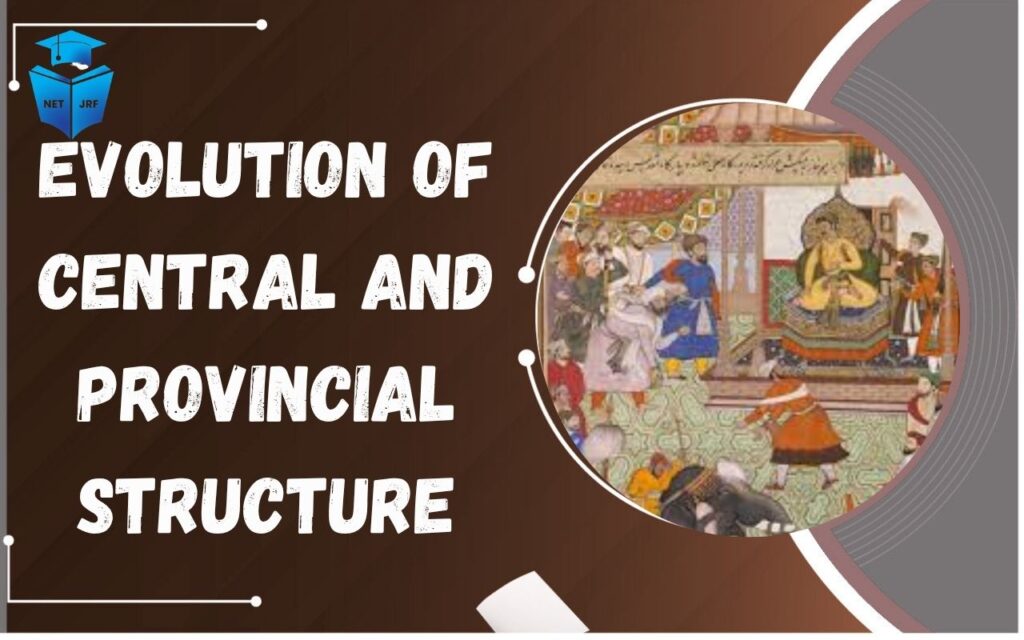
Evolution of Central and Provincial Structure started when the East India Company moved from trading to ruling. This process did not happen overnight. It took many decades of laws, battles, and reforms. The British needed a way to manage a large country like India. They wanted to collect taxes and keep order. This led to a system where power moved from local offices to a central head.

Understanding this history helps us see how modern India’s government began. The Company first acted as a merchant. Later, it became a powerful political force. This shift required a new way to organize offices in Bengal, Bombay, and Madras. Each new law from the British Parliament changed how these offices worked together.
Enroll UGC NET Online Coaching
Administration in British India Development
The Company took its first big step after the Battle of Buxar in 1765. It gained Diwani rights in Bengal, Bihar, and Odisha. These rights allowed the Company to collect land revenue.
- At first, the Company used a dual governance system. Mughal officials handled daily administration. Meanwhile, Company officials took the money.
- Many historians study the Evolution of Central and Provincial Structure to understand this messy start. The dual system caused many problems. Corruption grew, and the local people suffered. Warren Hastings eventually ended this system.
- He began to pull all power into a central office. He wanted the Company to rule directly instead of through local kings.
- The Evolution of Central and Provincial Structure began changing fast after 1770.
- The British Parliament realized the Company needed more control. They did not want the Company to fail because it was too important for trade. This concern led to the first major piece of legislation.
Regulating Act of 1773 and Central Authority
The British government closely watched the Evolution of Central and Provincial Structure in the 1770s. They passed the Regulating Act of 1773 to fix the mess in India.
- This Act was the first real attempt to organize the Company’s rule. It created the office of Governor-General of Bengal. This leader now had some power over the leaders in Bombay and Madras.
- The Regulating Act of 1773 marked a key point in the Evolution of Central and Provincial Structure. It showed that the British Parliament was the ultimate boss. The Act also created a Supreme Court in Calcutta. This court brought the British “rule of law” to India. It tried to stop Company officials from taking bribes.
- This Act changed the Evolution of Central and Provincial Structure by creating a Governor-General. Warren Hastings was the first person to hold this high post. He had a council of four members to help him.
- However, the system had flaws. The Governor-General and his council often fought. The court and the council also had many arguments.
Pitt’s India Act of 1784 and Dual Control
Pitt’s India Act of 1784 further shaped the Evolution of Central and Provincial Structure. It fixed the problems of the 1773 Act. The law introduced a system of dual control. This meant two groups managed India. The Court of Directors handled commercial trade. A new Board of Control represented the British Crown.
- It introduced dual control into the Evolution of Central and Provincial Structure. This move gave the British government direct supervision over Indian affairs. The Act also made the Governor-General stronger. He could now overrule his council in some cases. This centralization made the administration more efficient.
- The Act clearly separated the Company’s trade duties from its ruling duties. It marked a shift where governance became more important than selling spices or cloth. The British started seeing India as a “territorial possession.” This was a major change in how they viewed their presence in the East.

Charter Acts
Charter Acts from 1793 to 1853 influenced the Evolution of Central and Provincial Structure. The British Parliament renewed the Company’s “charter” or license every twenty years. Each renewal took away some of the Company’s private powers. The 1813 Act ended the Company’s monopoly on trade. This allowed other British merchants to enter India.
- The Charter Act of 1833 centralized the Evolution of Central and Provincial Structure significantly. It was a massive turning point for India’s legal and political map. The law turned the Governor-General of Bengal into the Governor-General of India. Lord William Bentinck became the first man with this title.
- It turned the Governor-General of Bengal into the head of the Evolution of Central and Provincial Structure. Now, the central government in Calcutta had total power over laws. Provinces like Madras and Bombay lost their right to make their own laws. All lawmaking happened at the center. This ensured that the same rules applied across all British lands.
The Legislative Council and 1853 Reforms
- The Charter Act of 1853 added a Legislative Council to the Evolution of Central and Provincial Structure. Before this, the same small group made and enforced laws. The 1853 Act started to separate these functions. It created a council specifically for making laws. This was the tiny seed that eventually grew into the Indian Parliament.
- This Act also changed how people got jobs in the government. It opened the Indian Civil Services to everyone through a competitive exam. Previously, the Company directors just picked their friends and family. The new system valued merit and hard work. However, the exams happened in London, which made it hard for Indians to join.
- The 1853 Act was the last Charter Act. It did not give the Company a fixed twenty-year term. Instead, it said the Crown could take over at any time. This showed that the Company’s time was running out. The British government was ready to rule India directly.
Understanding Provincial Units and Presidencies
Provincial units played a big role in the evolution of Central and Provincial Structure. India was too large to rule from one city. The British divided their land into three main Presidencies: Bengal, Bombay, and Madras. Each presidency had its own Governor and council at first.
- Presidency leaders followed the rules of the Evolution of Central and Provincial Structure. However, they also had their own armies and tax collectors. Over time, Bengal became the most powerful.
- The Governor of Bengal became the boss of the other two. This caused some tension between the different provincial offices.
- The provinces acted as experimental labs for new policies. For example, different land tax systems started in different provinces.
- The Ryotwari system began in Madras, while the Permanent Settlement started in Bengal. These local choices eventually shaped the national economy.
Bureaucracy and Civil Services
Administrative reforms improved the Evolution of Central and Provincial Structure under Cornwallis. Lord Cornwallis is often called the father of the modern Indian bureaucracy. He introduced the Cornwallis Code in 1793. This code separated the people who collected money from the people who acted as judges.
- Cornwallis wanted a clean and honest government. He gave higher salaries to officials so they would stop taking bribes.
- He also restricted high-level jobs to Europeans only. This created a “steel frame” of administration. It was very efficient but kept Indians out of power for a long time.
- The civil service became the backbone of the British Empire.
- These officers traveled to remote villages to collect taxes and keep peace.
- They represented the face of the British government to the common people.
- Their work helped the central government maintain control over a vast and diverse population.
Join UGC NET Offline Coaching in Jaipur
Judicial Evolution and Rule of Law
The British also changed the way courts worked. Before they arrived, local kings and religious leaders decided cases. The British introduced a formal court system. They created civil courts for money matters and criminal courts for crimes.
- The Evolution of Central and Provincial Structure included building a hierarchy of courts. District courts sat at the bottom.
- High Courts and the Supreme Court sat at the top. This system replaced local customs with written laws. It made the law predictable, even if it was often unfair to the poor.
- Codifying laws was a huge task. The British wrote down the rules for contracts, crimes, and property. This helped the central government manage the provinces better. Everyone knew the rules, and the central authority could enforce them across all regions.
Timeline of Major Acts
| Year | Act Name | Primary Impact on Governance |
| 1773 | Regulating Act | Created Governor-General of Bengal |
| 1784 | Pitt’s India Act | Introduced Board of Control (Dual Control) |
| 1833 | Charter Act | Created Governor-General of India |
| 1853 | Charter Act | Created Legislative Council for lawmaking |
Important Acts in the Evolution of Central and Provincial Structure
| Feature | Company Period (Before 1858) | Crown Period (After 1858) |
| Top Leader | Governor-General | Viceroy |
| Main Boss | Court of Directors | Secretary of State |
| Recruitment | Patronage / Competition | Strict Competitive Exams |
| Legislation | Executive Council | Expanded Legislative Council |
| Structure | Evolution of Central and Provincial Structure | Direct Colonial Rule |
Steps in Administrative Growth
he British administration in India did not develop overnight; it evolved gradually through a series of key reforms and organizational steps that strengthened governance across provinces and central authority
- Transition from Trade: The Company stops being just a shopkeeper and starts acting like a king.
- Revenue Control: Collecting land taxes becomes the main goal of the administration.
- Parliamentary Control: The British government passes laws to limit the Company’s greed.
- Centralisation: Power moves from provincial governors to the Governor-General in Calcutta.
- Legal Codification: Rules are written down to replace old customs and traditions.
- Bureaucratic Training: A professional class of officers is hired to run the country.

Conclusion
The Evolution of Central and Provincial Structure transformed India into a centralized state. It moved from the chaotic rule of a trading company to a disciplined bureaucratic system. While the Company sought profit, its administrative changes built the framework of modern governance. The central power in Calcutta eventually controlled every corner of the country. Scholars often debate the Evolution of Central and Provincial Structure impact on India. Some say it brought order, while others highlight the loss of local freedom. Finally, the Evolution of Central and Provincial Structure led to direct Crown rule in 1858. This history remains vital for understanding the roots of the Indian Republic today.
Top UGC NET Offline Coaching in Jaipur
Evolution of Central and Provincial Structure FAQs

2. Who was the first Governor-General of Bengal?
Warren Hastings became the first Governor-General of Bengal after the Regulating Act of 1773.
3. What did the Pitt's India Act of 1784 do?
It created a Board of Control to represent the British Crown. This gave the government a way to watch the Company's political moves.
4. When did the Governor-General of Bengal become the Governor-General of India?
This change happened under the Charter Act of 1833. Lord William Bentinck was the first to hold this unified title.
5. What were the three main Presidencies?
The three main administrative units were Bengal, Bombay, and Madras.
6. Why is Lord Cornwallis famous in Indian history?
He introduced the Cornwallis Code and created a structured, professional civil service system.
7. How did the Charter Act of 1853 change the Civil Services?
It introduced competitive exams for hiring, which meant jobs were based on merit rather than who you knew.
8. What was "Dual Governance" in Bengal?
It was a system where the Company collected money while local Mughal officials handled the actual work of ruling.
9. Why did the British Parliament pass the Regulating Act of 1773?
The Company was in a financial mess and corruption was high. Parliament wanted to bring order to the Company’s rule.
10. How did the Evolution of Central and Provincial Structure impact India?
Teachers explain the Evolution of Central and Provincial Structure in schools because it created the base for India’s current districts, courts, and civil service systems.