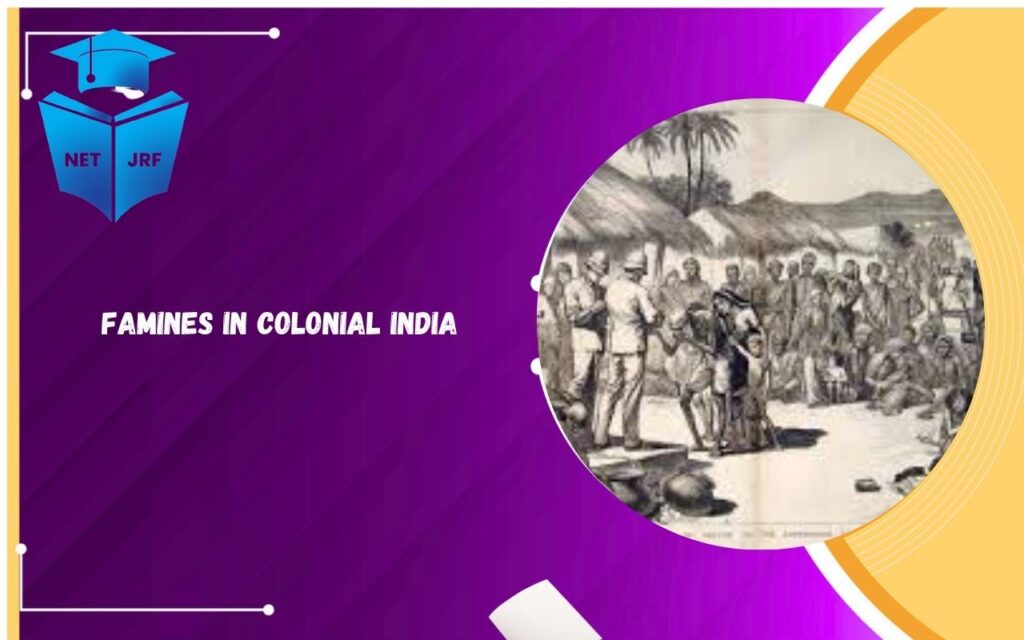
Famines in Colonial India: Check Causes, Revenue, Policies, Food Crisis and British Relief Measures

Famines in Colonial India in this topic you learn how drought colonial revenue policies grain exports cash crop farming and famine commissions shaped recurring food crises rural distress and social economic decline under British rule

pawan

Famines in Colonial India

Table of Contents

Famines in Colonial India represent one of the most painful chapters in the history of British rule. Large sections of the population suffered from starvation, disease, poverty, migration, social breakdown during repeated food shortages.

Between the eighteenth century to the early twentieth century, several major famine disasters occurred across the subcontinent. These crises affected millions of people in regions such as Bengal, Madras, Bombay, Rajputana, Central India.

Study Planner

Meaning and Concept of Famine

A famine refers to an extreme shortage of food that leads to widespread hunger, starvation, rising mortality. Such conditions usually occur when crop production declines severely or when people lose the ability to purchase food.

In colonial India, famine conditions often appeared when drought destroyed crops, agricultural production declined, transport failed to distribute food grains effectively.

Enroll UGC NET Online Coaching

Characteristics of Famine

Major features that appeared during famine crises included:

  • Severe shortage of food grains
  • Rapid rise in food prices
  • Large scale hunger among rural population
  • Spread of epidemics like cholera or smallpox
  • Migration from villages to towns

These features explain the humanitarian crisis that shaped Famines in Colonial India.

Famines in Colonial India Major Causes 

Famines in Colonial India occurred due to both natural disasters as well as colonial economic policies. While drought often triggered the crisis, government policies intensified the impact.

1. Failure of Monsoon

Indian agriculture depended heavily on monsoon rainfall. When rainfall failed, crops died quickly.

Farmers lost harvests, food grain production declined sharply, rural communities faced hunger.

2. Colonial Land Revenue System

British authorities imposed heavy land revenue taxes on peasants.

Even during drought or crop failure, farmers had to pay fixed taxes. Many peasants sold grain reserves or borrowed money to pay revenue.

3. Commercialization of Agriculture

Colonial authorities encouraged cultivation of cash crops such as:

  • Indigo
  • Cotton
  • Opium
  • Jute

This reduced cultivation of food crops, which increased food scarcity.

4. Export of Food Grains

During several famine periods, food grains continued to be exported to international markets.

Trade policies prioritized revenue generation rather than local food security.

5. Weak Transport and Distribution

Food grains sometimes existed in other regions. However poor infrastructure prevented effective transportation to famine affected areas.

Administrative delay worsened the crisis.

Enroll UGC NET Online Course

Major Famine Events During Colonial Period

Many large famine disasters occurred between the eighteenth to nineteenth centuries. These events illustrate the severity of Famines in Colonial India.

Great Bengal Famine (1770)

This famine occurred between 1769–1770 in Bengal. Nearly one third of the population in some regions died.

Crop failure combined with administrative failure intensified the crisis.

Guntur Famine (1832)

This famine affected parts of the Madras Presidency. Agricultural failure combined with taxation created food shortages.

Doab Famine (1860–61)

Regions between the Ganga River, Yamuna River suffered severe food shortages.

Thousands of people died due to starvation.

Rajputana Famine (1869)

Low rainfall caused drought across western India. Water shortage worsened agricultural collapse.

Great Famine (1876–78)

This was one of the most devastating famine disasters in colonial India.

Regions affected included:

  • Madras Presidency
  • Mysore
  • Bombay Presidency
  • Hyderabad

Millions of people died during this crisis.

Famine of 1899–1900

Western India faced severe drought conditions. Nearly sixty million people were affected.

App JRF Adda

Major Famines in Colonial India

Colonial India witnessed several major famines, including 

Year Region Impact
1770 Bengal Massive population loss
1832 Guntur Large mortality
1860–61 Doab Region Severe starvation
1869 Rajputana Drought crisis
1876–78 Southern India Millions died
1899–1900 Western India Widespread food shortage

Economic Consequences of Famine

Repeated famine crises deeply affected the rural economy. Agricultural productivity declined sharply when crops failed.

Livestock died due to lack of fodder. Many peasants lost land ownership.

Major economic consequences included:

  • Decline in agricultural output
  • Collapse of village economies
  • Sale of land by peasants
  • Growth of agricultural labour class
  • Increased rural poverty

These economic problems intensified the severity of Famines in Colonial India.

Enroll UGC NET Coaching in Jaipur

Social Impact of Famine

The social consequences were devastating. Famine disrupted family life, village communities, traditional social structures.

Large numbers of people migrated in search of food.

Social Effects

Important social consequences included:

  • Population decline due to mortality
  • Spread of epidemics
  • Migration from rural areas
  • Breakdown of family structures

Poor nutrition weakened immunity. Diseases spread rapidly among famine affected communities.

British Famine Policy

Repeated famine disasters forced the colonial government to study the causes carefully. British authorities introduced famine policies to manage food crises.

Famine Commissions

Several committees investigated famine problems.

  1. First Famine Commission (1878) – Led by Richard Strachey
  2. Second Famine Commission (1897) – Led by James Lyall
  3. Third Famine Commission (1900) – Led by Anthony McDonnell

These commissions studied administrative weaknesses that contributed to Famines in Colonial India.

Their reports recommended irrigation development, improved relief administration, food price monitoring.

Famine Codes

The British government introduced Famine Codes to guide relief operations.

These codes described administrative steps for managing famine situations.

Key Relief Measures

Important relief policies included:

  • Opening relief camps
  • Providing employment through public works
  • Distribution of food grains
  • Monitoring grain prices

Despite these measures, relief often reached late.

This limited the effectiveness of famine policies in reducing Famines in Colonial India.

Enroll UGC NET Offline Coaching in Jaipur

Stages in the Development of a Famine

A famine crisis usually developed in several stages.

  1. Failure of monsoon rains
  2. Crop destruction in agricultural regions
  3. Rapid rise in food prices
  4. Decline in purchasing power of peasants
  5. Starvation among rural communities
  6. Spread of epidemics

Understanding this process helps explain the structure of Famines in Colonial India.

JRF Adda Book

Conclusion

The history of Famines in Colonial India reveals how natural drought combined with colonial economic policies created severe food crises. Heavy taxation, commercialization of agriculture, grain export policies weakened rural food security.

Understanding famine history helps explain the economic distress faced by Indian peasants under British rule. 

Read UGC NET Notes
1 Archaeological Sources for UGC NET Epigraphy – Study of Inscriptions Meaning of Historical Sources Archaeological
2 Meaning of Historical Sources Archaeological Sources for UGC NET Literary Sources in History Archaeological
3 Exploration in Archaeology Excavation Techniques in Archaeology Dating of Archaeological Sites Archaeological
4 Excavation Techniques in Archaeology Exploration in Archaeology Dating of Archaeological Sites Archaeological
5 Epigraphy – Study of Inscriptions Inscriptions in Reconstructing History Numismatics in History Archaeological
6 Inscriptions in Reconstructing History Epigraphy – Study of Inscriptions Archaeological Sources for UGC NET Archaeological
7 Numismatics in History Importance of Coins in History Epigraphy – Study of Inscriptions Archaeological
8 Importance of Coins in History Numismatics in History Archaeological Sources for UGC NET Archaeological
9 Dating of Archaeological Sites Excavation Techniques in Archaeology Dating Ancient Literary Sources Archaeological
10 Indigenous Literature Literary Sources in History Secular Literature as Historical Source Literary
11 Dating Ancient Literary Sources Literary Sources in History Dating of Archaeological Sites Literary
12 Literary Sources in History Indigenous Literature Foreign Accounts of India Literary
13 Foreign Accounts of India Greek Accounts on Ancient India Chinese Accounts on India Literary
14 Greek Accounts on Ancient India Foreign Accounts of India Chinese Accounts on India Literary
15 Secular Literature as Historical Source Literary Sources in History Indigenous Literature Literary
16 Role of Myths and Legends in Historical Reconstruction Literary Sources in History Secular Literature as Historical Source Literary
17 Chinese Accounts on India Foreign Accounts of India Greek Accounts on Ancient India Literary
18 Arabic Accounts on India Foreign Accounts of India Chinese Accounts on India Literary
19 Neolithic and Chalcolithic Phases Neolithic Revolution in India Chalcolithic Culture in India Neolithic
20 Hunting, Gathering & Food Production Neolithic Revolution in India Neolithic Settlements in India Neolithic
21 Neolithic Revolution in India Neolithic Settlements in India Tools and Technology in Neolithic Period Neolithic
22 Neolithic Settlements in India Distribution of Neolithic Cultures in India Neolithic Revolution in India Neolithic
23 Distribution of Neolithic Cultures in India Neolithic Settlements in India Tools and Technology in Neolithic Period Neolithic
24 Tools and Technology in Neolithic Period Neolithic Revolution in India Chalcolithic Culture in India Neolithic
25 Chalcolithic Culture in India Settlement Pattern & Economy in Chalcolithic Phase Trade & Exchange Networks in Chalcolithic Societies Neolithic
26 Settlement Pattern & Economy – Chalcolithic Phase Chalcolithic Culture in India Trade & Exchange Networks in Chalcolithic Societies Neolithic
27 Trade & Exchange Networks – Chalcolithic Societies Chalcolithic Culture in India IVC Internal & External Trade Neolithic
28 Indus Valley Civilization – UGC NET Major Sites of Indus Civilization Urban Planning in Harappan Civilization IVC
29 IVC Internal & External Trade Internal Trade – Harappan Civilization Craft Specialization in Harappan Civilization IVC
30 Political Organization – Harappan Civilization Social Structure – Indus Civilization Urban Planning in Harappan Civilization IVC
31 Major Sites of Indus Civilization Indus Valley Civilization – UGC NET Urban Planning in Harappan Civilization IVC
32 Urban Planning & Settlement – Harappan Civilization Architecture & Town Planning – Harappan Cities IVC as First Urbanization in India IVC
33 Architecture & Town Planning – Harappan Cities Urban Planning in Harappan Civilization Major Sites of Indus Civilization IVC
34 Craft Specialization & Industrial Activities – Harappan Agriculture & Food Economy – Harappans IVC Internal & External Trade IVC
35 Agriculture & Food Economy – Harappans Craft Specialization in Harappan Civilization Internal Trade – Harappan Civilization IVC
36 Internal Trade – Harappan Civilization IVC Internal & External Trade Craft Specialization in Harappan Civilization IVC
37 Religion & Beliefs – Indus Civilization Social Structure – Indus Civilization Indus Valley Civilization – UGC NET IVC
38 Social Structure – Indus Civilization Political Organization – Harappan Civilization Religion & Beliefs – Indus Civilization IVC
39 Decline of Indus Civilization Indus Valley Civilization – UGC NET IVC as First Urbanization in India IVC
40 IVC as First Urbanization in India Urban Planning in Harappan Civilization Second Urbanization in India IVC
41 Vedic & Later Vedic Periods – Aryan Varna System Early Vedic Society and Economy Later Vedic Society and Economy Vedic
42 Origin of Vedic Civilization Aryan Debate – Migration, Invasion & Indigenous Theories Early Vedic Society and Economy Vedic
43 Aryan Debate – Migration, Invasion & Indigenous Theories Origin of Vedic Civilization Early Vedic Society and Economy Vedic
44 Early Vedic Society and Economy Political Institutions – Early Vedic Period Social Structure – Early Vedic Period Vedic
45 Political Institutions – Early Vedic Period Early Vedic Society and Economy Monarchical States in Ancient India Vedic
46 Social Structure – Early Vedic Period Emergence of Varnas & Social Stratification Early Vedic Society and Economy Vedic
47 Later Vedic Society and Economy Emergence of Varnas & Social Stratification Impact of Iron Technology in India Vedic
48 Emergence of Varnas & Social Stratification Social Structure – Early Vedic Period Later Vedic Society and Economy Vedic
49 Emergence of Heterodox Sects in India Jainism, Buddhism & Ajivikas – Origins & Teachings Later Vedic Society and Economy Vedic
50 Impact of Iron Technology in India Later Vedic Society and Economy Agricultural Expansion & Economic Changes – Ancient India Vedic
51 Religious & Philosophical Vedic Ideas Emergence of Varnas & Social Stratification Emergence of Heterodox Sects in India Vedic
52 Megalithic Culture of South India Neolithic and Chalcolithic Phases Agricultural Expansion & Economic Changes General
53 State System in Ancient India Rise of Mahajanapadas Transition: Tribal Polities to Territorial States General
54 Transition: Tribal Polities to Territorial States Rise of Mahajanapadas Later Vedic Society and Economy General
55 Rise of Mahajanapadas Monarchical States in Ancient India Republican States (Gana-Sanghas) – Ancient India Magadha
56 Monarchical States in Ancient India Rise of Mahajanapadas Emergence of Magadha Magadha
57 Republican States (Gana-Sanghas) – Ancient India Rise of Mahajanapadas Monarchical States in Ancient India Magadha
58 Agricultural Expansion & Economic Changes – Ancient India Second Urbanization in India Impact of Iron Technology in India General
59 Second Urbanization in India IVC as First Urbanization in India Rise of Mahajanapadas General
60 Jainism, Buddhism & Ajivikas – Origins & Teachings Emergence of Heterodox Sects in India Ashoka’s Policy of Dhamma General
61 Emergence of Magadha Geographical Advantages of Magadha Early Rulers of Magadha Magadha
62 Geographical Advantages of Magadha Natural Resources & Economic Strength of Magadha Reasons for Success of Magadha Magadha
63 Natural Resources & Economic Strength of Magadha Geographical Advantages of Magadha Economic Policies of the Nandas Magadha
64 Early Rulers of Magadha Haryanka Dynasty – Rise of Magadha Emergence of Magadha Magadha
65 Haryanka Dynasty – Rise of Magadha Expansion Policy of Bimbisara Early Rulers of Magadha Magadha
66 Expansion Policy of Bimbisara Ajatashatru – Military Reforms Haryanka Dynasty – Rise of Magadha Magadha
67 Ajatashatru – Military Reforms Wars of Ajatashatru Expansion Policy of Bimbisara Magadha
68 Wars of Ajatashatru Ajatashatru – Military Reforms Udayin & Establishment of Pataliputra Magadha
69 Udayin & Establishment of Pataliputra Wars of Ajatashatru Shishunaga Dynasty Magadha
70 Shishunaga Dynasty Administrative Structure of the Shishunagas Nanda Dynasty Magadha
71 Administrative Structure of the Shishunagas Shishunaga Dynasty Central Administration Under Mauryas Magadha
72 Nanda Dynasty Mahapadma Nanda – Imperial Expansion Shishunaga Dynasty Magadha
73 Mahapadma Nanda – Imperial Expansion Military Strength of the Nandas Nanda Dynasty Magadha
74 Economic Policies of the Nandas Nanda Dynasty Taxation System – Mauryan State Magadha
75 Military Strength of the Nandas Mahapadma Nanda – Imperial Expansion Defeat of Nandas & Rise of Mauryan Empire Magadha
76 Reasons for Success of Magadha Geographical Advantages of Magadha Natural Resources & Economic Strength of Magadha Magadha
77 Mahajanapadas to Empire – Evolution & Rise of Magadha Rise of Mahajanapadas Emergence of Magadha Magadha
78 Mauryan Empire – Expansion Rise of Chandragupta Maurya Expansion of Mauryan Empire Maurya
79 Rise of Chandragupta Maurya Role of Chanakya in Rise of Mauryan Empire Defeat of Nandas & Rise of Mauryan Empire Maurya
80 Role of Chanakya in Rise of Mauryan Empire Rise of Chandragupta Maurya Defeat of Nandas & Rise of Mauryan Empire Maurya
81 Defeat of Nandas & Rise of Mauryan Empire Military Strength of the Nandas Rise of Chandragupta Maurya Maurya
82 Chandragupta Maurya – Seleucus Treaty & Diplomacy Expansion of Mauryan Empire Greek Accounts on Ancient India Maurya
83 Expansion of Mauryan Empire Chandragupta Maurya – Seleucus Treaty & Diplomacy Kalinga War Maurya
84 Administration of Chandragupta Maurya Central Administration Under Mauryas Mauryan Bureaucracy Maurya
85 Sources for Mauryan History Archaeological Sources for UGC NET Greek Accounts on Ancient India Maurya
86 Central Administration Under Mauryas Provincial Administration – Mauryan Empire Mauryan Bureaucracy Maurya
87 Provincial Administration – Mauryan Empire Local Administration – Mauryan Empire Central Administration Under Mauryas Maurya
88 Local Administration – Mauryan Empire Provincial Administration – Mauryan Empire Mauryan Bureaucracy Maurya
89 Mauryan Bureaucracy Central Administration Under Mauryas Espionage System – Mauryan Empire Maurya
90 Espionage System – Mauryan Empire Mauryan Bureaucracy Central Administration Under Mauryas Maurya
91 Ancient India – Trade and Commerce Trade and Commerce Under Mauryas Agrarian Economy – Mauryan Period Maurya
92 Agrarian Economy – Mauryan Period Taxation System – Mauryan State Trade and Commerce Under Mauryas Maurya
93 Trade and Commerce Under Mauryas Ancient India – Trade and Commerce Agrarian Economy – Mauryan Period Maurya
94 Taxation System – Mauryan State Agrarian Economy – Mauryan Period Economic Policies of the Nandas Maurya
95 Kalinga War Ashoka’s Policy of Dhamma Expansion of Mauryan Empire Maurya
96 Ashoka’s Policy of Dhamma Nature & Philosophy of Dhamma Kalinga War Maurya
97 Nature & Philosophy of Dhamma Ashoka’s Policy of Dhamma Jainism, Buddhism & Ajivikas Maurya

FAQs

Loader image

Famines were frequent in colonial India due to a combination of natural and man-made factors, Droughts and crop failures caused by irregular monsoon rains, Heavy taxation and revenue policies under British rule, which left farmers with little food for themselves, Commercialization of agriculture, where farmers were encouraged to grow cash crops like cotton and indigo instead of food grains, Weak relief policies by the colonial administration, which often prioritized British economic interests over saving lives.

The Great Bengal Famine (1769–1770) was one of the deadliest famines in India. It occurred due to crop failure from drought and excessive rain, combined with administrative failures and high taxation by the East India Company. Millions of people died from starvation and disease, and large areas of Bengal saw widespread depopulation. This famine exposed the vulnerability of rural populations under exploitative colonial policies.

The Great Famine of 1876–78 affected large parts of Southern India, including Madras Presidency, Mysore, and Bombay Presidency. Prolonged drought, crop failure, and inadequate relief measures caused millions of deaths. Food shortages, skyrocketing grain prices, and limited government intervention worsened the crisis. This famine highlighted the failure of colonial administration to effectively prevent or manage famines despite knowledge of prior disasters.

Famine commissions were committees set up by the British government to investigate the causes of famines and suggest administrative reforms.

They studied rainfall patterns, crop production, land revenue policies, and transportation issues.The commissions provided recommendations for relief measures, public works, and early warning systems, aiming to prevent future famines.


Leave a Reply

Recent Posts
Aditi

Aditi Sharma, founder of JRFAdda, is a Computer Science educator with an MCA degree and JRF qualification (99.91 percentile, Dec 2019). Her experience includes roles as an SBI SO (DBA), work at Cognizant, and over 5 years of teaching online and offline. She has also served as a Government Computer Teacher in Rajasthan.