
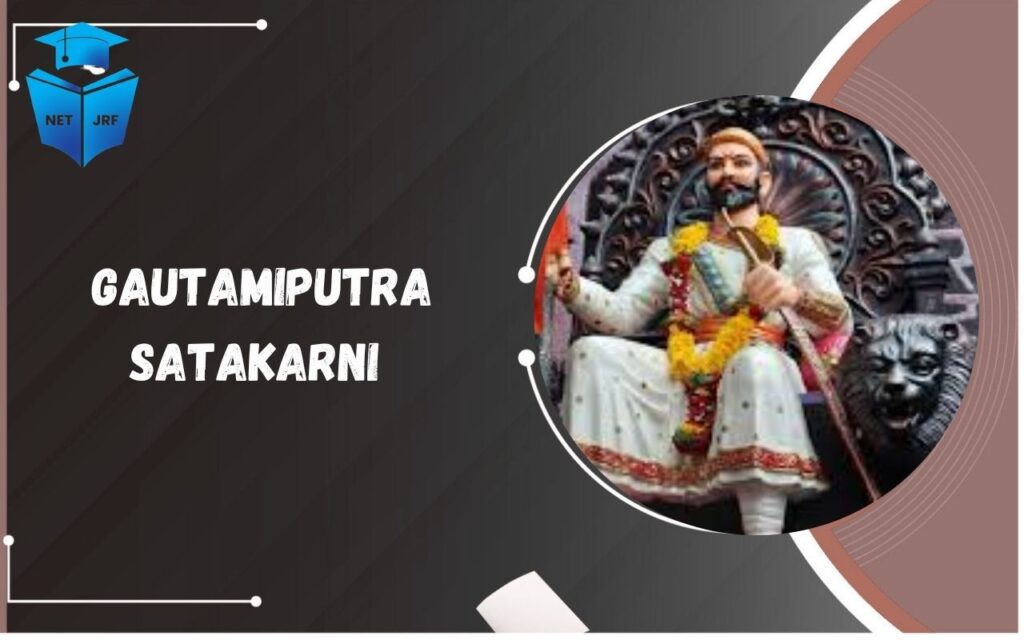

Gautamiputra Satakarni was one of the greatest rulers of the Satavahana dynasty. Gautamiputra Satakarni played a very important role in restoring the power of the Satavahanas in the Deccan region. Satavahana ruler was one of the most celebrated rulers of the Satavahana dynasty. He ruled during the 1st–2nd century CE and is credited with reviving the power of the dynasty after periods of decline. His reign marked the peak of Satavahana power in the Deccan region.

Background Satavahana Dynasty
Before understanding Gautamiputra Satakarni, we must know the condition of the Satavahana dynasty.
Situation Before His Rule
- Satavahana power had weakened
- Foreign rulers like Shakas became strong
- Western India faced political instability
This situation required a strong ruler like Gautamiputra Satakarni.
Enroll UGC NET Coaching in Jaipur
Early Life and Rise to Power
Gautamiputra Satakarni was the son of Gautami Balashri, whose name appears in inscriptions.
Important Points
- Belonged to Satavahana royal family
- Became king during a time of crisis
- Worked to rebuild lost power
His rise marks a turning point in Satavahana history.
Gautamiputra Satakarni Major Achievements
Gautamiputra Satakarni is remembered for his major achievements.
-
Defeat of Shakas
-
-
- Gautamiputra Satakarni is most famous for defeating the Shakas, who were foreign invaders ruling parts of western India. This victory wasn’t just about winning a battle it symbolized reclaiming Indian land and asserting independence. By overcoming these outsiders, he protected his people and restored pride to his dynasty, showing that Satavahana power was not to be challenged.
-
-
Defeated Nahapana
-
-
- Nahapana was a prominent Shaka ruler whose territories in western India were a challenge for the Satavahanas. By defeating him, Gautamiputra Satakarni reclaimed important regions and trade centers. This victory had a long-lasting impact because it not only weakened a strong rival but also gave the Satavahanas access to rich resources and strategic trade routes, boosting the empire’s wealth.
-
-
Restored Lost Territories
- Before his reign, the Satavahana dynasty had lost control over significant areas due to invasions and internal weakness. Gautamiputra Satakarni systematically restored these lost lands. This wasn’t just territorial expansion—it was a step toward reunifying his people under one stable rule, giving the kingdom a sense of continuity and security.
Ended Foreign Dominance in Many Regions
By defeating the Shakas and other local challengers, Gautamiputra Satakarni ended the foreign dominance that had plagued parts of India. His rule ensured that local administration, culture, and traditions could flourish without interference from outsiders. This was a crucial achievement, as it allowed his empire to maintain independence and strengthen its identity.
Expansion of Empire
- Gautamiputra Satakarni didn’t just defend his kingdom he actively expanded it. His empire extended over the Deccan region and included parts of western India. This expansion meant more resources, trade opportunities, and influence. It also reflected his ambition to make the Satavahana dynasty a dominant power in the subcontinent.
Controlled Parts of Western India
- Western India was strategically and economically important, with ports and trade routes connecting India to the broader world. By controlling this region, Gautamiputra Satakarni secured wealth and access to important trade networks. It also allowed him to project his authority further and maintain Satavahana influence beyond the Deccan heartland.
Strengthened Political Authority
- Through military victories, territorial control, and administrative reforms, Gautamiputra Satakarni strengthened the political authority of the Satavahanas. Local rulers and officials were brought under central supervision, reducing rebellions and inefficiency. This strong governance gave his subjects confidence in the stability and fairness of his rule.
Restoration of Satavahana Power
- At the start of his reign, the Satavahana dynasty was in decline, weakened by invasions and internal disputes. Gautamiputra Satakarni revived the dynasty’s prestige, ensuring it regained respect and influence in the region. His efforts made the Satavahanas a recognized and powerful force once again.
Established Strong Central Rule
- Instead of allowing fragmented control over distant territories, Gautamiputra Satakarni established a strong central administration. This ensured uniform laws, better tax collection, and consistent governance. Such centralization made the empire more resilient to challenges from rivals and internal instability.
Brought Stability
- All of Gautamiputra Satakarni’s efforts military victories, administrative reforms, and territorial restoration culminated in a stable and prosperous empire. Stability allowed trade, agriculture, and culture to flourish, improving the lives of his subjects. It also laid a foundation for future Satavahana rulers to build upon.
Join UGC NET Offline Coaching in Jaipur
Gautamiputra Satakarni Military Success
Gautamiputra Satakarni was renowned for his military strength, which was a key factor in making the Satavahana Empire powerful and stable. His success on the battlefield was not only about defeating enemies but also about securing his empire’s prosperity and authority.
- Successful Campaigns Against Enemies
He led multiple military campaigns that decisively defeated rivals like the Shakas and Nahapana. These victories restored lost territories and ended foreign dominance in many regions. Each campaign demonstrated his courage, strategic skill, and determination to protect and expand his kingdom. - Strong Army Organization
Gautamiputra Satakarni maintained a well-trained and disciplined army. The soldiers were organized in a way that allowed quick response to threats, whether from rebellious local rulers or invading forces. This efficient army structure made his rule more secure and his empire harder to challenge. - Strategic Control of Trade Routes
He understood that controlling trade routes was vital for both economic and military strength. By securing key routes in the Deccan and western India, he ensured the flow of wealth into the empire while preventing enemies from using them. This gave him an edge in resources, allowing him to sustain campaigns and maintain a strong empire. - Military Power Sustained the Empire
Gautamiputra Satakarni’s military strength was not just about winning wars—it was the backbone of his governance. It brought stability, protected his people, and allowed trade, agriculture, and culture to flourish. Without his powerful army and smart strategies, the Satavahana Empire could not have achieved the stability and influence it enjoyed.
Gautamiputra Satakarni Administrative System
Gautamiputra Satakarni was not only a great warrior but also an able administrator. His governance played a key role in maintaining the stability and prosperity of the Satavahana Empire.
Features
- Strong Central Authority
He established a strong central authority, ensuring that the king’s power was recognized across the empire. This meant that major decisions—from defense to taxation—were made at the top level, reducing conflicts between regional rulers and providing a clear, unified leadership. - Efficient Governance
Gautamiputra Satakarni’s administration was efficient and organized. Officials were appointed to oversee different aspects of governance, such as revenue collection, law enforcement, and justice. This system allowed the empire to function smoothly, even across distant regions. - Control Over Provinces
The empire was divided into provinces, each under the supervision of loyal governors. By controlling the provinces effectively, he prevented local rebellions and ensured that policies from the central government were implemented consistently. This helped maintain order and kept the empire unified. - Administration Maintained Stability
Thanks to his strong authority and organized governance, Gautamiputra Satakarni brought long-term stability to the empire. Trade, agriculture, and culture could flourish without disruption, allowing the Satavahanas to focus on expansion and consolidating their power.
Enroll UGC NET Online Coaching
Gautamiputra Satakarni Social Reforms
Apart from being a strong ruler and skilled administrator, Gautamiputra Satakarni also took significant steps to maintain social order and strengthen cultural traditions in his empire. His social reforms reflected his vision of a stable and harmonious society.
Important Points
- Supported Varna System
He upheld the varna system, which was the traditional social hierarchy in ancient India. By supporting this system, he aimed to maintain social structure and clarity in roles and responsibilities among different groups. This helped reduce internal conflicts and ensured that society functioned smoothly. - Promoted Brahmanical Values
Gautamiputra Satakarni encouraged Brahmanical traditions and practices, giving importance to religion, rituals, and moral codes. Promoting these values reinforced cultural continuity and respect for established norms, strengthening the moral and spiritual framework of society. - Worked to Maintain Social Discipline
He actively ensured social discipline, encouraging people to follow rules and traditions. By doing so, he minimized social unrest and maintained harmony between different communities, which was essential for a stable and prosperous empire. - Shaping Society Through Reforms
Through these measures, Gautamiputra Satakarni shaped society in a way that reinforced stability, moral order, and cultural identity. His reforms provided a framework that allowed the Satavahana Empire to flourish not just politically and economically, but socially as well.
Gautamiputra Satakarni Religious Policy
Gautamiputra Satakarni followed a balanced and tolerant approach to religion.
-
- Supported Brahmanism
He encouraged Brahmanical traditions, performed Vedic rituals, and patronized priests. This reinforced the social and moral framework of the time and strengthened ties with influential religious groups. - Also Respected Buddhism
At the same time, he showed respect for Buddhism. By supporting multiple religious traditions, he demonstrated religious tolerance, which helped maintain harmony in a diverse empire. - Performed Vedic Rituals
His active participation in Vedic rituals highlighted his role as a king who combined political power with religious duty, emphasizing dharma as a key aspect of governance.
- Supported Brahmanism
-
Role of Inscriptions
- Much of what we know about Gautamiputra Satakarni comes from inscriptions, which are primary historical sources.
- Nashik Inscription of Gautami Balashri
This important inscription, issued by his mother, provides details about his reign. It mentions his victories, titles, and achievements, giving historians and UGC NET aspirants direct evidence of his rule and contributions. - Importance
These inscriptions are crucial for understanding his military, political, and social accomplishments. They confirm his status as a powerful and respected ruler of the Satavahana dynasty.
Gautamiputra Satakarni Titles and Status
Gautamiputra Satakarni adopted several grand titles that reflected his achievements and stature:
- Destroyer of Shakas – emphasizing his victories over foreign invaders.
- Protector of Brahmanas – showing his support for religious and social institutions.
- Upholder of Social Order – highlighting his role in maintaining law, governance, and stability.
These titles underline his importance as a military leader, administrator, and guardian of society.
Gautamiputra Satakarni Economic Development
Economic strength was a key foundation of his rule.
- Control Over Trade Routes
By securing important trade routes in the Deccan and western India, he ensured wealth and resources flowed into his empire, strengthening both commerce and political power. - Use of Coins
The circulation of coins facilitated trade and standardized economic transactions, reflecting a well-organized and prosperous economy. - Growth of Agriculture
He promoted agricultural development, ensuring food security and prosperity for his people, which also supported population growth and economic stability.
Impact: The strong economy allowed him to maintain a powerful army, fund public works, and patronize religion and culture.

Gautamiputra Satakarni Cultural Contributions
Gautamiputra Satakarni also promoted cultural growth during his reign:
- Support to Art – He patronized artistic endeavors, including sculpture and architecture.
- Development of Prakrit Language – Many inscriptions and literary works were composed in Prakrit, contributing to the language’s growth and preservation.
- Growth of Inscriptions – His period saw an increase in stone inscriptions, which documented history, religious practices, and governance.
Outcome: Culture, language, and religious life flourished under his reign, leaving a lasting legacy.
Gautamiputra Satakarni Limitations
Even a great ruler like Gautamiputra Satakarni faced challenges that limited the full potential of his reign.
- Continuous Wars
Although his military campaigns brought victories, they were frequent and exhausting. Continuous wars against rivals like the Shakas and regional enemies strained resources, manpower, and administration. Sustaining such campaigns was difficult, and the empire had to constantly mobilize its army. - Regional Conflicts
Some regions of his empire were prone to rebellion or local disputes. Despite strong central authority, maintaining complete control over all provinces was a challenge. These internal conflicts occasionally threatened stability and required careful management. - Pressure from External Forces
The Satavahana Empire was surrounded by powerful neighbors and foreign groups. External threats persisted even after victories, meaning the empire had to remain vigilant. These pressures sometimes limited long-term peace and uninterrupted prosperity. - Impact of Limitations:
While these challenges did not dismantle his empire, they prevented long-term uninterrupted stability, requiring constant attention from the ruler and his administration.
Gautamiputra Satakarni Significance and Legacy
Despite these limitations, Gautamiputra Satakarni left a lasting legacy that shaped the Satavahana dynasty and ancient Indian history.
- Strengthened Satavahana Dynasty
His military victories, administrative reforms, and social policies revived the declining dynasty, making it a major power in central and western India. - Influenced Later Rulers
His strategies in governance, military organization, and religious policy inspired future Satavahana rulers, who followed his example to maintain political authority and stability. - Maintained Cultural Continuity
Through support for Brahmanical and Buddhist traditions, promotion of Prakrit language, and encouragement of art and inscriptions, he ensured cultural continuity. This helped preserve the social and religious fabric of the empire for generations. - Lasting Importance
Gautamiputra Satakarni’s reign is remembered as a period of strength, stability, and cultural growth. His combination of military skill, administration, social reforms, religious tolerance, and economic development made him one of the most significant rulers of the Satavahana dynasty.
Enroll UGC NET Foundation Course

Conclusion
Gautamiputra Satakarni stands as one of the greatest rulers of ancient India. He revived the Satavahana dynasty, defeated powerful enemies, and maintained social order. His achievements and policies make him very important for understanding ancient Indian history,