

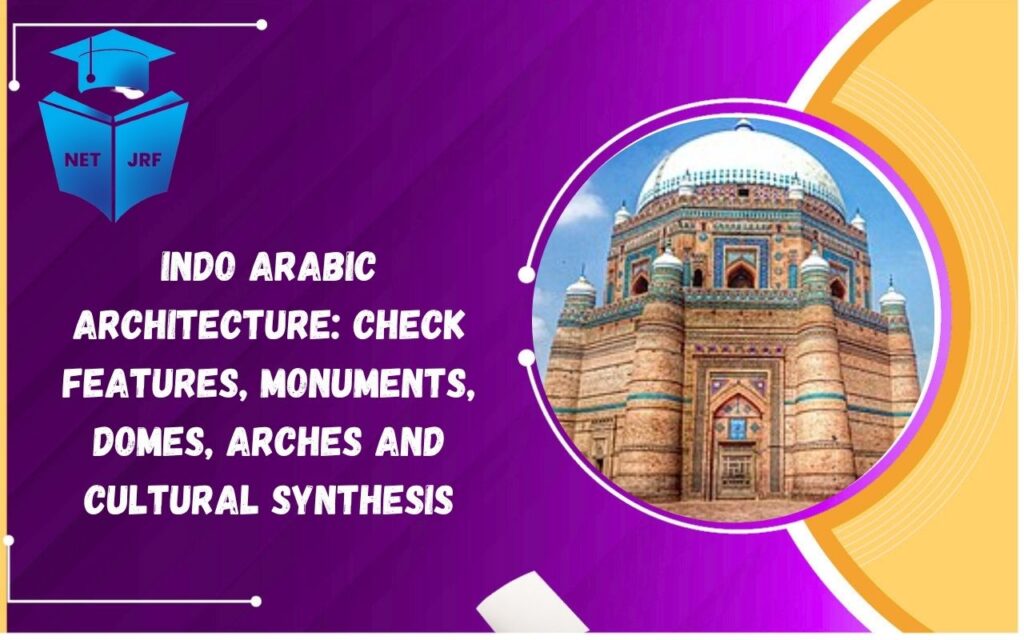
Indo Arabic Architecture: Check Features, Monuments, Domes, Arches and Cultural Synthesis

Indo Arabic Architecture in this topic you learn how Islamic and Indian building traditions combined through arches domes calligraphy geometric decoration courtyards Mughal influence structural innovations and cultural exchange in medieval India

vishal

indo arabic architecture

Table of Contents

Indo-Arabic Architecture represents the architectural tradition that developed in India after the arrival of Islamic rulers from Central Asia, Persia, and the Arab world. This style formed through interaction between Indian building traditions and Islamic design principles. Builders combined arches, domes, calligraphy, geometric decoration, and large courtyards with local construction methods.

Join UGC NET Online Coaching

Historians study this style to understand cultural exchange during medieval India. It shows how different traditions blended rather than replaced each other. Hindu craftsmen, Persian architects, and Turkish rulers together shaped a new form of architecture that later influenced Mughal monuments.

Study Planner

Indo Arabic Architecture Historical Background 

The roots of Indo-Arabic Architecture appeared during the early Delhi Sultanate period in the 12th–13th centuries. When Islamic rulers entered India, they brought architectural ideas from West Asia. However, they depended on local Indian artisans for construction.

Indian craftsmen already possessed strong skills in stone carving and temple building. As a result, early monuments show a mixture of Islamic planning and Indian decorative techniques.

Major Phases of Development

  1. Early Sultanate Phase (1200–1300 CE)
    Mosques and forts built using temple materials.
  2. Expansion Phase (1300–1500 CE)
    Development of arches, domes, and strong Islamic decorative patterns.
  3. Mughal Phase (1526–1707 CE)
    Architectural refinement with symmetry, gardens, marble structures.

Each phase refined Indo-Arabic Architecture and created new artistic achievements.

Indo-Arabic Architecture Key Characteristics 

The uniqueness of Indo-Arabic Architecture lies in the fusion of Indian structural techniques with Islamic artistic concepts.

1. Use of Arches

Islamic architecture introduced the true arch. Earlier Indian temples used beam-based structures. Arches allowed builders to create wider halls.

2. Domes

Domes became an important feature in mosques and tombs. They symbolized the vault of heaven in Islamic tradition.

3. Minarets

Tall towers called minarets served as places from where the call to prayer was announced.

4. Geometric Decoration

Islamic art discouraged human images in religious spaces. Instead, artists used geometric patterns, arabesques, and calligraphy.

5. Calligraphy

Verses from the Quran decorated walls, gateways, and domes.

6. Courtyard Layout

Large open courtyards allowed gatherings for prayer.

These elements together defined Indo-Arabic Architecture in medieval India.

Join UGC NET Online Course

Indo-Arabic Architecture Structural Elements 

The architecture used several structural innovations that differed from earlier temple designs.

Structural Feature Description Purpose
Arches Curved structures above doors Support heavy weight
Domes Hemispherical roof structures Symbolic plus structural role
Minarets Tall towers near mosques Religious function
Courtyards Open central space Community prayer
Decorative panels Carved stone patterns Artistic beauty

These structural forms became the visual identity of Indo-Arabic Architecture.

Major Monuments Representing the Style

Several historical monuments illustrate the evolution of Indo-Arabic Architecture.

  • Qutub Minar Complex

      • Built during the Delhi Sultanate period. It shows early experimentation with Islamic design in India.
  • Alai Darwaza

      • Famous for true arches and red sandstone decoration.
  • Humayun’s Tomb

      • Introduced Persian garden-tomb design in India.
  • Taj Mahal

    • A perfect Mughal example combining symmetry, marble, gardens, and domes.
    • These monuments demonstrate the artistic maturity of Indo-Arabic Architecture.

App JRF Adda

Important Monuments of Indo-Arabic Architecture

Monument Location Period Architectural Significance
Qutub Minar Delhi 13th century Early Sultanate tower
Alai Darwaza Delhi 14th century First true Islamic arch in India
Humayun’s Tomb Delhi 16th century Persian garden style
Taj Mahal Agra 17th century Mughal masterpiece

Indo-Arabic Architecture Materials Used in Construction

Builders used various materials depending on region and royal patronage.

Common Construction Materials

  • Red sandstone
  • White marble
  • Limestone
  • Brick
  • Decorative tiles

Red sandstone dominated early structures while white marble became popular during the Mughal period.

The choice of material influenced the visual beauty of Indo-Arabic Architecture.

Best UGC NET Offline Classes in Jaipur

Decorative Elements

Decoration played a central role in Indo-Arabic Architecture. Islamic aesthetics emphasized pattern and symmetry rather than human imagery.

Major Decorative Forms

  • Arabic calligraphy
  • Floral patterns
  • Geometric designs
  • Inlay work
  • Carved lattice screens (jalis)

Mughal monuments especially used marble inlay techniques known as pietra dura.

These decorative features increased the elegance of Indo-Arabic Architecture.

Role of Craftsmen and Cultural Exchange

Local artisans played a crucial role in the development of Indo-Arabic Architecture. Islamic rulers brought design ideas, but Indian craftsmen executed the construction.

  • Stone carving traditions from Hindu and Jain temples influenced decoration. Persian architects contributed symmetry and planning.
  • This collaboration produced architectural styles that were neither purely Islamic nor purely Indian. The blend gave rise to the distinctive visual identity of Indo-Arabic Architecture.

 Mughal Architecture Influence 

The Mughal Empire refined earlier architectural traditions. Emperors such as Akbar, Jahangir, and Shah Jahan sponsored large building projects.

Key developments included:

  1. Large gardens based on Persian designs
  2. Extensive marble construction
  3. Symmetrical layouts
  4. Monumental gateways

These innovations transformed Indo-Arabic Architecture into a more sophisticated artistic style.

Top UGC NET Coaching in Jaipur

JRF Adda Book

Cultural Importance in Indian History

The significance of Indo-Arabic Architecture goes beyond physical buildings. It reflects cultural dialogue between communities.

Important cultural contributions include:

  • Spread of urban planning concepts
  • Development of garden architecture
  • New decorative art forms
  • Symbol of imperial power

Many monuments built under this tradition today serve as major heritage sites and tourist attractions.

Conclusion

Indo-Arabic Architecture represents one of the most significant cultural achievements of medieval India. It emerged from interaction between Islamic design traditions and Indian craftsmanship. Through monuments, decorative arts, and urban planning, this architectural style demonstrated how cultural exchange can create entirely new artistic forms.


Read UGC NET Notes
1 Archaeological Sources for UGC NET Epigraphy – Study of Inscriptions Meaning of Historical Sources Archaeological
2 Meaning of Historical Sources Archaeological Sources for UGC NET Literary Sources in History Archaeological
3 Exploration in Archaeology Excavation Techniques in Archaeology Dating of Archaeological Sites Archaeological
4 Excavation Techniques in Archaeology Exploration in Archaeology Dating of Archaeological Sites Archaeological
5 Epigraphy – Study of Inscriptions Inscriptions in Reconstructing History Numismatics in History Archaeological
6 Inscriptions in Reconstructing History Epigraphy – Study of Inscriptions Archaeological Sources for UGC NET Archaeological
7 Numismatics in History Importance of Coins in History Epigraphy – Study of Inscriptions Archaeological
8 Importance of Coins in History Numismatics in History Archaeological Sources for UGC NET Archaeological
9 Dating of Archaeological Sites Excavation Techniques in Archaeology Dating Ancient Literary Sources Archaeological
10 Indigenous Literature Literary Sources in History Secular Literature as Historical Source Literary
11 Dating Ancient Literary Sources Literary Sources in History Dating of Archaeological Sites Literary
12 Literary Sources in History Indigenous Literature Foreign Accounts of India Literary
13 Foreign Accounts of India Greek Accounts on Ancient India Chinese Accounts on India Literary
14 Greek Accounts on Ancient India Foreign Accounts of India Chinese Accounts on India Literary
15 Secular Literature as Historical Source Literary Sources in History Indigenous Literature Literary
16 Role of Myths and Legends in Historical Reconstruction Literary Sources in History Secular Literature as Historical Source Literary
17 Chinese Accounts on India Foreign Accounts of India Greek Accounts on Ancient India Literary
18 Arabic Accounts on India Foreign Accounts of India Chinese Accounts on India Literary
19 Neolithic and Chalcolithic Phases Neolithic Revolution in India Chalcolithic Culture in India Neolithic
20 Hunting, Gathering & Food Production Neolithic Revolution in India Neolithic Settlements in India Neolithic
21 Neolithic Revolution in India Neolithic Settlements in India Tools and Technology in Neolithic Period Neolithic
22 Neolithic Settlements in India Distribution of Neolithic Cultures in India Neolithic Revolution in India Neolithic
23 Distribution of Neolithic Cultures in India Neolithic Settlements in India Tools and Technology in Neolithic Period Neolithic
24 Tools and Technology in Neolithic Period Neolithic Revolution in India Chalcolithic Culture in India Neolithic
25 Chalcolithic Culture in India Settlement Pattern & Economy in Chalcolithic Phase Trade & Exchange Networks in Chalcolithic Societies Neolithic
26 Settlement Pattern & Economy – Chalcolithic Phase Chalcolithic Culture in India Trade & Exchange Networks in Chalcolithic Societies Neolithic
27 Trade & Exchange Networks – Chalcolithic Societies Chalcolithic Culture in India IVC Internal & External Trade Neolithic
28 Indus Valley Civilization – UGC NET Major Sites of Indus Civilization Urban Planning in Harappan Civilization IVC
29 IVC Internal & External Trade Internal Trade – Harappan Civilization Craft Specialization in Harappan Civilization IVC
30 Political Organization – Harappan Civilization Social Structure – Indus Civilization Urban Planning in Harappan Civilization IVC
31 Major Sites of Indus Civilization Indus Valley Civilization – UGC NET Urban Planning in Harappan Civilization IVC
32 Urban Planning & Settlement – Harappan Civilization Architecture & Town Planning – Harappan Cities IVC as First Urbanization in India IVC
33 Architecture & Town Planning – Harappan Cities Urban Planning in Harappan Civilization Major Sites of Indus Civilization IVC
34 Craft Specialization & Industrial Activities – Harappan Agriculture & Food Economy – Harappans IVC Internal & External Trade IVC
35 Agriculture & Food Economy – Harappans Craft Specialization in Harappan Civilization Internal Trade – Harappan Civilization IVC
36 Internal Trade – Harappan Civilization IVC Internal & External Trade Craft Specialization in Harappan Civilization IVC
37 Religion & Beliefs – Indus Civilization Social Structure – Indus Civilization Indus Valley Civilization – UGC NET IVC
38 Social Structure – Indus Civilization Political Organization – Harappan Civilization Religion & Beliefs – Indus Civilization IVC
39 Decline of Indus Civilization Indus Valley Civilization – UGC NET IVC as First Urbanization in India IVC
40 IVC as First Urbanization in India Urban Planning in Harappan Civilization Second Urbanization in India IVC
41 Vedic & Later Vedic Periods – Aryan Varna System Early Vedic Society and Economy Later Vedic Society and Economy Vedic
42 Origin of Vedic Civilization Aryan Debate – Migration, Invasion & Indigenous Theories Early Vedic Society and Economy Vedic
43 Aryan Debate – Migration, Invasion & Indigenous Theories Origin of Vedic Civilization Early Vedic Society and Economy Vedic
44 Early Vedic Society and Economy Political Institutions – Early Vedic Period Social Structure – Early Vedic Period Vedic
45 Political Institutions – Early Vedic Period Early Vedic Society and Economy Monarchical States in Ancient India Vedic
46 Social Structure – Early Vedic Period Emergence of Varnas & Social Stratification Early Vedic Society and Economy Vedic
47 Later Vedic Society and Economy Emergence of Varnas & Social Stratification Impact of Iron Technology in India Vedic
48 Emergence of Varnas & Social Stratification Social Structure – Early Vedic Period Later Vedic Society and Economy Vedic
49 Emergence of Heterodox Sects in India Jainism, Buddhism & Ajivikas – Origins & Teachings Later Vedic Society and Economy Vedic
50 Impact of Iron Technology in India Later Vedic Society and Economy Agricultural Expansion & Economic Changes – Ancient India Vedic
51 Religious & Philosophical Vedic Ideas Emergence of Varnas & Social Stratification Emergence of Heterodox Sects in India Vedic
52 Megalithic Culture of South India Neolithic and Chalcolithic Phases Agricultural Expansion & Economic Changes General
53 State System in Ancient India Rise of Mahajanapadas Transition: Tribal Polities to Territorial States General
54 Transition: Tribal Polities to Territorial States Rise of Mahajanapadas Later Vedic Society and Economy General
55 Rise of Mahajanapadas Monarchical States in Ancient India Republican States (Gana-Sanghas) – Ancient India Magadha
56 Monarchical States in Ancient India Rise of Mahajanapadas Emergence of Magadha Magadha
57 Republican States (Gana-Sanghas) – Ancient India Rise of Mahajanapadas Monarchical States in Ancient India Magadha
58 Agricultural Expansion & Economic Changes – Ancient India Second Urbanization in India Impact of Iron Technology in India General
59 Second Urbanization in India IVC as First Urbanization in India Rise of Mahajanapadas General
60 Jainism, Buddhism & Ajivikas – Origins & Teachings Emergence of Heterodox Sects in India Ashoka’s Policy of Dhamma General
61 Emergence of Magadha Geographical Advantages of Magadha Early Rulers of Magadha Magadha
62 Geographical Advantages of Magadha Natural Resources & Economic Strength of Magadha Reasons for Success of Magadha Magadha
63 Natural Resources & Economic Strength of Magadha Geographical Advantages of Magadha Economic Policies of the Nandas Magadha
64 Early Rulers of Magadha Haryanka Dynasty – Rise of Magadha Emergence of Magadha Magadha
65 Haryanka Dynasty – Rise of Magadha Expansion Policy of Bimbisara Early Rulers of Magadha Magadha
66 Expansion Policy of Bimbisara Ajatashatru – Military Reforms Haryanka Dynasty – Rise of Magadha Magadha
67 Ajatashatru – Military Reforms Wars of Ajatashatru Expansion Policy of Bimbisara Magadha
68 Wars of Ajatashatru Ajatashatru – Military Reforms Udayin & Establishment of Pataliputra Magadha
69 Udayin & Establishment of Pataliputra Wars of Ajatashatru Shishunaga Dynasty Magadha
70 Shishunaga Dynasty Administrative Structure of the Shishunagas Nanda Dynasty Magadha
71 Administrative Structure of the Shishunagas Shishunaga Dynasty Central Administration Under Mauryas Magadha
72 Nanda Dynasty Mahapadma Nanda – Imperial Expansion Shishunaga Dynasty Magadha
73 Mahapadma Nanda – Imperial Expansion Military Strength of the Nandas Nanda Dynasty Magadha
74 Economic Policies of the Nandas Nanda Dynasty Taxation System – Mauryan State Magadha
75 Military Strength of the Nandas Mahapadma Nanda – Imperial Expansion Defeat of Nandas & Rise of Mauryan Empire Magadha
76 Reasons for Success of Magadha Geographical Advantages of Magadha Natural Resources & Economic Strength of Magadha Magadha
77 Mahajanapadas to Empire – Evolution & Rise of Magadha Rise of Mahajanapadas Emergence of Magadha Magadha
78 Mauryan Empire – Expansion Rise of Chandragupta Maurya Expansion of Mauryan Empire Maurya
79 Rise of Chandragupta Maurya Role of Chanakya in Rise of Mauryan Empire Defeat of Nandas & Rise of Mauryan Empire Maurya
80 Role of Chanakya in Rise of Mauryan Empire Rise of Chandragupta Maurya Defeat of Nandas & Rise of Mauryan Empire Maurya
81 Defeat of Nandas & Rise of Mauryan Empire Military Strength of the Nandas Rise of Chandragupta Maurya Maurya
82 Chandragupta Maurya – Seleucus Treaty & Diplomacy Expansion of Mauryan Empire Greek Accounts on Ancient India Maurya
83 Expansion of Mauryan Empire Chandragupta Maurya – Seleucus Treaty & Diplomacy Kalinga War Maurya
84 Administration of Chandragupta Maurya Central Administration Under Mauryas Mauryan Bureaucracy Maurya
85 Sources for Mauryan History Archaeological Sources for UGC NET Greek Accounts on Ancient India Maurya
86 Central Administration Under Mauryas Provincial Administration – Mauryan Empire Mauryan Bureaucracy Maurya
87 Provincial Administration – Mauryan Empire Local Administration – Mauryan Empire Central Administration Under Mauryas Maurya
88 Local Administration – Mauryan Empire Provincial Administration – Mauryan Empire Mauryan Bureaucracy Maurya
89 Mauryan Bureaucracy Central Administration Under Mauryas Espionage System – Mauryan Empire Maurya
90 Espionage System – Mauryan Empire Mauryan Bureaucracy Central Administration Under Mauryas Maurya
91 Ancient India – Trade and Commerce Trade and Commerce Under Mauryas Agrarian Economy – Mauryan Period Maurya
92 Agrarian Economy – Mauryan Period Taxation System – Mauryan State Trade and Commerce Under Mauryas Maurya
93 Trade and Commerce Under Mauryas Ancient India – Trade and Commerce Agrarian Economy – Mauryan Period Maurya
94 Taxation System – Mauryan State Agrarian Economy – Mauryan Period Economic Policies of the Nandas Maurya
95 Kalinga War Ashoka’s Policy of Dhamma Expansion of Mauryan Empire Maurya
96 Ashoka’s Policy of Dhamma Nature & Philosophy of Dhamma Kalinga War Maurya
97 Nature & Philosophy of Dhamma Ashoka’s Policy of Dhamma Jainism, Buddhism & Ajivikas Maurya

Indo-Arabic Architecture FAQs

Leave a Reply

Recent Posts
Aditi

Aditi Sharma, founder of JRFAdda, is a Computer Science educator with an MCA degree and JRF qualification (99.91 percentile, Dec 2019). Her experience includes roles as an SBI SO (DBA), work at Cognizant, and over 5 years of teaching online and offline. She has also served as a Government Computer Teacher in Rajasthan.