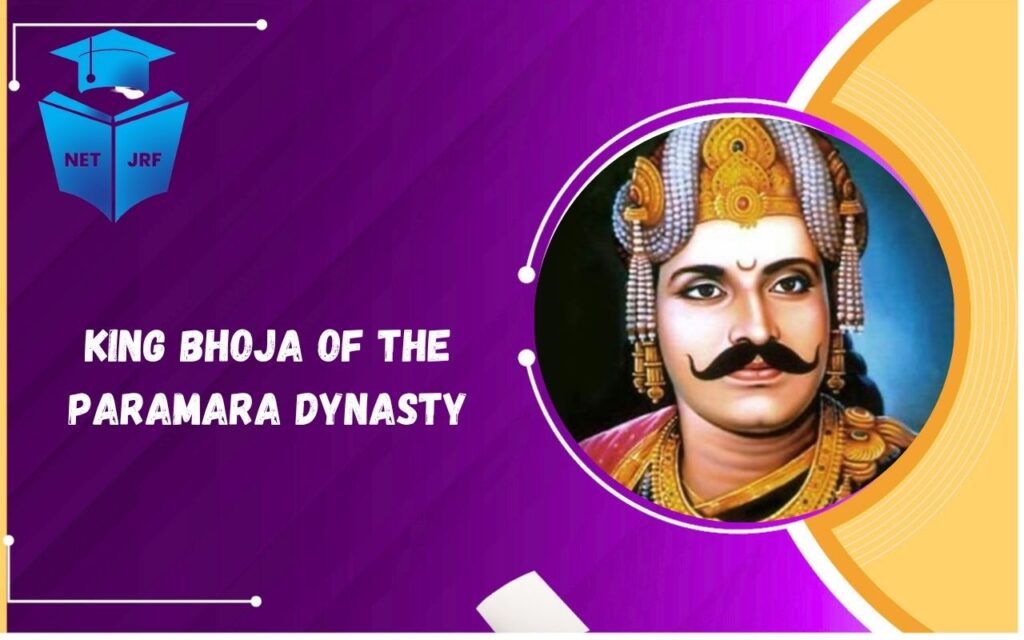
King Bhoja of Paramara Dynasty: Scholar King Achievements, Culture Education and Works

King Bhoja Paramara dynasty in this topic you learn how Bhoja emerged as a scholar king his works education system cultural contributions literature architecture arts and scientific thinking that shaped Malwa and left a lasting legacy

vishal

king bhoja of paramara dynasty

Table of Contents

King Bhoja of the Paramara dynasty is remembered not only for his power as a ruler but for the brilliance of his mind. In an age when most kings focused mainly on warfare and expansion, Bhoja chose a different path: he made knowledge, art, and learning the true pillars of his kingdom. He believed that a strong society is built not just with armies, but with ideas, creativity, and education.

What makes Bhoja truly special is that he was not just a patron of scholars, but a scholar himself. He wrote books, encouraged debates, supported poets, and turned his capital into a center of intellectual activity. Under his rule, learning was not limited to a few; it became a part of cultural life.

His reign shows us that a ruler’s greatness is not measured only by the land he conquers, but by the knowledge he spreads and the culture he nurtures. Bhoja’s legacy, therefore, lives on not just in history books, but in the rich traditions of Indian literature, art, and education.

Study Planner

Bhoja of Paramaras Introduction 

Bhoja of Paramaras ruled the Malwa region during the 11th century. He belonged to the Paramara dynasty, which was known for supporting scholars and artists. His capital was Dhar, which later became a major center of learning.

He is often remembered in history not only for his political power but also for his cultural contributions. His rule created a strong connection between governance and intellectual progress. 

Top UGC NET Coaching in Jaipur

Bhoja of Paramaras Historical Background 

To understand Bhoja of Paramaras, it is important to look at his historical context.

Key Historical Facts

  • Ruled during early 11th century
  • Capital city was Dhar
  • Belonged to Paramara dynasty
  • Known for both warfare and scholarship
  • Promoted Sanskrit learning

His time was marked by regional conflicts, but he balanced warfare with cultural growth. This balance made Bhoja of Paramaras unique among medieval rulers.

Bhoja of Paramaras as a Scholar King

King Bhoja of the Paramara dynasty stands out in Indian history as a rare combination of power and intellect. Unlike many rulers who depended only on court scholars, Bhoja himself actively engaged in learning and writing. He believed that a king should not only govern people but also guide society through knowledge and wisdom. This made him a true “Scholar King” in every sense.

Areas of Knowledge He Contributed To

Bhoja’s intellectual curiosity was vast. He did not limit himself to one subject but explored many fields with equal interest:

  • Literature – He promoted poetic excellence and refined literary traditions
  • Grammar – He worked on improving linguistic clarity and structure
  • Architecture – He studied city planning, temple design, and engineering
  • Astronomy – He showed interest in celestial knowledge and calculations
  • Medicine – He supported the understanding of health and healing
  • Philosophy – He explored deeper questions about life, knowledge, and truth

This wide range of interests clearly shows that Bhoja believed knowledge should be holistic. For him, true learning meant understanding both science and art together.

Important Works

Several important texts are traditionally attributed to Bhoja, reflecting his deep scholarship:

  • Saraswati Kanthabharana – A significant work on grammar that highlights language rules and usage
  • Shringara Prakasha – A detailed treatise on poetry, emotions, and aesthetics
  • Samarangana Sutradhara – A remarkable text on architecture, covering building techniques, town planning, and even mechanical devices

These works prove that Bhoja was not just a supporter of knowledge but a creator of it. His writings combine practical understanding with creative thinking, making them valuable even today.

Best UGC NET Offline Classes in Jaipur

Bhoja of Paramaras Cultural Contributions 

King Bhoja was not just a ruler sitting on a throne he was a builder of culture. His reign reflects how knowledge, art, science, and spirituality can grow together under wise leadership. He transformed his kingdom into a vibrant center of learning and creativity.

Key contributions:

  • Encouraged open debates and intellectual discussions
  • Supported teachers, scholars, and students
  • Established libraries with rich collections of manuscripts
  • Promoted Sanskrit as the main language of learning

Dhar, his capital, became a famous center of education where scholars from different regions gathered. Education was not limited only to elites it slowly reached wider sections of society.

Promotion of Education

Bhoja of Paramaras established many centers of learning. Dhar became a hub where scholars gathered.

Key points:

  • Encouraged debate and discussion
  • Supported teachers and students
  • Built libraries
  • Promoted Sanskrit education

Education under Bhoja of Paramaras was not limited to elites. It reached wider sections of society.

Development of Literature

Bhoja created an atmosphere where literature could truly flourish.

His role included:

  • Encouraging poetic creativity and originality
  • Supporting scholars writing in Sanskrit
  • Promoting discussions and exchange of ideas

Because of his support, many poets and writers found recognition. His court became a lively space of intellectual exchange, helping literature grow in richness and depth.

Best UGC NET Foundation Course

App JRF Adda

Architectural Contributions

Architecture was one of Bhoja’s strongest areas of interest.

Key features:

  • Focus on temple construction
  • Planned cities with proper structure
  • Developed detailed architectural designs

His famous work Samarangana Sutradhara explains building techniques, layout planning, and even early ideas about machines. It shows how advanced architectural thinking was during his time.

Temple Building Activity

Temples during Bhoja’s time were more than places of worship they were centers of culture and art.

Important aspects:

  • Beautiful and detailed carvings
  • Use of symmetry in design
  • Deep spiritual symbolism

These temples reflect his artistic vision and show how religion and culture were closely connected.

Promotion of Arts

Bhoja actively supported different forms of art.

  • Encouraged music, dance, and painting
  • Provided artists with freedom to express themselves
  • Created a culturally rich environment

Because of this support, art became an important part of everyday life in his kingdom.

Scientific Thinking

Bhoja believed that knowledge should include both tradition and science.

Examples:

  • Study of astronomy and celestial bodies
  • Interest in medicine and healing practices
  • Understanding of mechanical systems

This shows that he encouraged a balanced approach respecting traditional knowledge while also promoting scientific thinking.

Educational Institutions Under Bhoja

Education formed the backbone of King Bhoja’s vision for a strong and enlightened society. He did not treat learning as a privilege of a few but as a powerful tool for social and cultural growth. Under his rule, educational institutions became active centers of discussion, curiosity, and intellectual development.

Key features included:

  • Open learning spaces – Learning often took place in flexible environments like gurukuls and scholarly gatherings rather than closed classrooms
  • Focus on debate – Discussions and debates were encouraged, helping students develop critical thinking
  • Strong teacher-student interaction – Close guidance ensured deeper understanding, not just memorization
  • Study of multiple subjects – Students explored literature, science, philosophy, and arts together

Impact of These Institutions

These educational centers played a major role in spreading knowledge across society. They:

  • Created a culture of inquiry and reasoning
  • Attracted scholars from different regions to places like Dhar
  • Helped preserve and expand Sanskrit learning
  • Made education more dynamic and engaging 

Bhoja of Paramaras Cultural Contributions Overview

King Bhoja of the Paramara dynasty is remembered as one of the greatest cultural builders in Indian history. His reign was not just about political power, it was about shaping a society rich in knowledge, creativity, and intellectual depth. He believed that a strong kingdom must stand on the pillars of education, art, science, and spirituality.

Area Contribution Impact
Education Schools, libraries Spread of knowledge
Literature Books, patronage Growth of Sanskrit
Architecture Temples, texts Artistic development
Science Astronomy, medicine Intellectual progress
Arts Music, dance Cultural richness

Bhoja of Paramaras Sanskrit Culture

Under King Bhoja, Sanskrit was not just a language it became the soul of intellectual and cultural life. He deeply respected its richness and saw it as a powerful medium to express knowledge, creativity, and philosophy. Because of his efforts, Sanskrit reached new heights during his reign and became widely used among scholars and learners.

Bhoja actively encouraged different aspects of Sanskrit culture:

  • Grammar studies – He promoted structured understanding of language, helping improve clarity and precision
  • Poetry writing – Poets were encouraged to compose creative and expressive works in Sanskrit
  • Scholarly debates – Intellectual discussions in Sanskrit became common, sharpening reasoning and knowledge

Impact on Society

Because of Bhoja’s patronage:

  • Sanskrit became the main language of education and scholarship
  • Scholars from different regions gathered to exchange ideas
  • Knowledge in subjects like literature, philosophy, and science was preserved and expanded

Sanskrit was no longer limited to rituals it became a living language of intellectual expression.

Best UGC NET Foundation Batch Online

Bhoja of Paramaras Social Impact

His contributions were not limited to elite scholars.

Effects on Society

  • Increased literacy
  • Cultural unity
  • Intellectual curiosity
  • Respect for education

Society became more aware and culturally active under Bhoja of Paramaras.

Comparison with Other Rulers

When we compare Bhoja of Paramaras with other kings, we see clear differences.

Unique Features

  • Scholar king
  • Multi-disciplinary knowledge
  • Focus on education
  • Cultural development priority

Few rulers matched the intellectual depth of Bhoja of Paramaras.

JRF Adda Book

Bhoja of Paramaras Legacy 

The legacy of Bhoja of Paramaras continues even today.

His influence can be seen in:

  • Indian literature
  • Temple architecture
  • Educational traditions

He is remembered as a ruler who valued knowledge as much as power.

Bhoja of Paramaras represents the perfect example of a ruler who combined power with wisdom. His cultural contributions shaped education, literature, and art in medieval India. Even today

Read UGC NET Notes
1 Archaeological Sources for UGC NET Epigraphy – Study of Inscriptions Meaning of Historical Sources Archaeological
2 Meaning of Historical Sources Archaeological Sources for UGC NET Literary Sources in History Archaeological
3 Exploration in Archaeology Excavation Techniques in Archaeology Dating of Archaeological Sites Archaeological
4 Excavation Techniques in Archaeology Exploration in Archaeology Dating of Archaeological Sites Archaeological
5 Epigraphy – Study of Inscriptions Inscriptions in Reconstructing History Numismatics in History Archaeological
6 Inscriptions in Reconstructing History Epigraphy – Study of Inscriptions Archaeological Sources for UGC NET Archaeological
7 Numismatics in History Importance of Coins in History Epigraphy – Study of Inscriptions Archaeological
8 Importance of Coins in History Numismatics in History Archaeological Sources for UGC NET Archaeological
9 Dating of Archaeological Sites Excavation Techniques in Archaeology Dating Ancient Literary Sources Archaeological
10 Indigenous Literature Literary Sources in History Secular Literature as Historical Source Literary
11 Dating Ancient Literary Sources Literary Sources in History Dating of Archaeological Sites Literary
12 Literary Sources in History Indigenous Literature Foreign Accounts of India Literary
13 Foreign Accounts of India Greek Accounts on Ancient India Chinese Accounts on India Literary
14 Greek Accounts on Ancient India Foreign Accounts of India Chinese Accounts on India Literary
15 Secular Literature as Historical Source Literary Sources in History Indigenous Literature Literary
16 Role of Myths and Legends in Historical Reconstruction Literary Sources in History Secular Literature as Historical Source Literary
17 Chinese Accounts on India Foreign Accounts of India Greek Accounts on Ancient India Literary
18 Arabic Accounts on India Foreign Accounts of India Chinese Accounts on India Literary
19 Neolithic and Chalcolithic Phases Neolithic Revolution in India Chalcolithic Culture in India Neolithic
20 Hunting, Gathering & Food Production Neolithic Revolution in India Neolithic Settlements in India Neolithic
21 Neolithic Revolution in India Neolithic Settlements in India Tools and Technology in Neolithic Period Neolithic
22 Neolithic Settlements in India Distribution of Neolithic Cultures in India Neolithic Revolution in India Neolithic
23 Distribution of Neolithic Cultures in India Neolithic Settlements in India Tools and Technology in Neolithic Period Neolithic
24 Tools and Technology in Neolithic Period Neolithic Revolution in India Chalcolithic Culture in India Neolithic
25 Chalcolithic Culture in India Settlement Pattern & Economy in Chalcolithic Phase Trade & Exchange Networks in Chalcolithic Societies Neolithic
26 Settlement Pattern & Economy – Chalcolithic Phase Chalcolithic Culture in India Trade & Exchange Networks in Chalcolithic Societies Neolithic
27 Trade & Exchange Networks – Chalcolithic Societies Chalcolithic Culture in India IVC Internal & External Trade Neolithic
28 Indus Valley Civilization – UGC NET Major Sites of Indus Civilization Urban Planning in Harappan Civilization IVC
29 IVC Internal & External Trade Internal Trade – Harappan Civilization Craft Specialization in Harappan Civilization IVC
30 Political Organization – Harappan Civilization Social Structure – Indus Civilization Urban Planning in Harappan Civilization IVC
31 Major Sites of Indus Civilization Indus Valley Civilization – UGC NET Urban Planning in Harappan Civilization IVC
32 Urban Planning & Settlement – Harappan Civilization Architecture & Town Planning – Harappan Cities IVC as First Urbanization in India IVC
33 Architecture & Town Planning – Harappan Cities Urban Planning in Harappan Civilization Major Sites of Indus Civilization IVC
34 Craft Specialization & Industrial Activities – Harappan Agriculture & Food Economy – Harappans IVC Internal & External Trade IVC
35 Agriculture & Food Economy – Harappans Craft Specialization in Harappan Civilization Internal Trade – Harappan Civilization IVC
36 Internal Trade – Harappan Civilization IVC Internal & External Trade Craft Specialization in Harappan Civilization IVC
37 Religion & Beliefs – Indus Civilization Social Structure – Indus Civilization Indus Valley Civilization – UGC NET IVC
38 Social Structure – Indus Civilization Political Organization – Harappan Civilization Religion & Beliefs – Indus Civilization IVC
39 Decline of Indus Civilization Indus Valley Civilization – UGC NET IVC as First Urbanization in India IVC
40 IVC as First Urbanization in India Urban Planning in Harappan Civilization Second Urbanization in India IVC
41 Vedic & Later Vedic Periods – Aryan Varna System Early Vedic Society and Economy Later Vedic Society and Economy Vedic
42 Origin of Vedic Civilization Aryan Debate – Migration, Invasion & Indigenous Theories Early Vedic Society and Economy Vedic
43 Aryan Debate – Migration, Invasion & Indigenous Theories Origin of Vedic Civilization Early Vedic Society and Economy Vedic
44 Early Vedic Society and Economy Political Institutions – Early Vedic Period Social Structure – Early Vedic Period Vedic
45 Political Institutions – Early Vedic Period Early Vedic Society and Economy Monarchical States in Ancient India Vedic
46 Social Structure – Early Vedic Period Emergence of Varnas & Social Stratification Early Vedic Society and Economy Vedic
47 Later Vedic Society and Economy Emergence of Varnas & Social Stratification Impact of Iron Technology in India Vedic
48 Emergence of Varnas & Social Stratification Social Structure – Early Vedic Period Later Vedic Society and Economy Vedic
49 Emergence of Heterodox Sects in India Jainism, Buddhism & Ajivikas – Origins & Teachings Later Vedic Society and Economy Vedic
50 Impact of Iron Technology in India Later Vedic Society and Economy Agricultural Expansion & Economic Changes – Ancient India Vedic
51 Religious & Philosophical Vedic Ideas Emergence of Varnas & Social Stratification Emergence of Heterodox Sects in India Vedic
52 Megalithic Culture of South India Neolithic and Chalcolithic Phases Agricultural Expansion & Economic Changes General
53 State System in Ancient India Rise of Mahajanapadas Transition: Tribal Polities to Territorial States General
54 Transition: Tribal Polities to Territorial States Rise of Mahajanapadas Later Vedic Society and Economy General
55 Rise of Mahajanapadas Monarchical States in Ancient India Republican States (Gana-Sanghas) – Ancient India Magadha
56 Monarchical States in Ancient India Rise of Mahajanapadas Emergence of Magadha Magadha
57 Republican States (Gana-Sanghas) – Ancient India Rise of Mahajanapadas Monarchical States in Ancient India Magadha
58 Agricultural Expansion & Economic Changes – Ancient India Second Urbanization in India Impact of Iron Technology in India General
59 Second Urbanization in India IVC as First Urbanization in India Rise of Mahajanapadas General
60 Jainism, Buddhism & Ajivikas – Origins & Teachings Emergence of Heterodox Sects in India Ashoka’s Policy of Dhamma General
61 Emergence of Magadha Geographical Advantages of Magadha Early Rulers of Magadha Magadha
62 Geographical Advantages of Magadha Natural Resources & Economic Strength of Magadha Reasons for Success of Magadha Magadha
63 Natural Resources & Economic Strength of Magadha Geographical Advantages of Magadha Economic Policies of the Nandas Magadha
64 Early Rulers of Magadha Haryanka Dynasty – Rise of Magadha Emergence of Magadha Magadha
65 Haryanka Dynasty – Rise of Magadha Expansion Policy of Bimbisara Early Rulers of Magadha Magadha
66 Expansion Policy of Bimbisara Ajatashatru – Military Reforms Haryanka Dynasty – Rise of Magadha Magadha
67 Ajatashatru – Military Reforms Wars of Ajatashatru Expansion Policy of Bimbisara Magadha
68 Wars of Ajatashatru Ajatashatru – Military Reforms Udayin & Establishment of Pataliputra Magadha
69 Udayin & Establishment of Pataliputra Wars of Ajatashatru Shishunaga Dynasty Magadha
70 Shishunaga Dynasty Administrative Structure of the Shishunagas Nanda Dynasty Magadha
71 Administrative Structure of the Shishunagas Shishunaga Dynasty Central Administration Under Mauryas Magadha
72 Nanda Dynasty Mahapadma Nanda – Imperial Expansion Shishunaga Dynasty Magadha
73 Mahapadma Nanda – Imperial Expansion Military Strength of the Nandas Nanda Dynasty Magadha
74 Economic Policies of the Nandas Nanda Dynasty Taxation System – Mauryan State Magadha
75 Military Strength of the Nandas Mahapadma Nanda – Imperial Expansion Defeat of Nandas & Rise of Mauryan Empire Magadha
76 Reasons for Success of Magadha Geographical Advantages of Magadha Natural Resources & Economic Strength of Magadha Magadha
77 Mahajanapadas to Empire – Evolution & Rise of Magadha Rise of Mahajanapadas Emergence of Magadha Magadha
78 Mauryan Empire – Expansion Rise of Chandragupta Maurya Expansion of Mauryan Empire Maurya
79 Rise of Chandragupta Maurya Role of Chanakya in Rise of Mauryan Empire Defeat of Nandas & Rise of Mauryan Empire Maurya
80 Role of Chanakya in Rise of Mauryan Empire Rise of Chandragupta Maurya Defeat of Nandas & Rise of Mauryan Empire Maurya
81 Defeat of Nandas & Rise of Mauryan Empire Military Strength of the Nandas Rise of Chandragupta Maurya Maurya
82 Chandragupta Maurya – Seleucus Treaty & Diplomacy Expansion of Mauryan Empire Greek Accounts on Ancient India Maurya
83 Expansion of Mauryan Empire Chandragupta Maurya – Seleucus Treaty & Diplomacy Kalinga War Maurya
84 Administration of Chandragupta Maurya Central Administration Under Mauryas Mauryan Bureaucracy Maurya
85 Sources for Mauryan History Archaeological Sources for UGC NET Greek Accounts on Ancient India Maurya
86 Central Administration Under Mauryas Provincial Administration – Mauryan Empire Mauryan Bureaucracy Maurya
87 Provincial Administration – Mauryan Empire Local Administration – Mauryan Empire Central Administration Under Mauryas Maurya
88 Local Administration – Mauryan Empire Provincial Administration – Mauryan Empire Mauryan Bureaucracy Maurya
89 Mauryan Bureaucracy Central Administration Under Mauryas Espionage System – Mauryan Empire Maurya
90 Espionage System – Mauryan Empire Mauryan Bureaucracy Central Administration Under Mauryas Maurya
91 Ancient India – Trade and Commerce Trade and Commerce Under Mauryas Agrarian Economy – Mauryan Period Maurya
92 Agrarian Economy – Mauryan Period Taxation System – Mauryan State Trade and Commerce Under Mauryas Maurya
93 Trade and Commerce Under Mauryas Ancient India – Trade and Commerce Agrarian Economy – Mauryan Period Maurya
94 Taxation System – Mauryan State Agrarian Economy – Mauryan Period Economic Policies of the Nandas Maurya
95 Kalinga War Ashoka’s Policy of Dhamma Expansion of Mauryan Empire Maurya
96 Ashoka’s Policy of Dhamma Nature & Philosophy of Dhamma Kalinga War Maurya
97 Nature & Philosophy of Dhamma Ashoka’s Policy of Dhamma Jainism, Buddhism & Ajivikas Maurya

FAQs

Loader image

He is credited with works like Saraswati Kanthabharana and Samarangana Sutradhara. These cover grammar and architecture.

He built learning centers, supported scholars, and encouraged debates. His capital Dhar became a knowledge hub.

He combined kingship with scholarship. He contributed to many fields like science, literature, and architecture.

He promoted arts, built temples, supported literature, and encouraged scientific thinking.

Leave a Reply

Recent Posts
Aditi

Aditi Sharma, founder of JRFAdda, is a Computer Science educator with an MCA degree and JRF qualification (99.91 percentile, Dec 2019). Her experience includes roles as an SBI SO (DBA), work at Cognizant, and over 5 years of teaching online and offline. She has also served as a Government Computer Teacher in Rajasthan.