

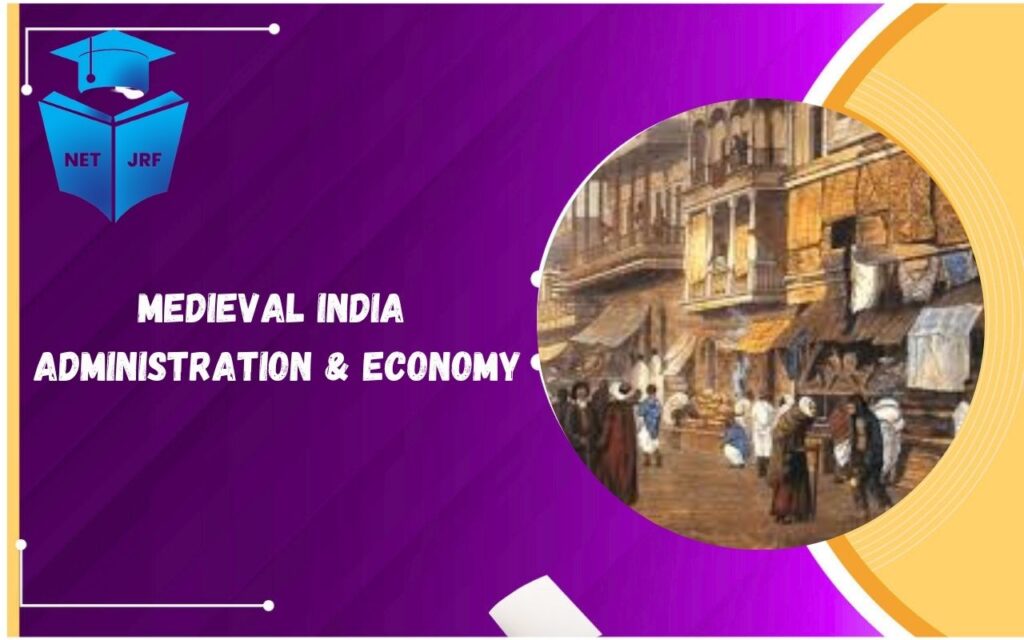
Medieval India Administration & Economy provides a fascinating look into how the Delhi Sultanate functioned. This period marks a major shift in the political and financial history of the Indian subcontinent. Many historians debate whether the Sultanate was a true theocracy or a secular state. Understanding these nuances helps students grasp the complex nature of power during this era.

Medieval India Theocratic Nature of the Sultanate
To understand Medieval India Administration & Economy we must first define a theocratic state. In a pure theocracy, the religious head is also the political head. There is a total fusion between religion and politics.
- This means the government bases every policy on religious laws. The king acts as a guardian of the faith rather than a secular leader.
- In such a system, the priestly class or the Ulema interpret the law.
- The king does not make independent decisions. Instead, religion guides every political, social, and economic move. For many years, scholars looked at the Delhi Sultanate through this lens. They noticed that the Sultans often used Islamic symbols to justify their rule.
- However, the reality of Medieval India Administration & Economy was much more complex. While the state had Islamic features, it did not always follow the strict definition of a theocracy.
- The Sultans often prioritized political survival over religious dogma. This tension created a unique administrative style that balanced faith with the practical needs of governing a vast, diverse population.
Enroll UGC NET Offline Classes in Jaipur
Medieval India – Role of Khalifa
A key feature of Medieval India Administration & Economy involves the relationship with the Khalifa. The Khalifa was the spiritual head of the entire Islamic world. Many Delhi Sultans sought a formal document of recognition, known as ‘Investiture’, from the Khalifa. This document gave them the legal right to rule in the eyes of the Muslim population.
- Rulers like Iltutmish and later Sultans issued coins in the name of the Khalifa.
- They also mentioned the Khalifa’s name in the Friday prayers, or Khutba. To a superficial observer, this makes the Sultan appear as a mere deputy or nominal head.
- It suggests that the real power resided with the religious leadership in Baghdad or Cairo.
- However, modern historians argue this was a tool for legitimacy. The Sultans used the Khalifa’s name to prevent revolts and ensure loyalty among their Muslim subjects.
- In practice, the Khalifa never interfered in the daily affairs of the Delhi Sultanate. The Sultan remained the absolute authority within India. This shows that while the form was religious, the function was purely political.
Medieval India Administration & Economy Core Pillars
The administrative structure of the Sultanate was built on several pillars. These systems ensured that the state could collect revenue and maintain a large standing army. The Sultan sat at the top of this hierarchy, assisted by various ministers.
- The Diwan-i-Wizarat: This was the finance department headed by the Wazir.
- The Diwan-i-Arz: This department handled military affairs and recruitment.
- The Diwan-i-Insha: This office managed royal correspondence and state records.
- The Diwan-i-Rasalat: This department dealt with religious matters and foreign affairs.
Each of these offices played a role in maintaining the Medieval India Administration & Economy The Iqtadari system was perhaps the most vital economic innovation. The Sultan granted land tracts, called Iqtas, to military commanders. These commanders collected revenue and maintained troops for the Sultan. This system linked the economy directly to military strength.
Join UGC NET Coaching in Jaipur
Medieval India Influence of Ulema on State Policy
The Ulema, or the class of Islamic theologians, held a significant position in society. In a theocratic state, their interpretation of the law would be final. They often pushed the Sultans to implement Sharia law strictly.
- They wanted the state to focus on spreading Islam and suppressing other faiths.
- However, the power of the Ulema was not absolute. It often depended on the personality of the Sultan on the throne.
- Strong rulers like Alauddin Khilji and Muhammad bin Tughlaq did not allow the Ulema to interfere in state matters. T
- hey believed that politics and religion should remain separate. These Sultans made decisions based on the welfare of the state rather than religious advice.
- When the Ulema suggested that the Iltutmish should force all Hindus to convert, he rejected the idea. He stated that such a move was impractical in a country like India. This shows that Medieval India Administration & Economy was often guided by “Siyasa” (politics) rather than just “Sharia” (religious law). The state needed to be pragmatic to survive.

Taxation Systems in Medieval India – Kharaj, Jizya, and Zakat
Taxation is a vital part of Medieval India Administration & Economy:. The Sultanate followed Islamic fiscal theory but adapted it to Indian conditions. There were four main types of taxes mentioned in historical texts.
- Kharaj: This was the land tax collected from non-Muslim peasants.
- Zakat: This was a charitable tax paid only by Muslims.
- Jizya: This was a tax imposed on non-Muslim subjects, known as Zimmis.
- Khums: This was the state’s share of the spoils of war.
The Jizya tax is often cited as evidence of a theocratic state. However, the application of Jizya was not as harsh as it seems. The state exempted women, children, the elderly, and the disabled from this tax. Even the poor and the unemployed did not have to pay it. For a long time, the state also exempted Brahmins from Jizya. It was only under Firoz Shah Tughlaq that Brahmins were forced to pay it.
Enroll UGC NET Online Coaching
Comparison of Medieval India Administration & Economy
| Feature | Theocratic View | Secular/Pragmatic View |
| Head of State | King as a religious deputy | King as an independent ruler |
| Law Source | Strict Sharia law | State laws (Zawabit) |
| Non-Muslim Status | Not considered full citizens | Allowed to live normal lives |
| Ulema Role | Dominant in decision making | Influence limited by strong kings |
| Goal of State | Spread of religion | Political stability and expansion |
Secular Administrative Orders and Zawabit
One of the strongest arguments against the theocratic label is the existence of Zawabit. Zawabit were secular state laws enacted by the Sultans to meet specific administrative needs.
- These laws were independent of religious scriptures.
- They covered issues like land revenue, military organization, and market regulations.
- Ziauddin Barani, a famous contemporary historian, noted this distinction. He described the government as “Jahandari,” which refers to secular state-craft.
- He admitted that the Sultanate was not a “Dindari” or a purely religious state.
- This admission is crucial because Barani himself was quite orthodox. If he even recognized the secular nature of the administration, it proves that Medieval India Administration & Economy prioritized practical governance.
- The Sultans issued “Farmans” (royal decrees) that all subjects had to follow. These decrees often protected the interests of the state over the demands of the clergy. For instance, Alauddin Khilji’s market reforms were purely economic. They aimed to keep prices low so he could maintain a large army. There was no religious motivation behind these successful policies.
Medieval India Social Fabric and Status of Zimmis
In the context of Medieval India Administration & Economy, non-Muslims were classified as “Zimmis” or protected people. While they did not have the same religious status as the “Millat” (the Muslim community), they were not excluded from society. Most of the land and wealth remained in the hands of Hindu masters and traders.
The Hindu population in villages continued to live their normal lives. The state did not force them to accept Islam.
- Forceful conversions were rare and usually happened during times of war. The Sultans realized that they could not rule India by antagonizing the majority population.
- Therefore, they allowed Hindus to practice their religion and manage their own local affairs.
- This social reality shaped the Medieval India Administration & Economy:. The state relied on Hindu intermediaries, like the Khuts and Muqaddams, to collect rural taxes.
- Without the cooperation of these local Hindu elites, the Sultanate’s revenue system would have collapsed. This interdependence further pushed the state away from a strict theocratic path.

Conclusion
In summary, Medieval India Administration & Economy: represents a period of intense transition and adaptation. The Delhi Sultanate was an Islamic state in its outward appearance and symbols. It sought legitimacy from the Khalifa and collected taxes like Jizya. However, when we look deeper, we see a state driven by secular needs and political survival. Strong rulers prioritized state law over religious dogma to maintain order in a diverse land.
The use of Zawabit and the pragmatic treatment of the Hindu majority suggest that the state was more “Jahandari” than “Dindari”. The Sultanate created a bridge between Islamic administrative traditions and Indian local systems. This blend allowed the empire to thrive for centuries. For any student of history, understanding Medieval India Administration & Economy is essential to seeing how power and faith interacted in the medieval world.
Enroll UGC NET Mock Test Series
Chronology of Administrative Evolution
Iltutmish: Established the Iqtadari system and secured the first Investiture from the Khalifa.
Balban: Strengthened the monarchy and introduced Persian court etiquettes to enhance royal prestige.
Alauddin Khilji: Separated religion from politics and introduced rigorous market and land reforms.
Muhammad bin Tughlaq: Attempted to create a more centralized and rational administration.
Firoz Shah Tughlaq: Reverted to some orthodox policies and expanded the irrigation system.
Medieval India Administration & Economy FAQs

Was the Delhi Sultanate a true theocratic state?
While it had theocratic elements, such as the state religion being Islam, it was not a pure theocracy. Sultans often ignored religious leaders to make secular, political decisions.
Who were the Ulema?
The Ulema were Islamic scholars and theologians who advised the Sultan on religious and legal matters. Their influence varied depending on the strength of the ruler.
What are Zawabit?
Zawabit are secular state laws or regulations created by the Sultans. They were not based on religious scriptures and focused on practical administration.
How did Medieval India Administration & Economy: handle non-Muslims?
Non-Muslims were called Zimmis. They paid Jizya but were generally allowed to practice their faith and own property. The state relied on Hindu elites for local governance.
What was the role of the Khalifa?
The Khalifa was a symbolic head. Sultans used his name on coins and in prayers to gain legitimacy among Muslims, but the Khalifa did not rule India.
Why did Alauddin Khilji oppose the Ulema?
He believed that the requirements of the state were different from the requirements of religion. He wanted total control over his administration without clerical interference.
What was the purpose of the Jizya tax?
Technically, it was a tax on non-believers for state protection. However, many groups like women, children, and the disabled were exempt from paying it.
What does the term "Jahandari" mean?
It refers to secular or worldly governance. Historian Ziauddin Barani used it to describe the Delhi Sultanate's administrative style.
How did the economy support the military?
The state used the Iqtadari system to assign land revenues to military officers. This ensured a steady supply of troops and funds for the Sultan's expansion.