
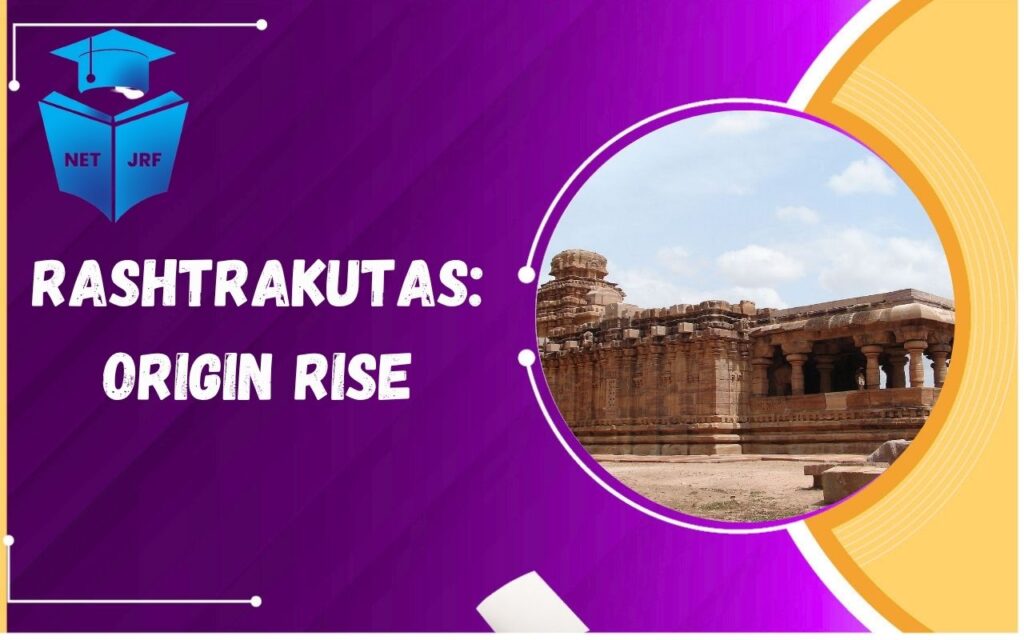

The Rashtrakutas were one of the most powerful dynasties in early medieval India, especially in the Deccan region. Their rise changed the political balance of India after the decline of earlier empires like the Chalukyas. Understanding their origin and the rise of Dantidurga helps students clearly see how regional powers emerged and created strong kingdoms.

Rashtrakutas Introduction
The term Rashtrakutas refers to a ruling dynasty that controlled large parts of the Deccan from the 8th to 10th century. They played a key role in shaping early medieval Indian politics, culture, and administration.
Their empire extended over areas of present-day Maharashtra, Karnataka, Gujarat, and parts of central India. They were also involved in the famous tripartite struggle for control over Kannauj.
Enroll UGC NET Coaching in Jaipur
Key Features
- Strong military leadership
- Efficient administration
- Support for art and culture
- Strategic expansion policy
Rashtrakutas Origin
The Rashtrakutas, one of the most prominent dynasties in early medieval India, have an origin that has been debated by historians. Multiple theories exist, and each provides insight into the cultural, linguistic, and political background of this dynasty.
Theory of Kannada Origin:
- Many scholars argue that the Rashtrakutas originated from the Kannada-speaking regions of Karnataka.
- This theory is supported by inscriptions and administrative records in Kannada, showing early use of the local language in governance.
- The prominence of Kannada culture in early Rashtrakuta domains suggests that they had strong roots in the Deccan region.
Link with Ancient Tribes:
- Some historians connect the Rashtrakutas with ancient tribal groups mentioned in early Indian texts.
- These tribes were known for their warrior traditions, which aligns with the Rashtrakutas’ reputation for military skill and conquests.
- The tribal connection helps explain the dynasty’s early military strength and social organization.
Connection with Earlier Rulers:
- Another theory proposes that the Rashtrakutas were initially feudatories under the Chalukyas.
- Over time, they gradually gained power and independence, eventually establishing their own dynasty.
- This progression from subordinate chiefs to sovereign rulers reflects a common pattern in Deccan political history.
Epigraphic Evidence:
- Inscriptions from the early Rashtrakuta period provide valuable clues about their origin:
- Use of Sanskrit and Kannada in official records, showing bilingual administration.
- Titles like Maharajadhiraja, indicating sovereignty and royal authority.
- References to early chiefs and regional rulers, helping trace the lineage and expansion of the dynasty.
Before the Rashtrakutas became a dominant force, the Deccan region was largely under the control of the Badami Chalukyas. However, by the mid-8th century, internal weaknesses in the Chalukya kingdom created an opening for new powers.
Political Situation:
- The Chalukyas faced a decline of central authority, which made it difficult to manage their vast territories.
- Local chiefs and feudatories started asserting autonomy, leading to fragmentation.
- Frequent wars and conflicts among regional rulers weakened overall political stability.
- This environment allowed ambitious and capable leaders to rise and challenge the old order.
Rise of Dantidurga
Dantidurga was the key figure who transformed the Rashtrakutas from regional powers into an imperial dynasty. His rise marks the beginning of the Rashtrakuta imperial phase.
Early Life of Dantidurga:
- Dantidurga was initially a subordinate ruler under the Chalukyas.
- He came from a family that had established military strength and regional influence, giving him the resources needed for expansion.
Overthrow of the Chalukyas:
- Dantidurga successfully defeated the last Chalukya ruler, Kirtivarman II.
- This victory was highly significant, as it marked the start of independent Rashtrakuta rule in the Deccan.
- By overthrowing a declining power, Dantidurga established himself as a sovereign ruler, capable of challenging neighboring dynasties.
Key Achievements of Dantidurga:
- Established control over the Deccan: Unified large parts of the region under Rashtrakuta authority.
- Defeated powerful enemies: Consolidated power by subduing rival chiefs and local rulers.
- Strengthened administration: Set up systems to manage provinces efficiently, including tax collection, military organization, and local governance.
- His leadership laid the foundation for the Rashtrakuta Empire, which later became one of the most influential dynasties in medieval India.

Military Expansion under Dantidurga
Dantidurga, the founder of the Rashtrakuta Empire, expanded his territory through careful planning and strategic military campaigns. His victories not only increased the size of the empire but also enhanced its political and cultural influence.
Major Campaigns:
- Defeat of the Chalukyas: Dantidurga overthrew the last Badami Chalukya ruler, Kirtivarman II, which established Rashtrakuta independence.
- Victories over the Pallavas: He successfully checked the influence of the Pallavas in the southern Deccan, expanding Rashtrakuta authority into Tamil regions.
- Control over Malwa region: Expansion into Malwa and central India gave the Rashtrakutas access to fertile lands and strategic trade routes.
Enroll UGC NET Offline Coaching in Jaipur
Importance of Expansion:
- Increased political power: The empire became a major force in early medieval India, recognized by neighboring dynasties.
- Access to resources: New territories provided agricultural surplus, trade opportunities, and manpower for the army.
- Strengthened reputation: Dantidurga’s military success enhanced the prestige of the Rashtrakutas, ensuring loyalty from feudatories and fear among rivals.
His campaigns laid the foundation for a dominant and stable Rashtrakuta Empire, setting a precedent for later rulers like Kakusthavarma and Amoghavarsha.
Rashtrakutas Administrative System
The Rashtrakuta administration was well-structured, allowing smooth governance over a vast empire. The system combined centralized authority with delegated power to local officials and feudatories.
Features of Administration:
- The king was the supreme authority, making final decisions on policy, taxation, and military campaigns.
- The empire was divided into provinces, which were further divided into districts, ensuring efficient management.
- Local officials managed villages, overseeing tax collection, law enforcement, and local disputes.
Role of Feudatories:
- Feudatories were subordinate rulers who retained control over their territories but owed loyalty to the king.
- Responsibilities included:
- Maintaining armed forces for the king’s campaigns.
- Collecting taxes and tributes from villages.
- Supporting the king during military conflicts or administrative challenges.
This balance between central authority and local autonomy helped maintain stability across the Rashtrakuta Empire and allowed Dantidurga to focus on expansion and consolidation.
Economic Condition under Dantidurga
The economy of the Rashtrakutas was strong, diverse, and sustainable, forming the backbone of political power.
Sources of Revenue:
- Land tax formed the main source of income, collected from agricultural lands across the empire.
- Trade duties from marketplaces and trade routes contributed significantly.
- Tribute from subordinate rulers under the feudatory system ensured steady revenue.
Trade and Commerce:
- The empire’s strategic location in the Deccan facilitated both inland and foreign trade.
- Connections with traders from the north and south, as well as maritime trade routes, enriched the kingdom.
- Markets and towns developed near trade hubs, promoting craft production, agriculture, and economic diversification.
A stable and growing economy supported the military, funded administrative activities, and allowed the Rashtrakutas to patronize art, literature, and temple construction.
Rashtrakutas Cultural Contributions
The Rashtrakutas were not only powerful rulers but also great patrons of art, literature, and religion. Their reign is remembered for promoting a vibrant cultural environment across the Deccan and beyond.
Literature
- The Rashtrakutas encouraged the growth of Sanskrit and Kannada literature, making both languages flourish during their rule.
- Poets, scholars, and writers received royal patronage, which allowed them to produce works on religion, philosophy, history, and poetry.
- Famous literary figures like Trivikrama, Jinasena, and Sri Vijaya composed important texts under Rashtrakuta support.
- This focus on literature helped spread knowledge and enhanced cultural prestige, contributing to the intellectual life of the empire.
Enroll UGC NET Online Coaching
Architecture
- Rashtrakutas were known for magnificent temples, monuments, and rock-cut architecture.
- The Ellora Caves in Maharashtra are a prime example, showcasing intricate carvings, sculptures, and engineering excellence.
- Temples reflected Dravidian and Nagara styles, often blending regional artistic traditions.
- These architectural works were not only religious centers but also served as cultural hubs, where art, education, and ritual practices combined.
Religious Tolerance
- The Rashtrakutas practiced religious inclusivity, supporting multiple faiths.
- Hinduism received royal patronage through temples, rituals, and endowments.
- They also encouraged Jainism and Buddhism, granting land and support to monasteries and scholars.
- This tolerance promoted social harmony, helped integrate different communities, and strengthened the legitimacy of the rulers.
Art and Sculpture
- Beyond temples, the Rashtrakutas promoted sculpture, painting, and decorative arts.
- Stone carvings often depicted mythological scenes, royal achievements, and religious themes.
- Their emphasis on art helped preserve the cultural identity of the Deccan and inspired later dynasties like the Western Chalukyas and Hoysalas.
Key Facts about Rashtrakutas
The rise of the Rashtrakutas marked a period of political strength and cultural brilliance in the Deccan, leaving a lasting impact on Indian history through their achievements in warfare, architecture, and literature.
| Feature | Details |
| Dynasty Name | Rashtrakutas |
| Founder | Dantidurga |
| Region | Deccan |
| Capital | Manyakheta |
| Time Period | 8th–10th century |
| Known For | Military power, culture |
Rashtrakutas Political Significance
The rise of the Rashtrakutas was a major turning point in early medieval Indian history. Their emergence reshaped the political landscape of the Deccan and northern India.
Emergence of Regional Powers:
- The Rashtrakutas consolidated large parts of the Deccan, which encouraged the rise of regional powers in surrounding areas.
- Local chiefs and feudatories were either integrated into the empire or influenced by Rashtrakuta administration.
- This contributed to a more structured regional political system, replacing fragmented smaller kingdoms.
Decline of Old Dynasties:
- The rise of the Rashtrakutas led to the decline of the Badami Chalukyas and weakened other established powers such as the Pallavas.
- Old dynasties either became subordinate feudatories or lost relevance, giving the Rashtrakutas supremacy in the Deccan.
Beginning of the Tripartite Struggle:
- The Rashtrakutas were key players in the tripartite struggle involving the Rashtrakutas, Palas, and Pratiharas for control over northern India.
- This competition for supremacy shaped political dynamics for the next two centuries, highlighting the strategic importance of the Rashtrakuta Empire.

Rashtrakutas Social Structure
The Rashtrakuta period saw a diverse and evolving society with a mix of traditional hierarchies and emerging urban centers.
Varna System and Communities:
- The varna system existed, with Brahmins, Kshatriyas, Vaishyas, and Shudras playing distinct roles.
- Various communities, including artisans, traders, and farmers, contributed to the economic and social life of the empire.
- Urbanization led to the growth of towns and markets, allowing interaction among different social groups.
Role of Women:
- Women, especially in royal and noble families, enjoyed certain rights and influence.
- Some royal women acted as patrons of temples, literature, and art, highlighting their social significance.
- Ordinary women participated in family businesses, craft production, and local community life, showing that society was structured but not completely rigid.
The history of the Rashtrakutas shows how strong leadership and strategic planning can create a powerful empire. The rise of Dantidurga was not sudden but the result of careful military and political efforts.