
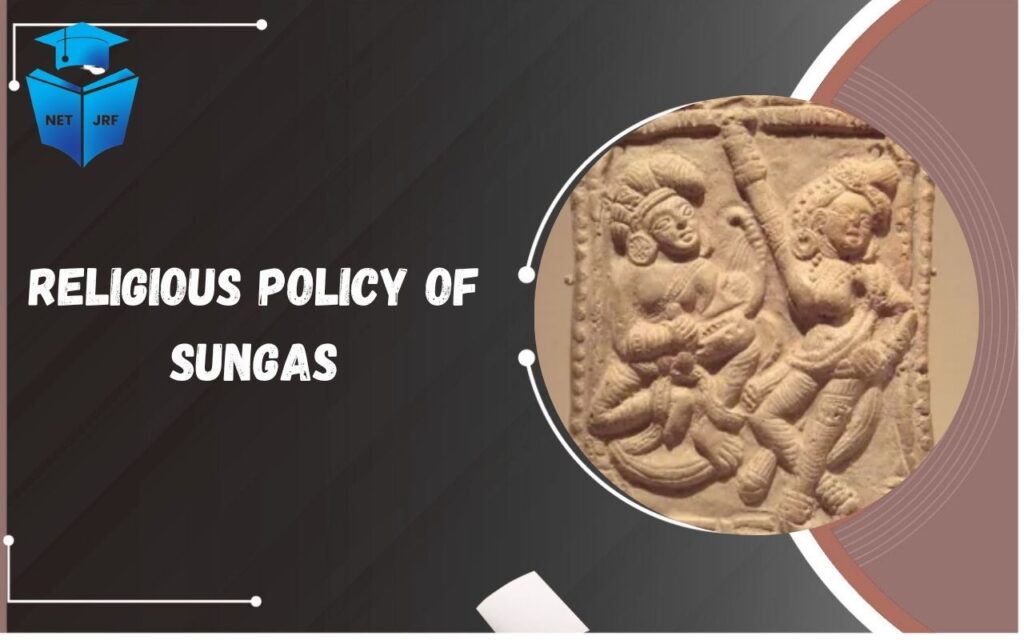

The Religious policy of Sungas is an important topic in ancient Indian history. The Religious policy of Sungas helps us understand how religion influenced politics and society after the fall of the Mauryan Empire.

Religious Situation Before Sungas Background
To understand the Religious policy of Sungas, we must first look at the situation under Ashoka.
Ashoka strongly supported Buddhism.
Key Features of Mauryan Religious Policy
- Promotion of Buddhism
- Spread of Dhamma
- Support to monks and stupas
After his death, this system weakened, creating space for change.
Enroll UGC NET Online Coaching
Religious policy of Sungas Overview
The Religious policy of Sungas reflects a shift in religious priorities.
Main Features
Revival of Brahmanism
- The Shunga rulers actively supported Brahmanical traditions.
- Brahmins regained influence in politics, rituals, and social life.
Performance of Vedic Rituals
- Rituals such as the Ashvamedha Yajna were performed to assert royal authority.
- Emphasis on Vedic ceremonies reinforced the legitimacy of the ruling dynasty.
Reduced Royal Patronage to Buddhism
- Support to Buddhist institutions and monasteries declined compared to the Mauryan period.
- Some historical accounts suggest conflicts with Buddhist establishments, though evidence is debated.
Complex Religious Environment
- Despite the focus on Brahmanism, the situation was not simple religious antagonism.
- Multiple faiths coexisted, and local religious practices continued alongside royal patronage.
However, the situation was more complex than simple opposition.
Rise of Brahmanism
The Religious policy of Sungas strongly supported Brahmanical traditions.
Key Elements
Promotion of Vedic Texts
- Vedic literature and scriptures were encouraged and preserved.
- Learning centers and recitation of sacred texts were supported by the state.
Support to Brahmins
- Brahmins received royal patronage, land grants, and positions of influence.
- Their role in rituals and governance reinforced the authority of the Shunga kings.
Importance of Rituals
- Vedic rituals, such as Ashvamedha Yajna, were performed to assert power and legitimacy.
- Rituals served both religious and political purposes, strengthening central authority symbolically.
This revival was significant after Mauryan rule.
Performance of Vedic Rituals
The Religious policy of Sungas included major Vedic ceremonies.
Important Rituals
Ashvamedha Yajna
- The most significant ritual performed by Pushyamitra Shunga was the Ashvamedha Yajna.
- It symbolized the king’s sovereignty and dominance over territories.
Political Significance of Rituals
- Rituals were public demonstrations of power and legitimacy.
- They reinforced the king’s status in the eyes of nobles, priests, and subjects.
Strengthening Royal Authority
- Performing these rituals consolidated social and political hierarchies.
- They showcased the integration of religion and governance in the Shunga period.
Debate on Buddhist Persecution
The Religious policy of Sungas is often debated regarding Buddhism.
Historical Claims
Literary Sources
- Texts like the Divyavadana mention that some Buddhist monasteries were destroyed during the Shunga period.
- Accounts suggest that the dynasty, particularly under Pushyamitra Shunga, favored Brahmanical institutions over Buddhist ones.
Destruction of Buddhist Monasteries
- Some historical sources report attacks on or neglect of Buddhist stupas and monasteries.
- These narratives reflect the rise of Brahmanism and the decline of royal patronage to Buddhism.
Modern Scholarly View
Reliability of Sources
- Many accounts were written centuries later and may exaggerate or misrepresent events.
- Historical accuracy is debated; evidence is not fully reliable.
Continuity of Buddhism
- Archaeological findings show that numerous Buddhist structures continued to function.
- Buddhism remained influential in several regions despite reduced royal support.
So, the Religious policy of Sungas may not have been purely anti-Buddhist.

Continued Existence of Buddhism
The Religious policy of Sungas did not completely eliminate Buddhism.
Evidence
- Buddhist stupas like Bharhut continued
- Donations by local rulers
This shows coexistence.
Enroll UGC NET Coaching in Jaipur
Religious Tolerance
The Religious policy of Sungas shows some level of tolerance.
Key Points
Continuation of Buddhist Stupas
- Monuments like the Bharhut Stupa remained active and were maintained during the Shunga period.
- Artistic and structural developments continued in Buddhist religious sites.
Donations by Local Rulers
- Local kings and regional elites made contributions to Buddhist monasteries and stupas.
- These donations indicate ongoing support at the regional level, even if royal patronage at the center was limited.
Shunga Religious Policy on Society Influence
The religious policies of the Shunga dynasty had far-reaching effects on both social life and political structures.
Influence on Society
Strengthening of the Caste System
- Royal support for Brahmanism reinforced social hierarchies.
- Brahmins gained prominence in both religious and social spheres.
Revival of Traditional Customs
- Vedic rituals and ceremonies became widespread, reviving older cultural practices.
- Social norms aligned more closely with Brahmanical traditions.
Role of Religion in Daily Life
- Religion guided moral conduct, social obligations, and community interactions.
- The Shunga period shows how state policies and religion shaped societal behavior.
Political Use of Religion
Legitimization of Kingship
- Rituals like the Ashvamedha Yajna were performed to assert political authority.
- Religious ceremonies symbolized the divine sanction of the king’s rule.
Brahminical Influence in Politics
- Brahmins held advisory roles and influenced policy decisions.
- Royal patronage strengthened the link between religion and governance.
Religion as a Tool of Power
- Religious support helped consolidate central and regional authority.
- This demonstrates the strategic use of religious traditions to reinforce political control.
Significance
- The Shunga religious policy reinforced social hierarchies and cultural continuity.
- Religion was not only a personal or spiritual matter but also a key instrument of political legitimacy.
- The period illustrates the intertwined nature of religion, society, and politics in post-Mauryan India.
Cultural Developments under Shunga Religious Policy
The religious policy of the Shunga dynasty not only shaped social and political life but also had a profound influence on culture, art, and architecture.
Development of Sanskrit Literature
- Sanskrit literary works flourished under Shunga patronage.
- Religious and philosophical texts were composed and preserved, strengthening Brahmanical culture.
Growth of Religious Art
- Artistic expression was closely tied to religious themes.
- Sculptures, carvings, and reliefs reflected Brahmanical ideals and rituals.
Construction of Monuments
- Temples and shrines were built to honor deities and perform rituals.
- Monuments served both religious and political purposes, symbolizing royal authority.
Role of Art and Architecture
Bharhut Stupa Decorations
- Reliefs and carvings at Bharhut Stupa depict religious themes and mythological stories.
- These artworks show the influence of Brahmanical as well as Buddhist traditions.
Development of Temple Architecture
- Shunga rulers encouraged construction and decoration of temples.
- Architectural developments reflect religious symbolism and cultural sophistication.
Strengths of the Shunga Religious Policy
Revival of Traditional Culture
- Promotion of Vedic rituals and Sanskrit texts revived Brahmanical traditions.
Strengthening of Social Order
- Brahminical influence reinforced caste hierarchies and social norms.
Support for Religious Practices
- Patronage of rituals, art, and monuments ensured continuity of religious and cultural practices.

Legacy Shunga Religious Policy
While the religious policies of the Shunga dynasty had many strengths, they also had notable limitations and long-term impacts on Indian society and culture.
Limitations
Potential Religious Tension
- Royal emphasis on Brahmanism may have caused friction with other religious communities, particularly Buddhists and Jains.
- Conflicting historical accounts create debates about the degree of intolerance.
Reduced Diversity in Patronage
- Royal support became more focused on Brahmanical institutions.
- Other religious traditions received less attention or diminished royal backing.
Debate over Intolerance
- Some texts suggest persecution of Buddhists, though archaeological evidence shows continued Buddhist activity.
- Historians continue to debate whether the policy was actively oppressive or mainly symbolic
Enroll UGC NET Offline Coaching in Jaipur
Conclusion
The Religious policy of Sungas represents an important shift in ancient India. It shows the revival of Brahmanical traditions while maintaining some level of religious diversity.