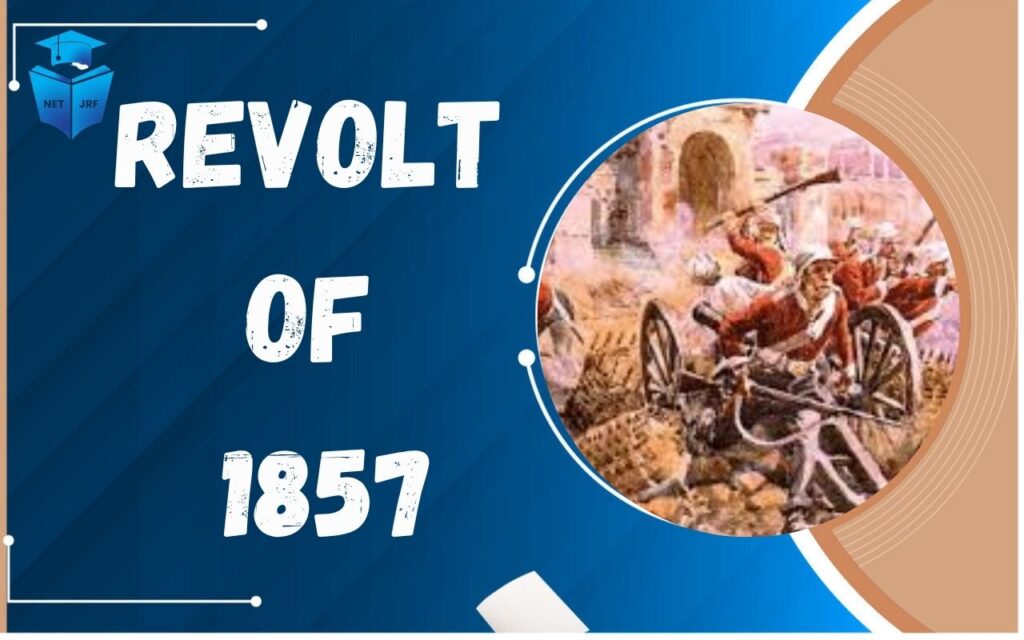
The revolt of 1857 stands as the first significant attempt by Indians to end the rule of the British Empire. This massive uprising began on 10 May 1857 as a military mutiny but soon turned into a large-scale rebellion. It challenged the very foundation of British power in India. People from different walks of life joined this struggle to protect their rights and traditions.

The movement first erupted in Meerut before spreading across North and Central India. It brought together soldiers, peasants, and local rulers under one common goal. This event served as a watershed moment that changed how the British governed the Indian subcontinent. History books often call it the “First War of Independence” because it united various communities against foreign rule.
Join UGC NET Foundation Course
Revolt of 1857 Political Causes
The British introduced several political policies that deeply offended Indian rulers and the public. These actions stripped local leaders of their power and prestige. The primary goal of these policies was to expand British territory at any cost.
- One major policy was the Doctrine of Lapse introduced by Lord Dalhousie. Under this rule, the British annexed any Indian state where the ruler died without a natural male heir. They took over states like Satara, Jhansi, and Nagpur using this controversial method. This policy directly attacked the traditional rights of Indian royalty.
- In 1856, the British annexed the state of Awadh on the pretext of misgovernance. This move sparked intense resentment among the local people and the soldiers who came from that region. Furthermore, the British showed great disrespect to the Mughal Emperor, Bahadur Shah II. They barred his successors from living in the Red Fort and humiliated the royal family.
- Many landlords and zamindars also lost their estates and traditional privileges. This alienated the elite class who previously held significant social influence.
- The British also denied Indians high-ranking positions in the civil and military administration. This exclusion frustrated educated Indians and the ruling classes who felt like second-class citizens in their own land.
Revolt of 1857 Economic Causes
British economic policies caused widespread poverty and destroyed traditional Indian industries. The main objective of the East India Company was to extract as much wealth as possible from India. This “Drain of Wealth” financed British administration and military operations outside India.
- The British implemented harsh land revenue systems like the Permanent Settlement, Mahalwari, and Ryotwari systems. These systems imposed heavy taxes on peasants, leading to massive debt and loss of land. Farmers often lived in extreme misery while the British collected revenue even during times of crop failure.
- The rise of British machine-made goods ruined the local handicraft industry. Artisans and weavers lost their jobs because they could not compete with cheap imports from England. This shift made India a mere supplier of raw materials and a market for British products.
- The British also forced farmers to grow cash crops like indigo and opium instead of food crops. This practice led to frequent famines and food shortages across the country. Indigo farmers faced severe oppression and lived in a state of perpetual poverty. These economic grievances created a fertile ground for a mass rebellion against colonial rule.
Revolt of 1857 Social and Religious Causes
The British often interfered with Indian social customs and religious practices, which caused deep fear and anger. Many Indians viewed these reforms as a direct threat to their traditional way of life. The British maintained a sense of racial superiority and treated Indians with contempt.
- Reforms such as the abolition of Sati and the legalization of widow remarriage alienated conservative sections of society. While these reforms had humanitarian goals, many Indians saw them as unwanted interference in their religious laws. The aggressive activities of Christian missionaries further intensified this fear. People worried that the British intended to convert the entire population to Christianity.
- The British remained socially aloof and never integrated with Indian society. This lack of social connection deepened the divide between the rulers and the ruled. Traditional religious leaders, like Pandits and Maulvis, lost their prestige and influence under the new administration.
- Western education and legal systems were also seen as an attempt to erase Indian culture. The British ignored local traditions while imposing their own laws and values. This cultural insensitivity made the population feel that their identity was at risk.
Revolt of 1857 Administrative and Military Causes
The centralized British administration reduced the influence of local chiefs and traditional rulers. This shift in power created a sense of instability in the social order. Many people felt that the new legal system was complex, expensive, and biased toward the British.
- The Indian soldiers, known as sepoys, faced significant discrimination within the British army. They received lower pay compared to European soldiers and had very few chances for promotion. The British military recruitment policies also ignored the cultural and religious sensibilities of the sepoys.
- Soldiers often had to serve in distant lands or overseas, which sometimes conflicted with their religious beliefs. Poor service conditions and the lack of respect from British officers created a tense environment in the army camps. These grievances turned the very protectors of the British Empire into its biggest enemies.
Top UGC NET Online Test Series
Revolt – Greased Cartridges : Immediate Cause
While long-term grievances were piling up, a single event acted as the final spark for the uprising. The British introduced the new Enfield Rifle, which required a specific type of cartridge. Rumors spread that these greased cartridges were coated with the fat of cows and pigs.
- This rumor deeply offended both Hindu and Muslim soldiers. Hindus consider the cow sacred, while Muslims consider the pig unclean. Using these cartridges required biting off the ends, which the soldiers felt would violate their religious beliefs.
- In March 1857, a soldier named Mangal Pandey revolted against his officers at Barrackpore. The British executed him, which further fueled the anger of other sepoys. By May 1857, a large group of sepoys in Meerut refused to use the cartridges. Their arrest led to a full-scale mutiny that quickly moved to Delhi.
Revolt of 1857 Features and Nature
The uprising was not a simple event but a complex movement with unique characteristics. It combined military mutiny with a widespread civilian rebellion. This duality made it a formidable challenge for the British forces.
- One of the most striking features was the incredible Hindu-Muslim unity. Members of both communities fought side-by-side against the common enemy. They declared the Mughal Emperor, Bahadur Shah II, as the symbolic leader of India. This act showed a growing sense of collective Indian identity.
- The movement was mainly concentrated in northern, central, and western India. Areas like Delhi, Kanpur, Lucknow, and Jhansi became major centers of the fight. However, the revolt did not gain much momentum in southern and eastern parts of India.
- The participation was diverse, involving various sections of society. Peasants joined the sepoys to attack moneylenders and British officials. Local zamindars and displaced rulers provided leadership to the masses. Despite its eventual failure, the movement sowed the seeds of modern Indian nationalism.

Revolt of 1857 Key Leaders
The rebellion saw the emergence of several brave leaders who led the fight in different regions. These leaders represented the diverse interests that the British had harmed. They fought valiantly against superior British forces.
Key Leaders of the Revolt of 1857
| Leader Name | Primary Center | Key Contribution and Action |
| Bahadur Shah II | Delhi | Symbolic head of the revolt and last Mughal Emperor. |
| Rani Lakshmi Bai | Jhansi | Led Bundelkhand rebels and fought bravely against Hugh Rose. |
| Nana Saheb | Kanpur | Declared himself Peshwa and led the Kanpur uprising. |
| Begum Hazrat Mahal | Lucknow | Proclaimed her son as Nawab and led the resistance in Awadh. |
| Kunwar Singh | Bihar | Led rebellions in Bihar even at an advanced age. |
| Tatya Tope | Gwalior | Expert in guerrilla tactics and allied with Rani Lakshmi Bai. |
| Bakht Khan | Delhi | Led the troops from Bareilly and took charge in Delhi. |
These leaders managed to keep the British on their toes for over a year. They captured important cities and established their own administration for a brief period. Their bravery became a source of inspiration for future generations of freedom fighters.
Enroll UGC NET Offline Classes in Jaipur
Causes Behind the Collapse of 1857
Despite the widespread passion and bravery, the movement eventually collapsed by 1858. Several internal and external factors contributed to this outcome. The British managed to regain control through brutal force and better strategy.
A major reason for failure was the lack of unity among Indians. Large parts of the country, including Punjab and the South, remained loyal to the British. Many Indian princes and chiefs even helped the British suppress the rebellion. The educated class also stayed away, believing that British rule was necessary for modernizing India.
The rebels lacked a unified program or a clear vision for the future of the country. Each leader focused on their local grievances rather than a coordinated national strategy. This led to a lack of central leadership and poor coordination between different centers.
The British had significant military superiority. They possessed advanced weapons, better communication lines like the telegraph, and a disciplined army. The British also used brutal tactics, including mass executions and the burning of villages, to crush the spirit of the rebels.
Impact and Consequences of Movement
- The uprising forced the British to make massive changes in how they managed India. It ended the era of the East India Company and brought India under the direct control of the British Crown. This change happened through the Government of India Act of 1858.
- The British restructured the Indian military to prevent future mutinies. They increased the number of European soldiers and organized Indian regiments based on caste and region. This divide and rule policy aimed to break the unity among Indian soldiers.
- The policy toward princely states also changed. The British stopped the practice of annexation and allowed local rulers to adopt heirs. This was an attempt to win back the loyalty of the Indian royalty. However, the British continued to deepen religious divisions, particularly by discriminating against the Muslim community in public jobs.
Comparison of India Before and After 1857
| Feature | Before the Revolt | After the Revolt |
| Governing Body | East India Company | British Crown (Direct Rule) |
| Annexation Policy | Aggressive (Doctrine of Lapse) | Annexation stopped; heirs allowed |
| Military Structure | High number of Indian sepoys | Increased European soldiers; caste-based units |
| Administrative Head | Governor-General | Viceroy and Secretary of State |
| Social Policy | Attempted westernization | More cautious and “Divide and Rule” |
Timeline of Major Events
The movement followed a logical progression from local unrest to a major war. Understanding the sequence of events helps in grasping the scale of the uprising.
| Date/Period | Event Description |
| March 1857 | Mangal Pandey revolts at Barrackpore and is later executed. |
| April 1857 | Sepoys in Meerut refuse to use the greased cartridges. |
| May 10, 1857 | Sepoys in Meerut start a full mutiny and kill British officers. |
| May 11–12, 1857 | Rebels reach Delhi and proclaim Bahadur Shah II as Emperor. |
| June 1857 | Movement spreads to Kanpur, Lucknow, and Jhansi under local leaders. |
| September 1857 | British begin a heavy siege of Delhi to recapture the city. |
| Early 1858 | Major centers like Lucknow and Jhansi fall to British forces. |
| August 1858 | British officially suppress the revolt and establish Crown rule in India. |
Revision Points
- The movement began as a sepoy mutiny in Meerut on May 10, 1857.
- Key political causes included the Doctrine of Lapse and the annexation of Awadh.
- Economic causes focused on the “Drain of Wealth” and heavy land taxes.
- The immediate cause was the rumor about greased cartridges in Enfield Rifles.
- Rani Lakshmi Bai, Nana Saheb, and Kunwar Singh were prominent regional leaders.
- The uprising failed due to lack of unity and British military superiority.
- It led to the end of Company rule and the start of direct British Crown rule.
- The event is famously known as India’s First War of Independence.
Best UGC NET Offline Classes in Jaipur
Conclusion
The Revolt of 1857 was a monumental event that permanently changed the course of Indian history. Even though the rebels did not achieve their immediate goal of ending British rule, they proved that Indians could unite against a powerful foreign empire. The bravery of leaders like Rani Lakshmi Bai and Nana Saheb left a lasting legacy of resistance.

The movement forced the British to become more cautious and change their administrative strategies. It led to the end of the East India Company and the start of a new era of direct colonial rule under the British Crown. More importantly, it sowed the seeds of nationalism that eventually led to India’s independence in 1947. Today, it remains a symbol of courage and the beginning of the long struggle for freedom.
Revolt of 1857 FAQs

Q2. Who was the symbolic leader of the rebellion?
The rebels declared the last Mughal Emperor, Bahadur Shah II, as their symbolic leader.
Q3. What was the "Doctrine of Lapse"?
It was a policy by Lord Dalhousie where the British annexed states if a ruler died without a natural male heir.
Q4. Where did the uprising first begin?
The main mutiny started in Meerut on May 10, 1857, though Mangal Pandey's earlier defiance happened in Barrackpore.
Q5. Why did Rani Lakshmi Bai join the fight?
She joined because the British refused to recognize her adopted son as the heir and annexed Jhansi.
Q6. What was the immediate cause of the mutiny?
The introduction of greased cartridges, rumored to contain cow and pig fat, sparked the immediate rebellion.
Q7. Which regions remained mostly loyal to the British?
Large parts of Southern India and the Punjab region did not join the revolt and remained loyal to the British.
Q8. What was the main economic grievance?
The heavy taxation on land and the destruction of traditional Indian handicrafts by British imports were the main economic issues.
Q9. How did the British change the government after 1857?
They transferred power from the East India Company to the British Crown through the Act of 1858.
Q10. Why is this event called the "First War of Independence"?
It is called so because it was the first time diverse groups of Indians united on a large scale to overthrow British rule.