
Socio-Religious Reforms: were a set of major changes in Indian society during the 19th and early 20th centuries. These reforms challenged deep‑rooted social evils such as caste discrimination, sati practice, child marriage and promoted education, women’s rights and rational religion. Socio‑Religious Reforms acted as the moral foundation for larger cultural and national awakening in colonial India, influencing how people viewed tradition and modern values.

Socio-Religious Reforms Meaning
Socio‑Religious Reforms: refers to movements and ideas that aimed to improve Indian society by reforming customs, beliefs, religion and social practices. Reformers sought to remove harmful practices while preserving good traditions. These reforms emerged under the influence of Western education, modern thinking and contact with new ideas during British colonial rule. Reformers believed religion should promote morality, equality and rational thinking rather than rigid rituals. They tried to combine ancient Indian wisdom with modern ideals of human dignity.
Socio‑Religious Reforms Features
The main features of these reforms included:
- Criticism of social evils like sati (widow burning), caste discrimination, child marriage.
- Promotion of rational religion rather than blind ritual practices.
- Encouragement of women’s education and women’s rights.
- Spread of modern education including Western science and literature.
- Rise of reform organizations to spread new ideas.
These features collectively encouraged Indians to think critically about social norms and religious practices.
Socio‑Religious Reforms Causes
Several factors triggered these reforms:
- Western education was introduced through colonial schools and universities.
- The printing press and newspapers spread reformist ideas.
- Social thinkers exposed Indian society to modern values such as equality and justice.
- Contact with global ideas like human rights, rationalism and liberalism.
These causes helped reformers rethink society and religion.
Enroll UGC NET Mock Test Series
Major Reform Movements of Socio‑Religious Reforms
Socio‑Religious Reforms: in these movements focused on changing society’s core norms.
| Movement | Founder | Year | Main Aim |
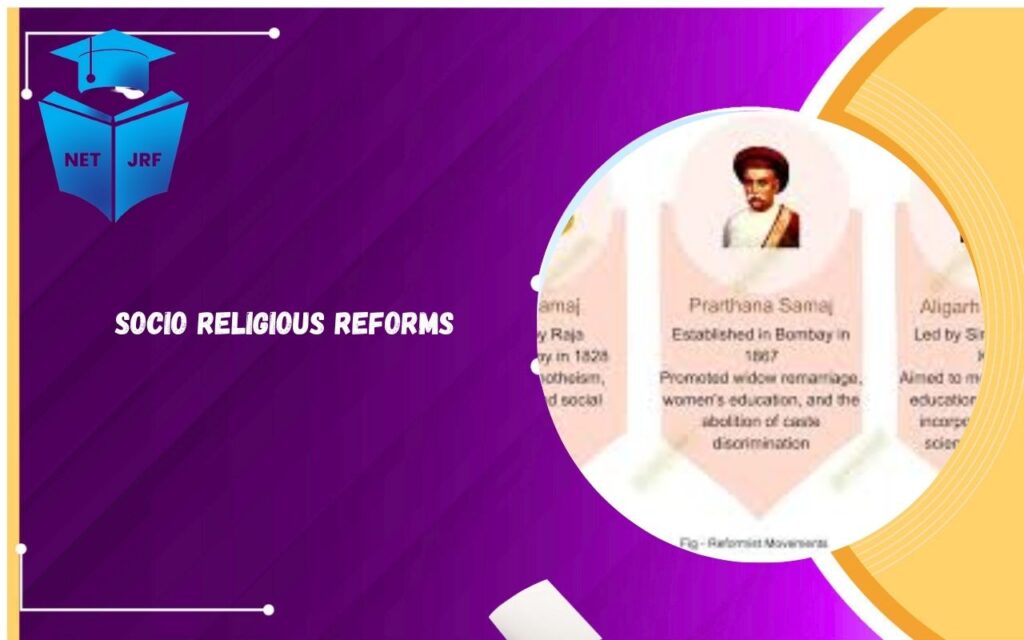
| Brahmo Samaj | Raja Ram Mohan Roy | 1828 | Rational religion & social reform |
| Prarthana Samaj | Atmaram Pandurang | 1867 | Religious reform & social change |
| Arya Samaj | Dayananda Saraswati | 1875 | Vedic revival & social reform |
| Aligarh Movement | Sir Syed Ahmad Khan | 1875 | Modern education for Muslims |
Socio‑Religious Reforms Important Leaders
Many reformers played key roles in shaping new ideas.
-
Raja Ram Mohan Roy
-
-
- Raja Ram Mohan Roy is often called the Father of Indian Renaissance. He strongly opposed sati, supported widow remarriage, and fought caste discrimination. He founded Brahmo Samaj which promoted monotheism and rational religious beliefs.
-
-
Swami Vivekananda
-
-
- Swami Vivekananda emphasized the spiritual unity of all religions and promoted service to humanity. He inspired youth with ideas of self‑respect and the mission to uplift society.
-
-
Dayananda Saraswati
-
-
- Founder of Arya Samaj, Dayananda Saraswati encouraged people to return to the teachings of the Vedas and abandon ritualistic practices.
-
-
Sir Syed Ahmad Khan
-
- Sir Syed focused on the Muslim community and promoted modern scientific education through the Aligarh movement. His efforts helped develop a modern mindset among Muslims.
- Other important figures included Jyotirao Phule, Ishwar Chandra Vidyasagar, Keshab Chandra Sen, Mahadev Govind Ranade, and later reformers in South India and among Muslim communities.

Socio‑Religious Reforms Objectives
The main goals of these reforms were:
- Eradicate social evils like sati, caste inequalities
- Promote women’s rights especially education and remarriage.
- Spread modern education through schools and colleges.
- Encourage rational religion by challenging blind beliefs
- Build national unity and prepare society for future struggles.
These objectives helped open new doors for social thinking in India.
Enroll UGC NET Offline Coaching in Jaipur
Traditional Society vs Reform Ideas
This comparison shows how reforms brought modern thinking into Indian society.
| Aspect | Traditional Society | Socio‑Religious Reform Ideas |
| Religion | Rituals & superstition | Rational belief & monotheism |
| Caste | Strict hierarchy | Equality |
| Women’s role | Limited | Education & rights |
| Education | Restricted | Modern ideas |
| Social Customs | Conservative | Progressive reforms |
Socio‑Religious Reforms Social Impact
The reforms brought many positive changes.
Major impacts included
- Reduced harmful practices like sati and child marriage.
- Increased awareness of women’s rights and girls’ education
- Growth of schools and colleges promoting modern learning. Encouraged debates about equality and human dignity.
- Helped build the foundation for nationalist consciousness in India. These impacts influenced later movements such as the freedom struggle.
Enroll UGC NET Offline Classes in Jaipur
Role of Education in Reforms
Education played a key role in supporting Socio‑Religious Reforms:.
- Western education introduced modern science and rational thought.
- Reformers used schools to spread new ideas.
- Universities became centers of social debate and reform.
Modern education strengthened the ability of Indians to question old practices.

Spread of Reform Ideas
Reform ideas spread through:
- Newspapers and journals published reform literature.
- Public meetings and lectures by reform leaders.
- Reform organizations established to educate people.
These tools helped reformers reach both urban and rural people.
Socio-Religious Reforms FAQs

Who initiated Socio-Religious Reforms in India?
The early pioneers included Raja Ram Mohan Roy, who founded the Brahmo Samaj. He worked to abolish sati, promote women’s education, and introduce rational religious thinking. The Brahmo Samaj became a center for intellectual and social reform, inspiring others to challenge outdated practices and spread modern ideas across India.
How did Socio-Religious Reforms impact women?
Socio-Religious Reformers focused on improving the status of women in society. They promoted women’s education, supported widow remarriage, and opposed restrictive customs like child marriage. These initiatives enhanced women’s social position, increased literacy, and created opportunities for their participation in public life.
Which movement focused on Muslim reforms?
The Aligarh Movement, led by Sir Syed Ahmad Khan, aimed to modernize the Muslim community. It emphasized Western-style education, science, and rational thinking, while encouraging Muslims to engage with contemporary knowledge. The movement led to the establishment of the Aligarh Muslim University, which became a hub for intellectual and social reform.
What role did Prarthana Samaj play?
The Prarthana Samaj in Maharashtra promoted social reform through religious renewal. It encouraged equality, ethical conduct, and education, and worked to eliminate caste barriers and superstitions. The Samaj combined spiritual revival with social reform, influencing a broad section of society in western India.
How did reformers spread their ideas?
Reformers used multiple channels to reach the public, including newspapers, journals, lectures, reform schools, and public meetings. These platforms helped educate people, debate social issues, and mobilize support for change, ensuring that reform ideas reached both urban and semi-urban populations.
Did Socio-Religious Reforms influence nationalism?
Yes, Socio-Religious Reforms laid the intellectual foundation for Indian nationalism. By promoting rational thinking, education, and social justice, these reforms created a critical and aware citizenry. Reformers’ emphasis on self-improvement, equality, and rationality prepared Indian society to question colonial rule and participate in the freedom movement.