
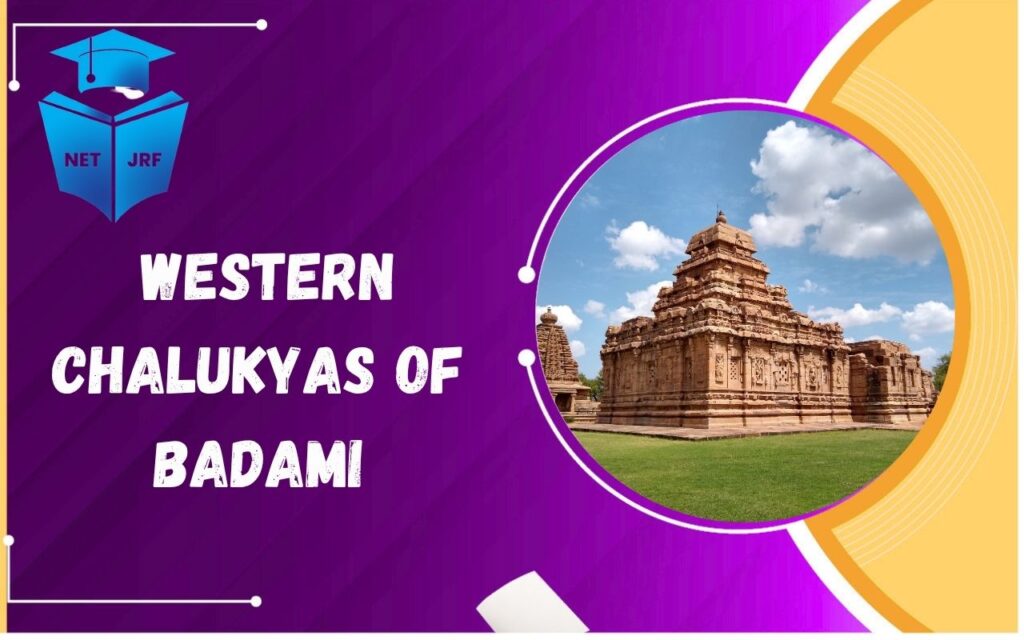

Western Chalukyas of Badami played a key role in shaping early medieval Deccan history as they established a strong regional kingdom that challenged existing powers. The Western Chalukyas of Badami emerged during a time of political change and laid the foundation for a powerful empire under Pulakesin I.

Western Chalukyas of Badami Background
Before the emergence of the Western Chalukyas of Badami, the Deccan region was divided among several small kingdoms. No single power had complete control.
After the decline of earlier dynasties like the Satavahanas and weakening of local rulers, a political vacuum developed. This created opportunities for new dynasties to rise.
Enroll UGC NET Coaching in Jaipur
Key Background Conditions
- Decline of older empires
- Rise of regional chiefs
- Frequent conflicts for power
- Weak central authority
These conditions helped the Western Chalukyas of Badami to emerge as a dominant force.
Western Chalukyas of Badami origin
The origin of the Western Chalukyas of Badami is still debated among historians. Different sources provide different interpretations.
Some inscriptions suggest that they were of local origin from Karnataka. Others try to connect them with northern lineages, but most modern historians support the regional origin theory.
Key Points about Origin
- Likely local chiefs from Karnataka
- Gradual rise through military power
- Strong connection with Deccan culture
- Early capital at Badami
This shows that the Western Chalukyas of Badami represented a regional political movement.
Rise of Pulakesin I
Pulakesin I is considered the real founder of the power of the Western Chalukyas of Badami. He transformed a small principality into a strong kingdom.
Early Life and Background
Pulakesin I belonged to the Chalukya family which was initially not very powerful. He used military strength and strategic planning to expand his authority.
Establishment of Power
- Captured the region around Badami
- Made Badami his capital
- Strengthened fortifications
- Organized administration
This marked the beginning of the Western Chalukyas of Badami as a recognized political power.
Why Pulakesin I was Important
Pulakesin I was not just a ruler; he was a state builder.
Major Contributions
- Founded a stable kingdom
- Created a strong military base
- Established capital at Badami
- Laid foundation for future expansion
Because of his efforts, the Western Chalukyas of Badami became a powerful dynasty in the Deccan.
Expansion under Pulakesin I
The Western Chalukyas of Badami began expanding their territory under Pulakesin I.
Methods of Expansion
- Military conquest
- Control over trade routes
- Alliances with local chiefs
Regions Covered
- Parts of Karnataka
- Areas near Malaprabha river
- Strategic hill regions
This expansion helped the Western Chalukyas of Badami gain economic and military strength.
Enroll UGC NET Offline Coaching in Jaipur
Key Facts about Western Chalukyas of Badami
Western Chalukyas of Badami Historical Overview
| Feature | Details |
| Founder | Pulakesin I |
| Capital | Badami |
| Region | Deccan (Karnataka) |
| Time Period | 6th century CE |
| Nature of Rule | Monarchy |
| Language | Sanskrit, Kannada |
Administration under early Chalukyas
The Western Chalukyas of Badami developed a structured administrative system.
Features of Administration
- King as supreme authority
- Council of ministers
- Division into provinces
- Local governance at village level
This system allowed effective control over expanding territories.
Administrative Units
- Rashtra
- Vishaya
- Grama
Each level had officials responsible for governance and revenue.

Military strength of Western Chalukyas of Badami
The Western Chalukyas of Badami relied heavily on military power to maintain authority, protect their territories, and expand their kingdom. Their well-organized army was a critical factor behind their political and territorial success.
Composition and Features of the Army:
- Infantry and Cavalry: The army had a strong base of foot soldiers (infantry) and mounted troops (cavalry), which allowed flexibility in both offensive and defensive campaigns.
- War Elephants: Elephants were used as a strategic weapon to break enemy lines and create psychological impact in battles.
- Fortified Capitals: Capitals and key cities were heavily fortified to defend against invasions and rebellions.
- Skilled Commanders: Experienced generals and military leaders ensured efficient coordination of troops and effective battlefield strategies.
Role of Pulakesin I:
- Pulakesin I, one of the early rulers, emphasized building a disciplined and organized army.
- His focus on training, strategy, and proper deployment helped the Chalukyas expand their territory and establish political dominance in the Deccan region.
Importance of Military Strength:
- The army was not just for warfare; it maintained internal stability, controlled rebellious regions, and secured trade routes.
- Military power allowed the Chalukyas to negotiate alliances, defend their kingdom from rival dynasties, and ensure continuity of their rule.
Economy and Resources of Western Chalukyas of Badami
A strong economy was necessary to support the Chalukya military and administration. The Western Chalukyas relied on a combination of agriculture, trade, and craft production to sustain their kingdom.
Land Revenue as Main Income:
- The primary source of income was land revenue, collected from fertile agricultural regions.
- Efficient taxation allowed the state to fund the army, administration, and public works.
Agriculture Supported by Irrigation:
- Fertile lands in the Deccan were cultivated using irrigation systems from rivers and tanks.
- This ensured consistent agricultural productivity, which provided food for the population and surplus for trade.
Trade Routes Connecting Regions:
- The Chalukyas controlled important trade routes, linking northern and southern India.
- Local and long-distance trade encouraged economic growth, increasing wealth and resources for the state.
Growth of Crafts and Artisans:
- Artisans and craftsmen produced goods like textiles, metalwork, and pottery.
- These products contributed to trade and helped in the development of urban centers, supporting both the economy and culture.
Link Between Economy and Military:
- Economic stability directly supported military strength by providing resources for soldiers, elephants, weapons, and fort construction.
- A prosperous economy also allowed rulers to patronize culture, religion, and education, consolidating their legitimacy.
Enroll UGC NET Online Coaching
Cultural contributions
The Western Chalukyas of Badami played a pivotal role in shaping the cultural and architectural landscape of southern India. Their support for religion, language, and temple-building left a lasting legacy.
Development of Temple Architecture:
- The Chalukyas are known for their distinctive temple architecture, which combined simple forms with intricate carvings.
- Early temples at Badami and Aihole reflect the experimentation with rock-cut and structural designs, laying the foundation for later South Indian temple styles.
- Temples served as centers for religious practices, learning, and community gatherings, becoming focal points of cultural life.
Use of Kannada Language:
- Kannada was promoted in inscriptions, administrative documents, and religious texts.
- This helped establish Kannada as a regional language of administration and literature, strengthening local identity and cultural continuity.
Support to Religion and Learning:
- The Chalukya rulers supported both Hinduism and Jainism, displaying religious tolerance.
- Temples and monasteries became hubs for scholars, poets, and religious teachers, fostering education and philosophical debates.
- Royal patronage encouraged literary and artistic development, creating a rich cultural environment.
Transition and Continuity under Later Rulers
After Pulakesin I, the successors of the Western Chalukyas continued the work of consolidating and expanding the kingdom, ensuring political and cultural continuity.
Expansion of Territory:
- Successive rulers extended the Chalukya influence into neighboring regions, controlling important trade routes and fertile agricultural lands.
- Expansion allowed the dynasty to increase wealth and resources, which supported further administrative and cultural development.
Increased Political Influence:
- The Western Chalukyas emerged as a major power in the Deccan, influencing smaller dynasties and neighboring regions.
- Their political presence ensured stability, enabling long-term planning in administration, culture, and military organization.
Stronger Administrative System:
- Later rulers refined administrative structures, including provincial governance, tax collection, and village administration.
- Efficient governance strengthened law, order, and economic stability, which in turn allowed the dynasty to focus on cultural patronage.
Significance of Continuity:
- This continuity ensured that the Chalukya dynasty could maintain long-term stability, protect cultural achievements, and create a legacy that influenced later dynasties such as the Hoysalas and Western Gangas.
Reasons for success of Western Chalukyas of Badami
Several factors contributed to their success.
Key Reasons
- Strong leadership of Pulakesin I
- Strategic location of Badami
- Effective administration
- Military strength
- Support from local population
These factors helped the Western Chalukyas of Badami become a major power.

Decline
Although strong in the beginning, the Western Chalukyas of Badami later faced decline.
The Western Chalukyas of Badami, despite their early military, political, and cultural success, eventually faced challenges that led to their gradual decline. Understanding the reasons for this decline provides insight into the dynamics of early medieval South Indian history.
Conflicts with the Pallavas:
- The Chalukyas frequently clashed with the Pallavas of Kanchipuram, a neighboring and powerful dynasty.
- These conflicts drained resources, disrupted administration, and weakened military strength over time.
- Repeated battles over border territories led to loss of manpower and economic strain, which affected the stability of the kingdom.
Internal Struggles:
- Succession disputes and internal rivalries among Chalukya princes caused political instability.
- Internal divisions weakened the central authority, making it difficult to govern distant provinces effectively.
- Local chiefs and feudatories sometimes challenged the king’s authority, creating further administrative difficulties.
Rise of New Powers:
- The emergence of new dynasties in the Deccan and surrounding regions, such as the Rashtrakutas, challenged Chalukya dominance.
- These rising powers gradually captured territories and influence, reducing the Chalukyas’ political and military strength.
Legacy Despite Decline:
- Despite their decline, the early phase of the Western Chalukyas of Badami remains highly significant.
- They laid the foundation for temple architecture, promoted Kannada as a regional language, and created administrative and military systems that influenced later dynasties.
- Their cultural and political contributions continued to shape the Deccan region long after their political power waned.
Conclusion
The rise of Pulakesin I marked the beginning of a powerful political phase in Deccan history. The Western Chalukyas of Badami created a strong foundation for future rulers and played an important role in shaping regional politics, administration, and culture.
FAQs
Pulakesin I founded this dynasty and established its power in the Deccan region.
They followed monarchy with organized administrative divisions and local governance.
The economy mainly depended on agriculture, land revenue, and trade.
They explain regional state formation, political expansion, and early medieval governance.
They rose due to strong leadership, weak existing powers, and military strength.
Sanskrit and Kannada were used in administration and culture.
They built a strong state, expanded territory, and contributed to culture.
It is a powerful early medieval dynasty of the Deccan that rose under Pulakesin I.