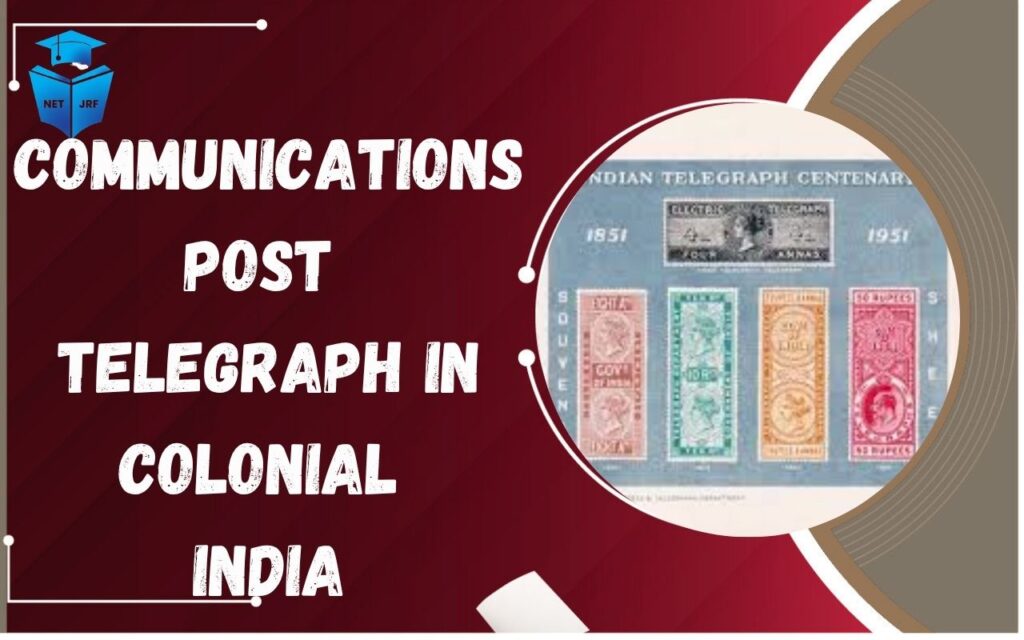
Communications Post Telegraph in Colonial India Postal and Telegraph Networks

Communications Post Telegraph in Colonial India in this topic you learn how postal services telegraph networks and communication infrastructure improved administration trade military coordination and information exchange during British rule in India

vishal

Communications Post Telegraph in Colonial India

Table of Contents

Communications played a transformative role in colonial India by connecting distant regions through faster information exchange. The development of postal networks and telegraph systems allowed the British administration to strengthen governance, expand trade, and maintain political control.

Study Planner

Before the nineteenth century, communication in India relied mainly on traditional methods such as runners, messengers, or horse couriers. These systems worked slowly and often failed to deliver urgent messages across long distances.

Enroll UGC NET Foundation Batch Online

Communication in Colonial Administration

The concept of Communications  refers to organized systems that transmit information, messages, and official correspondence across geographical areas.

During British rule, the communication network mainly included two major institutions:

  • Postal services (post offices, mail transport)
  • Telegraph services (electrical message transmission)

These systems improved administrative efficiency because officials could exchange information quickly across provinces. They also helped merchants coordinate trade and financial transactions.

The expansion of communication networks therefore became an important part of colonial infrastructure development.

Pre-British Communication Systems

Before the introduction of modern institutions, India already had traditional systems for message delivery.

Indigenous Messenger Networks

Local rulers used trained runners called dak carriers who transported letters between administrative centers. These runners carried messages in leather bags and moved from village to village.

Features of early messenger networks included:

  • Manual delivery through runners or horses
  • Limited speed of communication
  • High risk of message loss
  • Absence of organized infrastructure

Although these systems functioned for centuries, they could not support the administrative demands of a large colonial empire.

Indian Postal System: Development and Expansion

The modern postal system began to develop during the nineteenth century when the British government introduced reforms to standardize mail delivery.

Early Postal Reforms

Several administrative measures helped expand the postal network.

Important milestones included:

Reform Year Significance
Postal Act 1837 First attempt to regulate mail services
Uniform Postal System 1854 Standardized postage rates
Expansion of Post Offices Late 19th century Improved nationwide connectivity

These reforms created a centralized structure that allowed faster and more reliable message delivery.

Best UGC NET Foundation Course

Communications  Postal Network Expansion

The Communications – network expanded rapidly after the introduction of uniform postal rates. The government established thousands of post offices across towns and villages.

Features of the Colonial Postal System

The postal system introduced several innovations:

  • Standard postage stamps
  • Scheduled mail routes
  • Government-controlled delivery services
  • Mail transportation through railways

These improvements increased the speed and reliability of communication.

For traders, this system reduced uncertainty in business transactions. For administrators, it allowed quick circulation of government orders.

Telegraph System in Colonial India

The telegraph system represented a revolutionary step in the communication infrastructure.

Introduction of Electric Telegraph

  • The first experimental telegraph line in India appeared in 1851 between Calcutta and Diamond Harbour. This experiment demonstrated the potential of electrical message transmission.
  • Soon after, the British government expanded telegraph lines across the country.

Important developments included:

Year Development
1851 First telegraph experiment
1854 Public telegraph service introduced
1870 Telegraph network connected major cities

The telegraph system allowed messages to travel within minutes instead of days.

App JRF Adda

Impact of Telegraph on Administration

The telegraph dramatically improved administrative efficiency.

Key advantages included:

  1. Faster military coordination
  2. Quick communication between colonial officials
  3. Rapid transmission of political information
  4. Better monitoring of distant provinces

During the Revolt of 1857, telegraph lines allowed British authorities to exchange information quickly. This technological advantage helped the colonial government respond to the uprising more effectively.

Join UGC NET Offline Coaching in Jaipur

Economic Importance of Communication Networks

The development of communication infrastructure had major economic consequences.

Improved communication helped:

  • Expand commercial networks
  • Facilitate trade coordination
  • Support banking transactions
  • Increase market integration

Merchants could send information about prices, shipments, and contracts quickly. This reduced delays in business decisions.

In many regions, postal services also helped spread financial instruments such as money orders and remittances.

Social Impact of Communication Networks

The growth of modern communications  networks also influenced social and cultural life.

  • Spread of Information

      • Postal services allowed newspapers, magazines, and books to circulate across different regions. This increased literacy and awareness among the population.
  • Growth of Public Opinion

    • The expansion of print media helped develop political consciousness. Newspapers carried news about government policies, social reforms, and nationalist movements.
    • As a result, communication infrastructure indirectly supported the growth of public debate.

Administrative Role of Communications Systems

The Communications – infrastructure became a key tool for colonial governance.

British administrators relied on communication networks for:

  • Sending official orders
  • Coordinating revenue collection
  • Managing military operations
  • Maintaining law and order

The government also used the telegraph system for intelligence gathering and political surveillance.

Through these networks, the colonial state maintained centralized control over a vast territory.

Major Components of Colonial Communication Infrastructure

Several institutional elements supported the communication system.

Key Institutions

  1. Post offices across districts
  2. Telegraph stations in major cities
  3. Railway-based mail transportation
  4. Government communication departments

These institutions created an integrated system that linked remote areas with administrative centers.

Long-Term Impact of Communication Systems

Although the British developed these systems primarily for administrative control, the infrastructure later benefited independent India.

Modern communication networks evolved from colonial institutions such as:

  • Indian postal services
  • Telegraph departments
  • Communication ministries

These institutions later expanded into digital communication systems and telecommunications networks.

Thus, early infrastructure laid the foundation for modern information exchange in India.

Best UGC NET Offline Coaching in Jaipur

Conclusion

The development of Communications systems through postal services and telegraph networks transformed colonial administration in India. These systems enabled faster transmission of information, improved governance, strengthened trade networks, and supported military coordination.

JRF Adda Book

Although colonial policies often served imperial interests, communication infrastructure created long-term institutional foundations. 

Read UGC NET Notes
1 Archaeological Sources for UGC NET Epigraphy – Study of Inscriptions Meaning of Historical Sources Archaeological
2 Meaning of Historical Sources Archaeological Sources for UGC NET Literary Sources in History Archaeological
3 Exploration in Archaeology Excavation Techniques in Archaeology Dating of Archaeological Sites Archaeological
4 Excavation Techniques in Archaeology Exploration in Archaeology Dating of Archaeological Sites Archaeological
5 Epigraphy – Study of Inscriptions Inscriptions in Reconstructing History Numismatics in History Archaeological
6 Inscriptions in Reconstructing History Epigraphy – Study of Inscriptions Archaeological Sources for UGC NET Archaeological
7 Numismatics in History Importance of Coins in History Epigraphy – Study of Inscriptions Archaeological
8 Importance of Coins in History Numismatics in History Archaeological Sources for UGC NET Archaeological
9 Dating of Archaeological Sites Excavation Techniques in Archaeology Dating Ancient Literary Sources Archaeological
10 Indigenous Literature Literary Sources in History Secular Literature as Historical Source Literary
11 Dating Ancient Literary Sources Literary Sources in History Dating of Archaeological Sites Literary
12 Literary Sources in History Indigenous Literature Foreign Accounts of India Literary
13 Foreign Accounts of India Greek Accounts on Ancient India Chinese Accounts on India Literary
14 Greek Accounts on Ancient India Foreign Accounts of India Chinese Accounts on India Literary
15 Secular Literature as Historical Source Literary Sources in History Indigenous Literature Literary
16 Role of Myths and Legends in Historical Reconstruction Literary Sources in History Secular Literature as Historical Source Literary
17 Chinese Accounts on India Foreign Accounts of India Greek Accounts on Ancient India Literary
18 Arabic Accounts on India Foreign Accounts of India Chinese Accounts on India Literary
19 Neolithic and Chalcolithic Phases Neolithic Revolution in India Chalcolithic Culture in India Neolithic
20 Hunting, Gathering & Food Production Neolithic Revolution in India Neolithic Settlements in India Neolithic
21 Neolithic Revolution in India Neolithic Settlements in India Tools and Technology in Neolithic Period Neolithic
22 Neolithic Settlements in India Distribution of Neolithic Cultures in India Neolithic Revolution in India Neolithic
23 Distribution of Neolithic Cultures in India Neolithic Settlements in India Tools and Technology in Neolithic Period Neolithic
24 Tools and Technology in Neolithic Period Neolithic Revolution in India Chalcolithic Culture in India Neolithic
25 Chalcolithic Culture in India Settlement Pattern & Economy in Chalcolithic Phase Trade & Exchange Networks in Chalcolithic Societies Neolithic
26 Settlement Pattern & Economy – Chalcolithic Phase Chalcolithic Culture in India Trade & Exchange Networks in Chalcolithic Societies Neolithic
27 Trade & Exchange Networks – Chalcolithic Societies Chalcolithic Culture in India IVC Internal & External Trade Neolithic
28 Indus Valley Civilization – UGC NET Major Sites of Indus Civilization Urban Planning in Harappan Civilization IVC
29 IVC Internal & External Trade Internal Trade – Harappan Civilization Craft Specialization in Harappan Civilization IVC
30 Political Organization – Harappan Civilization Social Structure – Indus Civilization Urban Planning in Harappan Civilization IVC
31 Major Sites of Indus Civilization Indus Valley Civilization – UGC NET Urban Planning in Harappan Civilization IVC
32 Urban Planning & Settlement – Harappan Civilization Architecture & Town Planning – Harappan Cities IVC as First Urbanization in India IVC
33 Architecture & Town Planning – Harappan Cities Urban Planning in Harappan Civilization Major Sites of Indus Civilization IVC
34 Craft Specialization & Industrial Activities – Harappan Agriculture & Food Economy – Harappans IVC Internal & External Trade IVC
35 Agriculture & Food Economy – Harappans Craft Specialization in Harappan Civilization Internal Trade – Harappan Civilization IVC
36 Internal Trade – Harappan Civilization IVC Internal & External Trade Craft Specialization in Harappan Civilization IVC
37 Religion & Beliefs – Indus Civilization Social Structure – Indus Civilization Indus Valley Civilization – UGC NET IVC
38 Social Structure – Indus Civilization Political Organization – Harappan Civilization Religion & Beliefs – Indus Civilization IVC
39 Decline of Indus Civilization Indus Valley Civilization – UGC NET IVC as First Urbanization in India IVC
40 IVC as First Urbanization in India Urban Planning in Harappan Civilization Second Urbanization in India IVC
41 Vedic & Later Vedic Periods – Aryan Varna System Early Vedic Society and Economy Later Vedic Society and Economy Vedic
42 Origin of Vedic Civilization Aryan Debate – Migration, Invasion & Indigenous Theories Early Vedic Society and Economy Vedic
43 Aryan Debate – Migration, Invasion & Indigenous Theories Origin of Vedic Civilization Early Vedic Society and Economy Vedic
44 Early Vedic Society and Economy Political Institutions – Early Vedic Period Social Structure – Early Vedic Period Vedic
45 Political Institutions – Early Vedic Period Early Vedic Society and Economy Monarchical States in Ancient India Vedic
46 Social Structure – Early Vedic Period Emergence of Varnas & Social Stratification Early Vedic Society and Economy Vedic
47 Later Vedic Society and Economy Emergence of Varnas & Social Stratification Impact of Iron Technology in India Vedic
48 Emergence of Varnas & Social Stratification Social Structure – Early Vedic Period Later Vedic Society and Economy Vedic
49 Emergence of Heterodox Sects in India Jainism, Buddhism & Ajivikas – Origins & Teachings Later Vedic Society and Economy Vedic
50 Impact of Iron Technology in India Later Vedic Society and Economy Agricultural Expansion & Economic Changes – Ancient India Vedic
51 Religious & Philosophical Vedic Ideas Emergence of Varnas & Social Stratification Emergence of Heterodox Sects in India Vedic
52 Megalithic Culture of South India Neolithic and Chalcolithic Phases Agricultural Expansion & Economic Changes General
53 State System in Ancient India Rise of Mahajanapadas Transition: Tribal Polities to Territorial States General
54 Transition: Tribal Polities to Territorial States Rise of Mahajanapadas Later Vedic Society and Economy General
55 Rise of Mahajanapadas Monarchical States in Ancient India Republican States (Gana-Sanghas) – Ancient India Magadha
56 Monarchical States in Ancient India Rise of Mahajanapadas Emergence of Magadha Magadha
57 Republican States (Gana-Sanghas) – Ancient India Rise of Mahajanapadas Monarchical States in Ancient India Magadha
58 Agricultural Expansion & Economic Changes – Ancient India Second Urbanization in India Impact of Iron Technology in India General
59 Second Urbanization in India IVC as First Urbanization in India Rise of Mahajanapadas General
60 Jainism, Buddhism & Ajivikas – Origins & Teachings Emergence of Heterodox Sects in India Ashoka’s Policy of Dhamma General
61 Emergence of Magadha Geographical Advantages of Magadha Early Rulers of Magadha Magadha
62 Geographical Advantages of Magadha Natural Resources & Economic Strength of Magadha Reasons for Success of Magadha Magadha
63 Natural Resources & Economic Strength of Magadha Geographical Advantages of Magadha Economic Policies of the Nandas Magadha
64 Early Rulers of Magadha Haryanka Dynasty – Rise of Magadha Emergence of Magadha Magadha
65 Haryanka Dynasty – Rise of Magadha Expansion Policy of Bimbisara Early Rulers of Magadha Magadha
66 Expansion Policy of Bimbisara Ajatashatru – Military Reforms Haryanka Dynasty – Rise of Magadha Magadha
67 Ajatashatru – Military Reforms Wars of Ajatashatru Expansion Policy of Bimbisara Magadha
68 Wars of Ajatashatru Ajatashatru – Military Reforms Udayin & Establishment of Pataliputra Magadha
69 Udayin & Establishment of Pataliputra Wars of Ajatashatru Shishunaga Dynasty Magadha
70 Shishunaga Dynasty Administrative Structure of the Shishunagas Nanda Dynasty Magadha
71 Administrative Structure of the Shishunagas Shishunaga Dynasty Central Administration Under Mauryas Magadha
72 Nanda Dynasty Mahapadma Nanda – Imperial Expansion Shishunaga Dynasty Magadha
73 Mahapadma Nanda – Imperial Expansion Military Strength of the Nandas Nanda Dynasty Magadha
74 Economic Policies of the Nandas Nanda Dynasty Taxation System – Mauryan State Magadha
75 Military Strength of the Nandas Mahapadma Nanda – Imperial Expansion Defeat of Nandas & Rise of Mauryan Empire Magadha
76 Reasons for Success of Magadha Geographical Advantages of Magadha Natural Resources & Economic Strength of Magadha Magadha
77 Mahajanapadas to Empire – Evolution & Rise of Magadha Rise of Mahajanapadas Emergence of Magadha Magadha
78 Mauryan Empire – Expansion Rise of Chandragupta Maurya Expansion of Mauryan Empire Maurya
79 Rise of Chandragupta Maurya Role of Chanakya in Rise of Mauryan Empire Defeat of Nandas & Rise of Mauryan Empire Maurya
80 Role of Chanakya in Rise of Mauryan Empire Rise of Chandragupta Maurya Defeat of Nandas & Rise of Mauryan Empire Maurya
81 Defeat of Nandas & Rise of Mauryan Empire Military Strength of the Nandas Rise of Chandragupta Maurya Maurya
82 Chandragupta Maurya – Seleucus Treaty & Diplomacy Expansion of Mauryan Empire Greek Accounts on Ancient India Maurya
83 Expansion of Mauryan Empire Chandragupta Maurya – Seleucus Treaty & Diplomacy Kalinga War Maurya
84 Administration of Chandragupta Maurya Central Administration Under Mauryas Mauryan Bureaucracy Maurya
85 Sources for Mauryan History Archaeological Sources for UGC NET Greek Accounts on Ancient India Maurya
86 Central Administration Under Mauryas Provincial Administration – Mauryan Empire Mauryan Bureaucracy Maurya
87 Provincial Administration – Mauryan Empire Local Administration – Mauryan Empire Central Administration Under Mauryas Maurya
88 Local Administration – Mauryan Empire Provincial Administration – Mauryan Empire Mauryan Bureaucracy Maurya
89 Mauryan Bureaucracy Central Administration Under Mauryas Espionage System – Mauryan Empire Maurya
90 Espionage System – Mauryan Empire Mauryan Bureaucracy Central Administration Under Mauryas Maurya
91 Ancient India – Trade and Commerce Trade and Commerce Under Mauryas Agrarian Economy – Mauryan Period Maurya
92 Agrarian Economy – Mauryan Period Taxation System – Mauryan State Trade and Commerce Under Mauryas Maurya
93 Trade and Commerce Under Mauryas Ancient India – Trade and Commerce Agrarian Economy – Mauryan Period Maurya
94 Taxation System – Mauryan State Agrarian Economy – Mauryan Period Economic Policies of the Nandas Maurya
95 Kalinga War Ashoka’s Policy of Dhamma Expansion of Mauryan Empire Maurya
96 Ashoka’s Policy of Dhamma Nature & Philosophy of Dhamma Kalinga War Maurya
97 Nature & Philosophy of Dhamma Ashoka’s Policy of Dhamma Jainism, Buddhism & Ajivikas Maurya

Communications FAQs

Loader image

The telegraph system in India began in 1851 with the first experiment between Calcutta and Diamond Harbour. After the experiment was successful, telegraph lines were expanded to major cities. Public telegraph services started a few years later and allowed faster communication across the country.

The British developed communication systems to improve administrative control, military coordination, and trade management. Fast communication helped the colonial government send orders quickly, manage the army during conflicts, and support commercial activities across India.

Improved communication helped traders get quick information about market prices, demand, and shipments. This reduced uncertainty in business and allowed merchants to make better decisions. As a result, trade became faster and more organized.

Postal services helped circulate letters, newspapers, and books across the country. This improved communication between people and increased literacy. It also spread political ideas and awareness among the public.


Leave a Reply

Recent Posts
Aditi

Aditi Sharma, founder of JRFAdda, is a Computer Science educator with an MCA degree and JRF qualification (99.91 percentile, Dec 2019). Her experience includes roles as an SBI SO (DBA), work at Cognizant, and over 5 years of teaching online and offline. She has also served as a Government Computer Teacher in Rajasthan.