
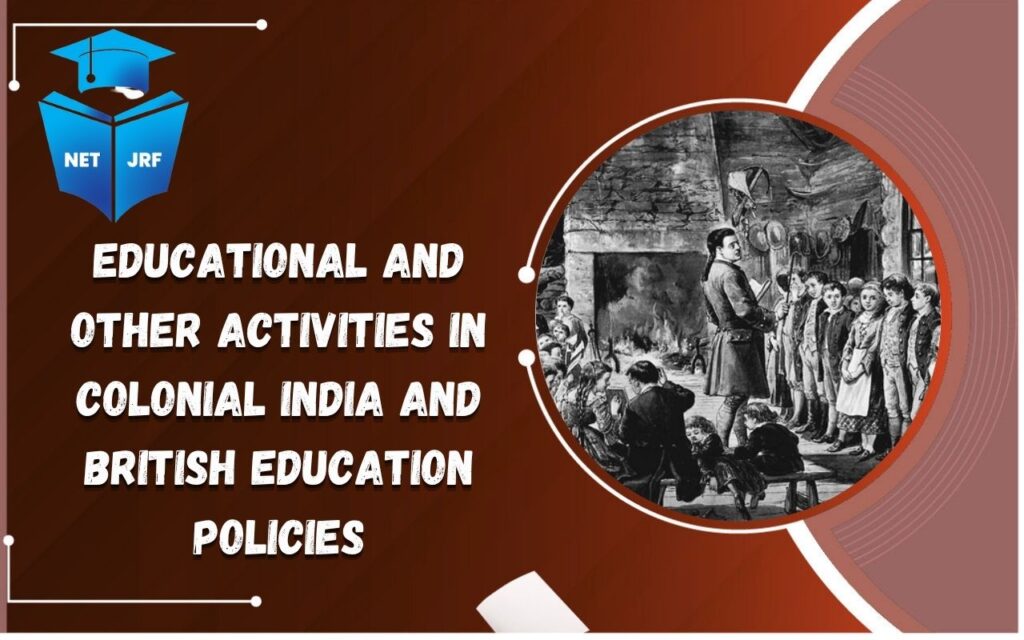
Educational development in colonial India changed the structure of learning, administration, culture, and social mobility. British rule introduced new institutions, policies, and curriculum. These changes influenced society, politics, and the economy. Before British rule, India already had a traditional education system through gurukuls, pathshalas, madrasas. These institutions worked locally with community support. Subjects included philosophy, astronomy, medicine, mathematics, language studies. Colonial rule gradually replaced

Education in India before British Rule
The Indian system existed long before colonial rule. Education was not controlled by the state. Villages supported teachers through community funds or local donations.
Main features:
- Flexible learning system
- Community-supported institutions
- Practical subjects related to daily life
- Moral training along with intellectual study
- Teaching through oral methods
Traditional schools included:
| Institution | Main Features | Subjects |
| Gurukul | Teacher-student residential learning | Vedas, philosophy |
| Pathshala | Village school system | Arithmetic, writing |
| Madrasa | Islamic institutions | Persian, theology |
Many reports in the early nineteenth century noted that thousands of such schools existed across India.
British Educational Policy in Colonial India
British authorities did not initially focus on education. Their priority remained administration, trade, revenue. Gradually they introduced education policies to serve colonial interests.
The British introduced formal education in India with several strategic objectives:
- Train clerks for colonial administration – producing a workforce to assist in governance and bureaucracy.
- Spread Western knowledge – introducing modern sciences, law, and philosophy to shape Indian intellectual life.
- Promote English language – creating a common medium for administration and communication.
- Create loyal Indian elites – cultivating a class of Indians aligned with British interests and values.
Overall, education became a political tool, serving colonial governance while also gradually exposing Indians to modern ideas that later fueled social reform and nationalist movements.
Debate on Education Policy: Orientalists vs Anglicists
Orientalist View
- Supported Indian languages and traditional knowledge systems.
- Believed in the continuation of Sanskrit and Persian learning to preserve India’s cultural and scholarly heritage.
Anglicist View
- Advocated Western knowledge, including European science, literature, and philosophy.
- Promoted English language education to create a class of Indians familiar with Western ideas and administrative skills.
The early British administrators debated the nature of education in India.
Macaulay’s Minute (1835)
One of the most influential events in shaping colonial education was Thomas Macaulay’s Minute on Education. He argued that Western knowledge was superior to traditional Indian learning and recommended focusing on English literature, science, and philosophy.
Key Ideas:
- English medium instruction in schools and colleges.
- Western curriculum replacing traditional Sanskrit and Persian studies.
- Limited funds allocated for English education, reducing support for Indian classical institutions.
- Objective: To create a class of Indians “Indian in blood and colour, but English in taste, in opinions, in morals, and in intellect,” who could act as intermediaries between British rulers and Indian society.
Enroll UGC NET Foundation Batch Online

English Education Act (1835)
The English Education Act officially implemented Macaulay’s recommendations.
Main Provisions:
- English became the medium of higher education.
- Government funds prioritized Western learning, reducing support for traditional Sanskrit and Persian institutions.
- Marked a major turning point in Indian education, laying the foundation for an English-educated Indian elite.
Wood’s Despatch (1854)
The Wood’s Despatch is often called the “Magna Carta of English Education in India”, as it established a comprehensive and structured educational system.
Major Recommendations:
- English medium in higher education; vernacular languages used in primary schools.
- Establishment of universities in major cities (Calcutta, Bombay, Madras).
- Teacher training institutions to improve education quality.
- Grant-in-aid system to support private schools.
- Promotion of women’s education for broader social development.
Impact:
The Despatch created a structured, multi-level education system across India, combining English and vernacular education, and laid the foundation for modern schooling and universities in colonial India.
Hunter Commission 1882
The British government created the Hunter Commission to review education progress.
Main recommendations:
- Improve primary education
- Promote vernacular languages
- Transfer control of primary schools to local bodies
- Divide secondary education into literary and vocational streams
This policy increased the number of schools in rural regions.
Universities Established During Colonial Rule
These universities followed the British model of examinations and degree programs. Following Wood’s Despatch, universities were established in India.
Enroll UGC NET Offline Coaching in Jaipur
Early Universities
| University | Year | Location |
| University of Calcutta | 1857 | Bengal |
| University of Bombay | 1857 | Bombay |
| University of Madras | 1857 | Madras |
Role of Christian Missionaries in Education
Christian missionaries were important agents in spreading modern education during colonial India. Their activities included:
- Opening schools in rural areas, making education more accessible to villages.
- Promoting female education, encouraging girls to attend schools at a time when women’s literacy was low.
- Translating books into local languages, helping students understand new knowledge in their own tongue.
- Printing educational material, including textbooks and reading materials for schools.
Missionary institutions also introduced Western science, mathematics, and modern subjects, complementing colonial education and contributing to the growth of literacy and intellectual awareness across India.
Educational Reforms in the Early 20th Century
During the early 20th century, colonial education policies continued to evolve, focusing on expanding access and improving quality.
1. Government Resolution on Education (1913)
- The British government accepted responsibility for educational development in India.
- The resolution promoted the expansion of primary education, aiming to increase literacy among children in towns and villages.
2. Wardha Scheme of Basic Education (1937)
- Proposed by Mahatma Gandhi, also called Nai Talim or “Basic Education.”
- Key Features:
- Learning through craft, combining education with productive skills.
- Free education for children to increase accessibility.
- Skill-based learning, preparing students for practical life and self-reliance.
3. Sergeant Plan (1944)
- Introduced by the British government as a blueprint for future educational development in India.
- Key Ideas:
- Provision of free primary education for all children.
- University reforms to improve higher education quality.
- Emphasis on vocational training, linking education to employment and skills development.
Impact of Colonial Education on Indian Society
Colonial education in India brought significant social transformations, with both positive and negative effects:
Positive Effects
- Spread of modern education – literacy increased and Western knowledge became more accessible.
- Growth of universities – higher education institutions were established in major cities, fostering intellectual development.
- Development of journalism – educated Indians started newspapers and publications, raising awareness about social and political issues.
- Rise of social reform movements – education empowered people to challenge social evils and demand reform.
Negative Effects
- Decline of traditional knowledge – Sanskrit, Persian, and indigenous learning systems lost support.
- Cultural alienation – emphasis on English and Western values distanced educated Indians from local traditions.
- Urban-rural education gap – education opportunities remained limited mostly to urban areas.

Role of Education in Nationalism
Western education exposed Indians to ideas like:
- Liberty
- Equality
- Democracy
Education under colonial rule played a crucial role in fostering nationalist ideas among Indians.
- Exposure to Western ideas such as liberty, equality, and democracy encouraged critical thinking about colonial rule.
- Educated Indians questioned British authority, social injustice, and economic exploitation.
- Leaders like Raja Rammohan Roy, Dadabhai Naoroji, and Bal Gangadhar Tilak used their education to mobilize public opinion, write articles, and organize movements for social and political reform.
Educational development during colonial rule reshaped Indian society. British policies introduced universities, English language learning, and a modern curriculum. At the same time, traditional systems declined. Despite limitations, colonial education helped create intellectual awareness, social reform movements, nationalist thought.
Join UGC NET Offline Coaching in Jaipur
Educational and Other Activities in Colonial India UGC NET FAQs

2. What was Macaulay’s Minute?
Macaulay’s Minute (1835) was a landmark policy document recommending English as the medium of instruction and a Western curriculum focusing on literature, science, and philosophy. It suggested that traditional Sanskrit and Persian institutions receive limited funding, while priority should be given to Western education. The goal was to create Indians who were “Indian in blood, but English in taste and intellect,” capable of serving as intermediaries between the British rulers and Indian society.
3. Why is Wood’s Despatch important?
Wood’s Despatch of 1854, often called the Magna Carta of English Education in India, established a structured and systematic education system. It recommended the establishment of universities in major cities, teacher training institutions, and the use of vernacular languages in primary schools while maintaining English in higher education. The Despatch also introduced the grant-in-aid system for private schools and promoted women’s education. It laid the foundation for a modern education system across India, combining accessibility with structured higher education.
4. What role did missionaries play in education?
Christian missionaries were significant in spreading modern education in India. They opened schools in rural areas, promoted female education, translated books into local languages, and printed educational materials for wider learning. Missionary institutions also introduced Western science and modern subjects, complementing colonial educational policies and helping to raise literacy levels and awareness among the Indian population.
5. What was the Hunter Commission?
The Hunter Commission of 1882 was established to review the state of primary education in India. It recommended the expansion of primary schools, increasing enrollment and accessibility, and emphasized education for girls. The commission also suggested using vernacular languages for instruction at the primary level and improving teacher training and school quality. Its aim was to make education more widespread, effective, and practical, especially for the rural population.