
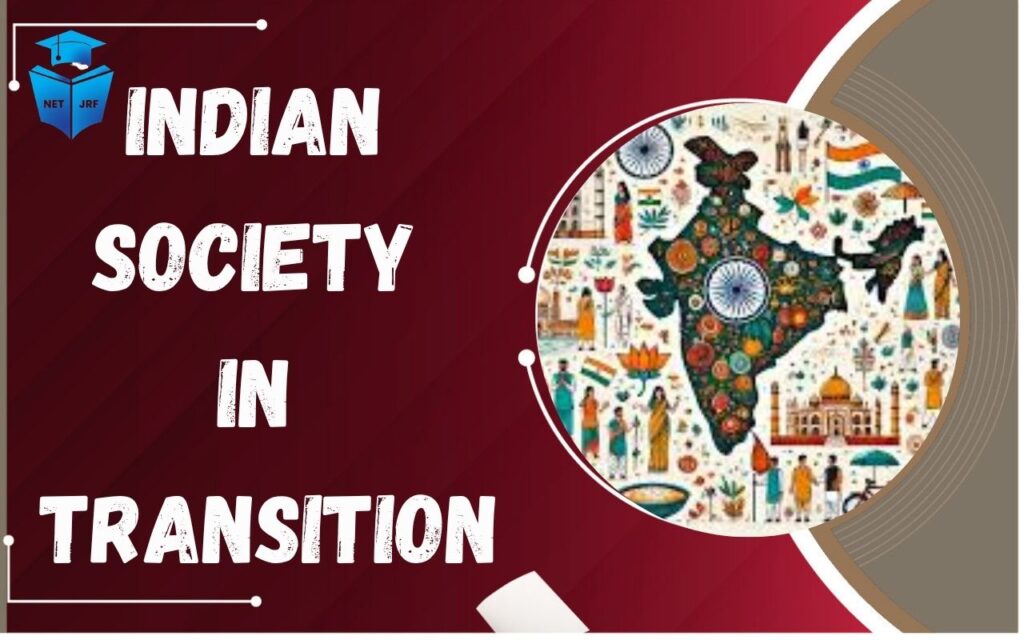
During the colonial period, Indian society underwent significant changes due to British political, economic, and cultural policies. Traditional structures of landholding, agriculture, trade, and education were altered, while new institutions of modern education, bureaucracy, and law were introduced. Social reforms and movements challenged orthodox practices, and exposure to Western ideas fostered rational thinking, political awareness, and early nationalist consciousness. Overall, these transformations marked a transition from a largely traditional society to a modern, complex social and economic structure.

Education Reforms in Changing Indian Society
Before British rule, India had traditional education systems like Gurukulas for Hindu learning and Madrassas for Islamic studies. Education focused on religion, philosophy, and local customs rather than modern sciences or administration.
Enroll UGC NET Online Coaching
Key Facts
- Before the introduction of modern education, education in India was limited to elites, religious leaders, and upper-caste communities.
- Literacy rates were extremely low before 1800, and there was no formal state involvement in mass education. Most learning took place in traditional schools, madrasas, or pathshalas, focusing on religious and classical subjects, which left the majority of the population without access to formal education.
Introduction of Modern Education
The East India Company introduced modern education to train a class of clerks and administrators for colonial governance. Several key steps were taken:
- Calcutta Madrassa (1781): Established under Warren Hastings to teach Muslim law and jurisprudence.
- Sanskrit College, Varanasi (1791): Founded by Jonathan Duncan for the study of Hindu philosophy and Sanskrit literature.
- Missionary schools: Focused on literacy, moral instruction, and religious conversion, spreading basic education among children in different regions.
- Western education: Introduced rational thinking, scientific principles, and modern subjects, forming the foundation for higher education and intellectual awakening in India.
Traditional vs Modern Education
| Feature | Traditional Education | Modern Education |
| Focus | Religion and philosophy | Science, administration, Western literature |
| Medium | Vernaculars | English |
| Scope | Local, elite | Broader, for administration |
| Purpose | Cultural and religious | Clerical and rational thought |
Key Policies
- Charter Act of 1813: Rs. 1 lakh sanctioned for education.
- Macaulay Minutes (1835): Advocated English education for administrative needs.
- Wood’s Despatch (1854): Recommended systematic education from primary to university levels, female education, and the establishment of universities in Madras, Calcutta, and Bombay.
Social Reforms and Movements
Social reformers in colonial India advocated modern education to promote rational thinking and challenge orthodox practices.
- They pioneered reforms such as the abolition of sati, promotion of widow remarriage, and encouragement of women’s education.
- Notable reformers like Raja Rammohan Roy and Ishwar Chandra Vidyasagar played a crucial role in raising social awareness and pushing for legislative and societal changes that challenged entrenched social inequalities.
Women and Education
During colonial India, female literacy remained very low due to strict societal norms and restrictions.
- However, missionaries and reformers emphasized women’s education, establishing schools and advocating for broader access to learning.
- Gradually, universities began opening their doors to women in the late 19th and early 20th centuries, laying the foundation for increased participation of women in education and public life.
Social Reforms
| Reform | Reformer | Period | Impact |
| Abolition of Sati | Raja Ram Mohan Roy | 1829 | Reduced social injustice |
| Widow Remarriage | Ishwar Chandra Vidyasagar | 1856 | Promoted women’s rights |
| Female Education | Christian Missionaries | 1800s | Increased literacy among women |
Economic Transformation in Indian Society in Transition
Colonial policies in land revenue, agriculture, and industry reshaped Indian society, leading to commercialization of farming, decline of traditional handicrafts, and the rise of a new rural and urban economic structure.
-
Land Revenue and Agriculture
-
-
- Colonial India witnessed major changes in land revenue and agriculture with the introduction of systems like the Permanent Settlement (1793), Ryotwari, and Mahalwari. These policies encouraged the commercialization of agriculture, pushing peasants to grow cash crops for the market rather than subsistence farming. Many peasants became landless laborers, which created social stress and economic vulnerability in rural areas.
-
-
Industrial Decline and British Policy
-
- At the same time, Indian handicrafts and traditional industries experienced a sharp decline due to British economic policies. The import of British manufactured goods undercut local production, while railways and roads were primarily built to serve commercial and colonial interests rather than local development.

Economic Impacts
The combined effect of agricultural and industrial changes led to several consequences:
- Decline of cottage industries, resulting in unemployment for skilled artisans.
- Increased rural indebtedness, as peasants borrowed money to pay taxes or survive.
- Emergence of landlord-tenant conflicts, creating tension in rural society.
- Rise of an urban labor class, employed in colonial industries and infrastructure projects, marking the beginning of urban working-class formation.
Enroll UGC NET Offline Coaching in Jaipur
Economic Policies and Effects
| Policy | Year | Effect |
| Permanent Settlement | 1793 | Landlords gained power, peasants burdened |
| Ryotwari System | 1820s | Direct collection from farmers, heavy tax |
| Mahalwari System | 1833 | Village revenue collection, increased debt |
British Administrative Reforms
The British introduced a modern bureaucracy to establish efficient control over India. This included the codification of laws and the setting up of formal courts to enforce these laws. The Indian Civil Service (ICS) was created to train Indians for administrative roles, though higher positions were largely dominated by the British. Overall, colonial governance prioritized revenue collection and administrative control rather than the welfare of the population.
Features
The British administrative system was marked by:
- Centralized administration, concentrating authority in British officials.
- District collectors and local governance structures managing taxation, law, and order.
- Codified laws to standardize legal procedures and reinforce colonial authority.
Governance and Society
Colonial policies also shaped social development. Education policies were aligned with administrative needs, emphasizing clerical skills and English literacy rather than scientific or technical training. The focus on urban administrative centers widened the urban-rural divide, leaving rural areas with limited access to governance, education, and infrastructure.
Traditional vs Colonial Administration
| Aspect | Traditional | Colonial |
| Administration | Local rulers, informal | Centralized, bureaucratic |
| Education | Minimal for governance | Focused for clerical jobs |
| Justice | Community-based | Codified laws |
| Economic Focus | Welfare | Revenue extraction |
Cultural and Intellectual Impact
Cultural and Intellectual Impact
The introduction of Western education in India exposed the population to European ideas, liberalism, and rational thinking.
- which encouraged critical analysis of traditional practices. Indian reformers skillfully blended traditional values with modern concepts, creating a foundation for social and cultural reform.
- The growth of newspapers, journals, and print culture further spread awareness, enabling debates on social, political, and cultural issues.
Cultural Impacts
- Colonial education and intellectual exchanges led to the development of modern literature in regional languages and nurtured a sense of political consciousness.
- The educated Indian elite began questioning colonial authority and social inequalities, laying the groundwork for early nationalist movements that eventually challenged British rule.
Challenges Faced
Despite reforms, Indian society faced low literacy, limited rural education, economic inequality, and social tensions, highlighting the uneven impact of colonial policies.
-
Literacy and Education
-
-
- During the colonial period, literacy rates remained extremely low, with only about 6–8% of the population able to read and write in the early 20th century (1911: 94% illiterate, 1921: 92% illiterate). English-medium education was largely limited to the elite, while rural education was neglected, leaving the majority of Indians without access to formal schooling.
-
Top UGC NET Offline Classes in Jaipur
-
Economic Inequality
-
- Colonial economic policies worsened economic disparities. Landless peasants struggled under high taxes, and rural indebtedness increased as farmers borrowed money to survive or pay revenue. The lack of local employment opportunities forced many to migrate to urban centers, which created social tensions and overcrowding in cities.

Indian Society in Transition FAQs

Q2: How did British education affect Indian society?
It introduced modern subjects, English language, and rational thinking while focusing on administrative needs.
Q3: Who were the main social reformers in India?
Raja Ram Mohan Roy, Ishwar Chandra Vidyasagar, and other reformers led campaigns against Sati, promoted women’s education, and social justice.
Q4: What was the impact of Permanent Settlement?
It increased landlord power, caused peasant indebtedness, and affected traditional agrarian structure.
Q5: How did Wood’s Despatch influence education?
It regularized education from primary to university levels, established universities, and emphasized language and women’s education.
Q6: What were the challenges in literacy?
Literacy rates remained very low due to elite-focused education and neglect of rural areas.
Q7: How did British policies affect culture?
Western education introduced new ideas, newspapers, and political awareness while traditional arts declined.