

Ashokan edicts are the most important historical sources from the Mauryan period. They are official inscriptions issued by Emperor Ashoka to communicate his ideas, policies, and moral teachings to the people of his empire. These inscriptions were written on rocks and pillars and placed in different regions so that maximum people could read or hear them.
Ashokan Edicts Nature
The term Ashokan edicts refers to royal orders or messages engraved on solid surfaces like rocks and pillars. Ashoka used simple language so that common people could understand his ideas easily. This shows that he wanted his message to reach every section of society. These edicts mainly focus on moral values such as respect for elders, kindness to animals, religious tolerance, and proper behavior in daily life. Instead of promoting only one religion, Ashoka encouraged harmony among different beliefs. This human approach makes Ashokan edicts unique in ancient history.

Ashokan Edicts Historical background
The origin of Ashokan edicts is closely linked to the Kalinga War. After witnessing the destruction and suffering caused by the war, Ashoka felt deep regret. This turning point changed his attitude towards governance.
He adopted the policy of Dhamma, which focused on ethical living and welfare of people. To spread this message across his vast empire, he issued inscriptions in different regions. In this way, Ashokan edicts became a powerful tool of communication and administration.
Ashokan Edicts types
The Ashokan edicts can be divided into different categories based on their form, content, and location. This classification helps in better understanding their purpose and significance.
-
Major Rock Edicts
-
-
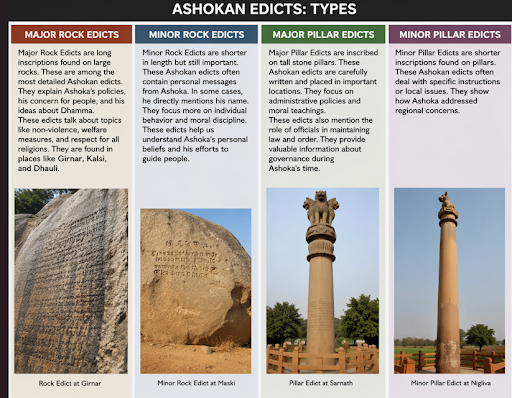
- Major Rock Edicts are long inscriptions found on large rocks. These are among the most detailed Ashokan edicts. They explain Ashoka’s policies, his concern for people, and his ideas about Dhamma.
- These edicts talk about topics like non-violence, welfare measures, and respect for all religions. They are found in places like Girnar, Kalsi, and Dhauli.
-
-
Minor Rock Edicts
-
-
- Minor Rock Edicts are shorter in length but still important. These Ashokan edicts often contain personal messages from Ashoka. In some cases, he directly mentions his name.
- They focus more on individual behavior and moral discipline. These edicts help us understand Ashoka’s personal beliefs and his efforts to guide people.
-
-
Major Pillar Edicts
-
-
- Major Pillar Edicts are inscribed on tall stone pillars. These Ashokan edicts are carefully written and placed in important locations. They focus on administrative policies and moral teachings.
- These edicts also mention the role of officials in maintaining law and order. They provide valuable information about governance during Ashoka’s time.
-
-
Minor Pillar Edicts
-
- Minor Pillar Edicts are shorter inscriptions found on pillars. These Ashokan edicts often deal with specific instructions or local issues. They show how Ashoka addressed regional concerns.

Ashokan Edicts Types and features
the classification of Ashokan edicts in a clear and simple way.
| Type | Medium | Content | Importance |
| Major Rock Edicts | Rocks | Detailed policies | Main source of Dhamma |
| Minor Rock Edicts | Rocks | Personal messages | Reflect beliefs |
| Major Pillar Edicts | Pillars | Governance ideas | Administrative insight |
| Minor Pillar Edicts | Pillars | Local instructions | Regional focus |
Join UGC NET Offline Coaching in Jaipur
Ashokan Edicts Language and script
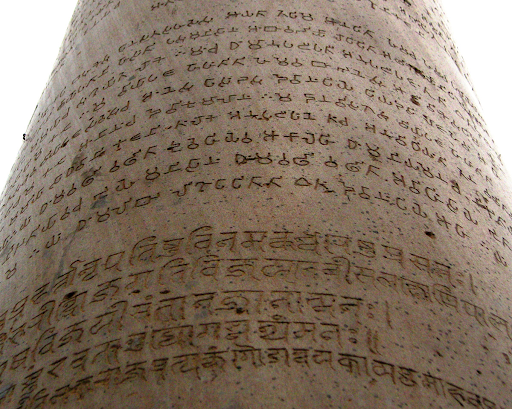
The language used in Ashokan edicts was mainly Prakrit, which was easy for common people to understand.
- The script used was Brahmi in most regions, while Kharoshthi was used in the north-western areas.
- In some places, Greek and Aramaic languages were also used.
- This shows the diversity of the Mauryan Empire and Ashoka’s effort to reach different communities.
- The use of simple language makes Ashokan edicts more effective as a communication tool.
Ashokan Edicts Themes
The content of Ashokan edicts covers a wide range of themes related to social, moral, and political life.
-
Moral values
-
-
- Ashoka emphasized values like honesty, kindness, and respect. These ideas were meant to improve the behavior of people in daily life.
-
-
Religious tolerance
-
-
- One of the key messages in Ashokan edicts is respect for all religions. Ashoka encouraged people to live peacefully without conflicts.
-
-
Welfare measures
-
-
- The edicts also mention steps taken for public welfare, such as building roads, planting trees, and providing medical facilities.
-
-
Non-violence
-
- After the Kalinga War, Ashoka promoted non-violence. This idea became a central theme in his policies.
Ashokan Edicts Key features
Some important features of Ashokan edicts can be summarized for quick revision:
- Written in simple language
- Spread across different regions
- Focus on moral and social values
- Reflect Ashoka’s personal transformation
- Provide information about administration
These features make them a valuable source for understanding ancient India.
Ashokan Edicts Significance in history
The Ashokan edicts hold great importance in Indian history. They are among the earliest written records that provide direct insight into the thoughts of a ruler.
- Unlike literary sources, these inscriptions are contemporary and reliable.
- They also show how a ruler used communication to influence society. This makes Ashokan edicts an important example of early statecraft and public policy.
Top UGC NET Coaching in Jaipur
Ashokan edicts are a remarkable source of information about the Mauryan period. They reflect Ashoka’s vision of a moral and peaceful society. Through these inscriptions, he communicated ideas that were simple yet powerful.