
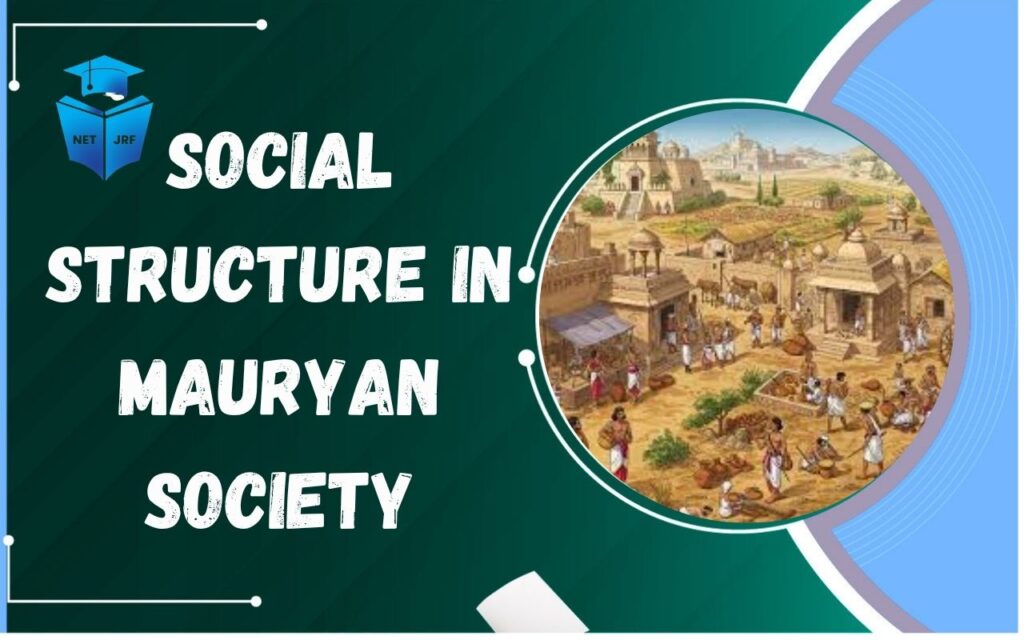

Social Structure in Mauryan Society Varna Jati Roles and Features

Social structure mauryan society in this topic you learn how varna system jati groups occupational division role of women slavery system urban rural life social mobility state influence features and strengths shaped ancient indian society for exams

vishal

Social structure in Mauryan society

Table of Contents

Social structure in Mauryan society was complex, organized, and deeply connected with economic and political life. It included different social groups, occupations, and roles that helped maintain order in the Mauryan Empire. This structure reflected both traditional practices and new developments during the period.

Enroll UGC NET Online Coaching

Study Planner

Varna System

The varna system was the base of the Social structure in Mauryan society.

Four Varnas

  • Brahmins – priests and teachers
  • Kshatriyas – rulers and warriors
  • Vaishyas – traders and farmers
  • Shudras – service providers

These groups formed the backbone of the Social structure in Mauryan society.

Role of Varnas

Each varna had specific duties. This clear division helped in the functioning of the Social structure in Mauryan society.

Jati System

The Social structure in Mauryan society also included jatis or sub-groups.

  • Nature of Jatis

      • Jatis were based on occupation and birth. They added complexity to the Social structure in Mauryan society.
  • Social Identity

    • People identified strongly with their jati. This shaped the Social structure in Mauryan society

Social structure in Mauryan society Features 

The Social structure in Mauryan society had several important features that shaped everyday life.

Hierarchical Nature

Society was divided into different levels. Each group had its own duties. This hierarchy defined the Social structure in Mauryan society.

  • Occupational Division

      • Work was divided based on skills and traditions. This made the Social structure in Mauryan society stable and organized.
  • Social Discipline

    • Rules guided behavior and interactions. This discipline maintained order in the Social structure in Mauryan society.

Enroll UGC NET Online Course

Social Structure Groups, Roles, and Importance

The social structure of the Maurya Empire was organized primarily around the varna system, which divided society into different groups based on duties and responsibilities. This system ensured an orderly arrangement of society and contributed to its stability and functioning.

  1. Brahmins
  • Role: Performed religious duties, rituals, and teaching
  • Importance: They provided spiritual guidance and preserved knowledge through sacred texts and traditions
  1. Kshatriyas
  • Role: Responsible for protection, warfare, and administration
  • Importance: They held political power and ensured security and governance of the state
  1. Vaishyas
  • Role: Engaged in trade, commerce, and agriculture
  • Importance: They formed the economic backbone by generating wealth and managing resources
  1. Shudras
  • Role: Performed various services and labor-intensive work
  • Importance: They supported the functioning of society by assisting other groups 

App JRF Adda

Role of Occupations in Mauryan Society

Occupations played a vital role in shaping the social structure of the Maurya Empire. The division of work not only ensured economic efficiency but also contributed to social organization and stability.

Artisans and Craftsmen

  • Role: Artisans and craftsmen were engaged in producing essential goods such as pottery, textiles, metal tools, and ornaments.
  • Importance: Their skills supported daily life and economic activities, strengthening the overall social structure. They were often organized into guilds (Shrenis), which regulated production and maintained quality standards.

Traders and Merchants

  • Role: Traders and merchants were responsible for the exchange of goods across regions, both within and outside the empire.
  • Importance: They connected different parts of the empire through trade networks, promoted economic integration, and enhanced the prosperity of society. 

Position of Women

Women played an important role in shaping the social structure of the Maurya Empire. Their contributions extended beyond the household into economic and religious spheres, reflecting a complex and diverse social position.

Roles of Women

  • Role: Women actively participated in household management as well as economic activities such as agriculture, spinning, weaving, and craft production.
  • Importance: Their involvement supported family livelihoods and contributed to the stability of the social and economic structure.

Rights and Status

  • Rights: Some women had the right to own property (Stridhana) and were involved in religious practices and rituals.
  • Status: Although society was largely patriarchal, the status of women varied across regions and social groups, indicating diversity within the social structure.

Enroll UGC NET Coaching in Jaipur

Slavery and Labor

The social structure of the Maurya Empire included various forms of labor, including bonded and servile labor. These labor systems played an important role in supporting the economic and social framework of the empire.

Types of Labor

Domestic Workers

  • Role: Engaged in household duties such as cooking, cleaning, and personal service.
  • Importance: They ensured the smooth functioning of households, especially in urban and elite settings.

Agricultural Laborers

    • Role: Worked on farms, assisting in cultivation, irrigation, and harvesting.
    • Importance: They were essential for agricultural production, which formed the backbone of the Mauryan economy.
  • Nature of Slavery

      • Slavery in the Mauryan period was not identical to later rigid systems. According to the Arthashastra, slaves could be acquired through birth, debt, or war, but they were provided certain legal protections. In some cases, they could earn wages, own property, and even gain freedom.
  • Conditions

    • Although slavery existed, it was not as harsh as in some other societies. This reflects the nature of the Social structure in Mauryan society.

Urban and Rural Society

The social structure of the Maurya Empire showed clear differences between urban and rural areas. These differences were based on occupation, lifestyle, and level of economic activity.

Urban Life

  • Features: Cities were centers of administration, trade, and craft production.
  • Social Composition: Urban areas included diverse groups such as traders, merchants, officials, artisans, and laborers.
  • Importance: This diversity made urban society more complex and dynamic, contributing to economic growth and cultural exchange.

Rural Life

  • Features: Villages were primarily based on agriculture and pastoral activities.
  • Social Composition: Rural society mainly consisted of farmers, agricultural laborers, and village artisans.
  • Importance: The simpler and more stable rural structure supported food production, which was the foundation of the Mauryan economy. 

Social Mobility

The social structure of the Maurya Empire was not entirely rigid and allowed a certain degree of flexibility, especially in terms of occupations.

Flexibility in Occupations

  • Feature: In some cases, individuals could change their occupations based on skills, opportunities, or economic needs.
  • Importance: This limited flexibility allowed people to improve their economic condition and contributed to a more dynamic social structure, particularly in urban areas.

Limitations of Mobility

  • Constraint: Despite some flexibility, birth remained a key factor in determining a person’s social position.
  • Impact: The varna system imposed restrictions on full social mobility, making it difficult for individuals to completely change their social status. 

Influence of State

The state played a significant role in shaping and regulating the social structure of the Maurya Empire. Through its administrative system and welfare policies, the Mauryan government ensured order, stability, and social cohesion.

Role of Administration

  • Function: A well-organized administrative system, guided by principles found in the Arthashastra, helped maintain law and order across the empire.
  • Impact: Officials monitored social activities, controlled corruption, and ensured justice, thereby strengthening the overall social structure.

Welfare Measures

  • Function: The Mauryan state introduced various welfare measures such as building roads, irrigation systems, hospitals, and rest houses.
  • Impact: These policies improved the living conditions of people and promoted social stability and economic well-being. Under Ashoka, welfare activities were further expanded with a focus on moral and social upliftment. 

Enroll UGC NET Offline Coaching in Jaipur

Strengths of Social System

The social structure of the Maurya Empire had several strengths that contributed to the stability and efficient functioning of society.

Key Strengths

Organized Hierarchy

  • Society was arranged in a structured manner based on the varna system.
  • This hierarchy helped maintain order and clearly defined social positions.

Clear Division of Work

  • Each group had specific duties and responsibilities.
  • This division of labor increased efficiency in economic, administrative, and social activities.

Social Stability

  • The structured system reduced conflicts and ensured smooth functioning of society.
  • Stability allowed the empire to focus on expansion, governance, and economic growth. 

The Social structure in Mauryan society was a well-organized system that balanced tradition with practical needs. It played a major role in maintaining order and supporting the empire. 

JRF Adda Book

Read UGC NET Notes
1 Archaeological Sources for UGC NET Epigraphy – Study of Inscriptions Meaning of Historical Sources Archaeological
2 Meaning of Historical Sources Archaeological Sources for UGC NET Literary Sources in History Archaeological
3 Exploration in Archaeology Excavation Techniques in Archaeology Dating of Archaeological Sites Archaeological
4 Excavation Techniques in Archaeology Exploration in Archaeology Dating of Archaeological Sites Archaeological
5 Epigraphy – Study of Inscriptions Inscriptions in Reconstructing History Numismatics in History Archaeological
6 Inscriptions in Reconstructing History Epigraphy – Study of Inscriptions Archaeological Sources for UGC NET Archaeological
7 Numismatics in History Importance of Coins in History Epigraphy – Study of Inscriptions Archaeological
8 Importance of Coins in History Numismatics in History Archaeological Sources for UGC NET Archaeological
9 Dating of Archaeological Sites Excavation Techniques in Archaeology Dating Ancient Literary Sources Archaeological
10 Indigenous Literature Literary Sources in History Secular Literature as Historical Source Literary
11 Dating Ancient Literary Sources Literary Sources in History Dating of Archaeological Sites Literary
12 Literary Sources in History Indigenous Literature Foreign Accounts of India Literary
13 Foreign Accounts of India Greek Accounts on Ancient India Chinese Accounts on India Literary
14 Greek Accounts on Ancient India Foreign Accounts of India Chinese Accounts on India Literary
15 Secular Literature as Historical Source Literary Sources in History Indigenous Literature Literary
16 Role of Myths and Legends in Historical Reconstruction Literary Sources in History Secular Literature as Historical Source Literary
17 Chinese Accounts on India Foreign Accounts of India Greek Accounts on Ancient India Literary
18 Arabic Accounts on India Foreign Accounts of India Chinese Accounts on India Literary
19 Neolithic and Chalcolithic Phases Neolithic Revolution in India Chalcolithic Culture in India Neolithic
20 Hunting, Gathering & Food Production Neolithic Revolution in India Neolithic Settlements in India Neolithic
21 Neolithic Revolution in India Neolithic Settlements in India Tools and Technology in Neolithic Period Neolithic
22 Neolithic Settlements in India Distribution of Neolithic Cultures in India Neolithic Revolution in India Neolithic
23 Distribution of Neolithic Cultures in India Neolithic Settlements in India Tools and Technology in Neolithic Period Neolithic
24 Tools and Technology in Neolithic Period Neolithic Revolution in India Chalcolithic Culture in India Neolithic
25 Chalcolithic Culture in India Settlement Pattern & Economy in Chalcolithic Phase Trade & Exchange Networks in Chalcolithic Societies Neolithic
26 Settlement Pattern & Economy – Chalcolithic Phase Chalcolithic Culture in India Trade & Exchange Networks in Chalcolithic Societies Neolithic
27 Trade & Exchange Networks – Chalcolithic Societies Chalcolithic Culture in India IVC Internal & External Trade Neolithic
28 Indus Valley Civilization – UGC NET Major Sites of Indus Civilization Urban Planning in Harappan Civilization IVC
29 IVC Internal & External Trade Internal Trade – Harappan Civilization Craft Specialization in Harappan Civilization IVC
30 Political Organization – Harappan Civilization Social Structure – Indus Civilization Urban Planning in Harappan Civilization IVC
31 Major Sites of Indus Civilization Indus Valley Civilization – UGC NET Urban Planning in Harappan Civilization IVC
32 Urban Planning & Settlement – Harappan Civilization Architecture & Town Planning – Harappan Cities IVC as First Urbanization in India IVC
33 Architecture & Town Planning – Harappan Cities Urban Planning in Harappan Civilization Major Sites of Indus Civilization IVC
34 Craft Specialization & Industrial Activities – Harappan Agriculture & Food Economy – Harappans IVC Internal & External Trade IVC
35 Agriculture & Food Economy – Harappans Craft Specialization in Harappan Civilization Internal Trade – Harappan Civilization IVC
36 Internal Trade – Harappan Civilization IVC Internal & External Trade Craft Specialization in Harappan Civilization IVC
37 Religion & Beliefs – Indus Civilization Social Structure – Indus Civilization Indus Valley Civilization – UGC NET IVC
38 Social Structure – Indus Civilization Political Organization – Harappan Civilization Religion & Beliefs – Indus Civilization IVC
39 Decline of Indus Civilization Indus Valley Civilization – UGC NET IVC as First Urbanization in India IVC
40 IVC as First Urbanization in India Urban Planning in Harappan Civilization Second Urbanization in India IVC
41 Vedic & Later Vedic Periods – Aryan Varna System Early Vedic Society and Economy Later Vedic Society and Economy Vedic
42 Origin of Vedic Civilization Aryan Debate – Migration, Invasion & Indigenous Theories Early Vedic Society and Economy Vedic
43 Aryan Debate – Migration, Invasion & Indigenous Theories Origin of Vedic Civilization Early Vedic Society and Economy Vedic
44 Early Vedic Society and Economy Political Institutions – Early Vedic Period Social Structure – Early Vedic Period Vedic
45 Political Institutions – Early Vedic Period Early Vedic Society and Economy Monarchical States in Ancient India Vedic
46 Social Structure – Early Vedic Period Emergence of Varnas & Social Stratification Early Vedic Society and Economy Vedic
47 Later Vedic Society and Economy Emergence of Varnas & Social Stratification Impact of Iron Technology in India Vedic
48 Emergence of Varnas & Social Stratification Social Structure – Early Vedic Period Later Vedic Society and Economy Vedic
49 Emergence of Heterodox Sects in India Jainism, Buddhism & Ajivikas – Origins & Teachings Later Vedic Society and Economy Vedic
50 Impact of Iron Technology in India Later Vedic Society and Economy Agricultural Expansion & Economic Changes – Ancient India Vedic
51 Religious & Philosophical Vedic Ideas Emergence of Varnas & Social Stratification Emergence of Heterodox Sects in India Vedic
52 Megalithic Culture of South India Neolithic and Chalcolithic Phases Agricultural Expansion & Economic Changes General
53 State System in Ancient India Rise of Mahajanapadas Transition: Tribal Polities to Territorial States General
54 Transition: Tribal Polities to Territorial States Rise of Mahajanapadas Later Vedic Society and Economy General
55 Rise of Mahajanapadas Monarchical States in Ancient India Republican States (Gana-Sanghas) – Ancient India Magadha
56 Monarchical States in Ancient India Rise of Mahajanapadas Emergence of Magadha Magadha
57 Republican States (Gana-Sanghas) – Ancient India Rise of Mahajanapadas Monarchical States in Ancient India Magadha
58 Agricultural Expansion & Economic Changes – Ancient India Second Urbanization in India Impact of Iron Technology in India General
59 Second Urbanization in India IVC as First Urbanization in India Rise of Mahajanapadas General
60 Jainism, Buddhism & Ajivikas – Origins & Teachings Emergence of Heterodox Sects in India Ashoka’s Policy of Dhamma General
61 Emergence of Magadha Geographical Advantages of Magadha Early Rulers of Magadha Magadha
62 Geographical Advantages of Magadha Natural Resources & Economic Strength of Magadha Reasons for Success of Magadha Magadha
63 Natural Resources & Economic Strength of Magadha Geographical Advantages of Magadha Economic Policies of the Nandas Magadha
64 Early Rulers of Magadha Haryanka Dynasty – Rise of Magadha Emergence of Magadha Magadha
65 Haryanka Dynasty – Rise of Magadha Expansion Policy of Bimbisara Early Rulers of Magadha Magadha
66 Expansion Policy of Bimbisara Ajatashatru – Military Reforms Haryanka Dynasty – Rise of Magadha Magadha
67 Ajatashatru – Military Reforms Wars of Ajatashatru Expansion Policy of Bimbisara Magadha
68 Wars of Ajatashatru Ajatashatru – Military Reforms Udayin & Establishment of Pataliputra Magadha
69 Udayin & Establishment of Pataliputra Wars of Ajatashatru Shishunaga Dynasty Magadha
70 Shishunaga Dynasty Administrative Structure of the Shishunagas Nanda Dynasty Magadha
71 Administrative Structure of the Shishunagas Shishunaga Dynasty Central Administration Under Mauryas Magadha
72 Nanda Dynasty Mahapadma Nanda – Imperial Expansion Shishunaga Dynasty Magadha
73 Mahapadma Nanda – Imperial Expansion Military Strength of the Nandas Nanda Dynasty Magadha
74 Economic Policies of the Nandas Nanda Dynasty Taxation System – Mauryan State Magadha
75 Military Strength of the Nandas Mahapadma Nanda – Imperial Expansion Defeat of Nandas & Rise of Mauryan Empire Magadha
76 Reasons for Success of Magadha Geographical Advantages of Magadha Natural Resources & Economic Strength of Magadha Magadha
77 Mahajanapadas to Empire – Evolution & Rise of Magadha Rise of Mahajanapadas Emergence of Magadha Magadha
78 Mauryan Empire – Expansion Rise of Chandragupta Maurya Expansion of Mauryan Empire Maurya
79 Rise of Chandragupta Maurya Role of Chanakya in Rise of Mauryan Empire Defeat of Nandas & Rise of Mauryan Empire Maurya
80 Role of Chanakya in Rise of Mauryan Empire Rise of Chandragupta Maurya Defeat of Nandas & Rise of Mauryan Empire Maurya
81 Defeat of Nandas & Rise of Mauryan Empire Military Strength of the Nandas Rise of Chandragupta Maurya Maurya
82 Chandragupta Maurya – Seleucus Treaty & Diplomacy Expansion of Mauryan Empire Greek Accounts on Ancient India Maurya
83 Expansion of Mauryan Empire Chandragupta Maurya – Seleucus Treaty & Diplomacy Kalinga War Maurya
84 Administration of Chandragupta Maurya Central Administration Under Mauryas Mauryan Bureaucracy Maurya
85 Sources for Mauryan History Archaeological Sources for UGC NET Greek Accounts on Ancient India Maurya
86 Central Administration Under Mauryas Provincial Administration – Mauryan Empire Mauryan Bureaucracy Maurya
87 Provincial Administration – Mauryan Empire Local Administration – Mauryan Empire Central Administration Under Mauryas Maurya
88 Local Administration – Mauryan Empire Provincial Administration – Mauryan Empire Mauryan Bureaucracy Maurya
89 Mauryan Bureaucracy Central Administration Under Mauryas Espionage System – Mauryan Empire Maurya
90 Espionage System – Mauryan Empire Mauryan Bureaucracy Central Administration Under Mauryas Maurya
91 Ancient India – Trade and Commerce Trade and Commerce Under Mauryas Agrarian Economy – Mauryan Period Maurya
92 Agrarian Economy – Mauryan Period Taxation System – Mauryan State Trade and Commerce Under Mauryas Maurya
93 Trade and Commerce Under Mauryas Ancient India – Trade and Commerce Agrarian Economy – Mauryan Period Maurya
94 Taxation System – Mauryan State Agrarian Economy – Mauryan Period Economic Policies of the Nandas Maurya
95 Kalinga War Ashoka’s Policy of Dhamma Expansion of Mauryan Empire Maurya
96 Ashoka’s Policy of Dhamma Nature & Philosophy of Dhamma Kalinga War Maurya
97 Nature & Philosophy of Dhamma Ashoka’s Policy of Dhamma Jainism, Buddhism & Ajivikas Maurya

Social structure in Mauryan society FAQs

Loader image

Varna system divided society into Brahmins, Kshatriyas, Vaishyas, Shudras based on duties.

Jati system consisted of sub groups based on birth, occupation that shaped social identity.

Hierarchy, occupational division, social discipline, organized roles were main features.

Women managed households, participated in economic activities, had limited property rights like Stridhana.

Yes slavery existed in mild form with legal protection, some rights like property, wages.

Urban society was complex with trade, crafts, administration while rural society was simple with agriculture focus.

Limited mobility existed but birth based system restricted full change in social status.

Leave a Reply

Recent Posts
Aditi

Aditi Sharma, founder of JRFAdda, is a Computer Science educator with an MCA degree and JRF qualification (99.91 percentile, Dec 2019). Her experience includes roles as an SBI SO (DBA), work at Cognizant, and over 5 years of teaching online and offline. She has also served as a Government Computer Teacher in Rajasthan.